GM Market Read · May 2026 · RevParGenius Intelligence · Live OTA + AirDNA STR
Most Australian hotel markets soften in winter. Hobart does not. The live OTA data for May through August 2026 shows a consistent +26% weekend premium running across the window, with AirDNA market score at 90.8/100 and rising, and STR RevPAR up 12.71% year on year. The Jul 11 weekend returns +39% healthy premium with 14 verified matched hotel comps. Aug 8 returns +22% with 15 comps. These are not weak shoulder-season signals dressed up as premiums. They are a genuine demand pattern that sets Hobart apart from almost every other regional Australian market in winter — and one that rewards the hotels with pricing processes fast enough to capture it.
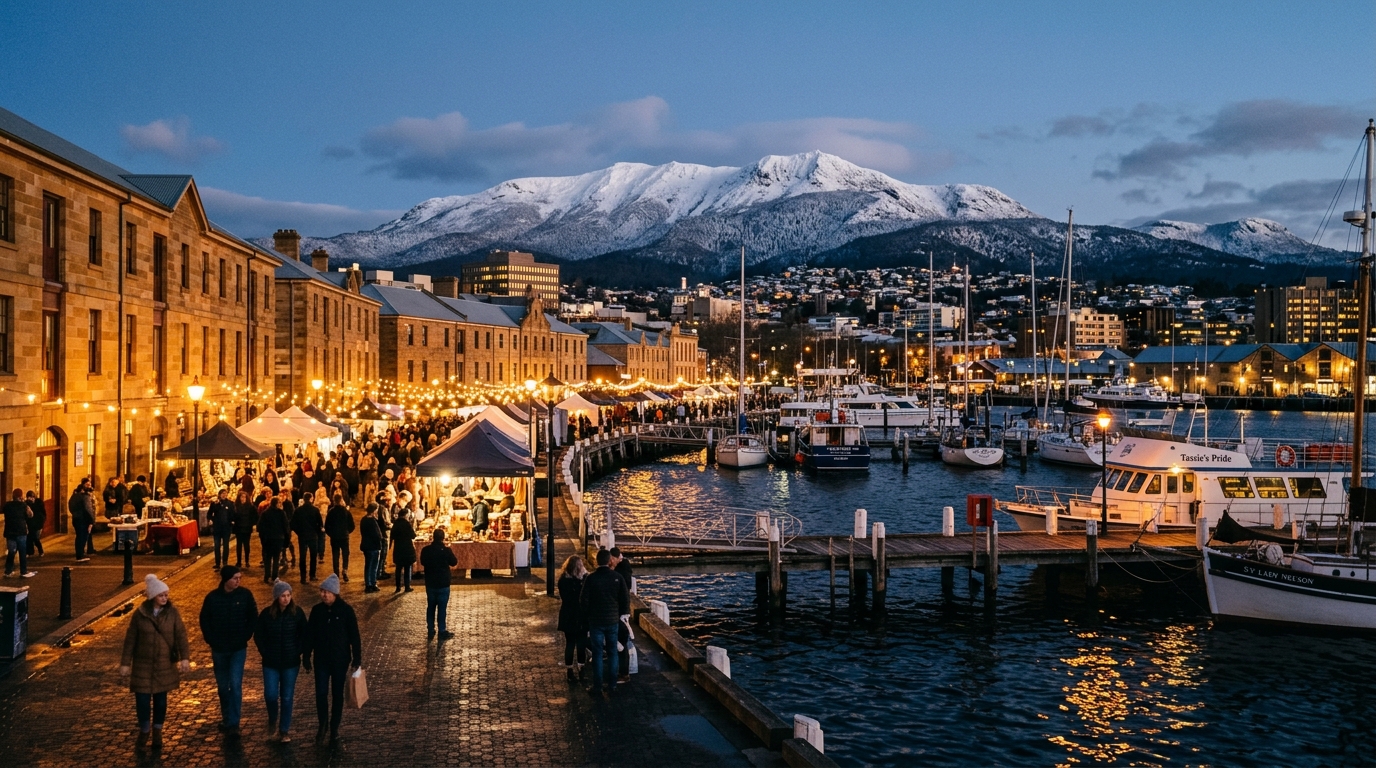
Understanding why Hobart's winter is commercially strong matters for how you price it. The demand is not random — it is structural. Hobart in winter draws interstate leisure travellers specifically because it is cold, atmospheric, and culturally distinct from mainland cities. Dark MOFO (June), Wooden Boat Festival, MONA programming, and the general "antipodean winter escape" narrative that Hobart has built over the past decade all feed consistent leisure weekend demand at a time when the comp set in Brisbane, Sydney, or Melbourne is soft. Pricing this market correctly means recognising that winter is not a risk period — it is the opportunity period.
Why Hobart Winter Works — The Numbers
The Demand Structure Behind the Winter Premium
Hobart's winter hotel demand has three structural drivers that most Australian regional markets lack. The first is cultural programming: MONA's Dark MOFO festival in June, the Wooden Boat Festival in February, and a year-round MONA calendar create a draw that operates independently of weather and seasonality. The second is the "cold-weather destination" positioning Hobart has built deliberately over the past decade — the only Australian capital city where winter is a feature rather than a deterrent for leisure travel. The third is geography: Hobart is a genuine escape from the mainland, with a distinct food, wine, and arts culture that attracts high-spending interstate visitors who book weekends rather than midweek.
The 1,331 active STR listings in the market add important context. That is a significant Airbnb and Vrbo supply pool competing for the same leisure weekend demand that hotels serve. An AirDNA market score of 90.8/100 with rising RevPAR despite this supply volume confirms that the underlying demand is strong enough to absorb both hotel and STR supply without weakening either. For hotels, this is the best possible signal: strong demand, active STR competition, and still a +26% weekend premium running consistently through the window.
The Jun 13 weekend shows a +187.8% compression signal from only 5 matched comps — most of the verified comp set has sold out Saturday availability. This is consistent with a major event in the Hobart calendar for that weekend. Dark MOFO typically runs across June and is the most likely candidate, but the exact dates need confirmation. If Jun 13–14 is a Dark MOFO headline weekend, it is the highest-value pricing opportunity in the 90-day window — and one that needs to be pre-positioned from early May, not the week before arrival. An automated system monitoring pickup pace would have flagged this accelerating in April and begun moving rates incrementally weeks ahead of the event date.
The Four Saturdays That Define the Quarter: Jul 4 to Aug 8
The four consecutive Saturday weekends from Jul 4 to Aug 8 are the commercial core of the Hobart winter window. All four return healthy premium or better — +25.4%, +39%, +13.7%, and +22% respectively — with 14–15 verified matched hotel comps on each. These are not thin-data signals. They are the most reliable pricing intelligence in the scan, pointing at four consecutive Saturdays where the Hobart market is genuinely delivering above-normal weekend rates.
For a 12-room boutique property, these four Saturdays are disproportionately important. At A$200–A$225 average Saturday ADR across the four weeks against a weekday average of A$161, the incremental weekend revenue from those four nights — approximately A$1,560–A$1,800 in Saturday room revenue per week at 80% occupancy — adds up to A$6,240–A$7,200 in incremental Saturday revenue for the month. That figure is what the Hobart winter premium is worth to a property that prices it correctly. It is also the figure that disappears if the Saturday rate sits flat at the weekday equivalent through the same period.
The Hobart weekend ADR has 50.6% volatility across the window. That means the market is moving significantly week to week — from A$168 Saturday in late May to A$225 in mid-July. A property reviewing rates weekly on Friday will see the Jul 4 market at A$213 and consider moving Saturday rates up. But the early-booking wave for that Saturday — guests who book 3–6 weeks out in a leisure destination like Hobart — has already been captured at whatever rate was set in mid-June. Automated pricing sees the Jul 4 pickup pace accelerating in early June and moves rates incrementally before the early-booking window closes. That is the difference between capturing the first third of July weekend bookings at A$200+ or at A$175.
RevParGenius Take
Hobart's winter premium is one of the most consistent and commercially significant seasonal pricing opportunities in the Australian hotel market. A 90.8/100 market score, +12.71% YoY RevPAR growth, and four consecutive healthy-premium Saturdays with 14–15 verified comps each is not a soft market. It is a market that rewards preparation, rate discipline, and the speed to pre-position before the early-booking wave arrives.
The properties that capture the Hobart winter premium fully are the ones that set their Saturday rate in June — not in July. Automated dynamic pricing makes that timing automatic. The market tells the system the window is building. The system moves rates. The early-booking wave books at the correct price. By the time a manual Friday review has noticed the window, the first third of it has already been captured — at the right rate or the wrong one depending on when the decision was made.
The Hobart Winter Window Is Open Now. Price It Before It Peaks.
Automated Dynamic Pricing for Hobart's Winter Season.
Automated dynamic pricing monitors live OTA signals and booking pace in real time — pre-positioning your July and August Saturday rates as demand builds in June, not after it peaks. Try it free for 14 days and let it run your winter window.
Try Automated Dynamic Pricing FreeGet Your Free Market Analysis
No commitment. No credit card. Just live data at revpargenius.com
Data sources: Live OTA pricing scans in AUD, AirDNA STR data (partial, market score 90.8/100, RevPAR A$163 +12.71% YoY, 1,331 active STR listings). 14–16 matched hotel comps across 11 validated weeks. Analysis run May 2026. RevParGenius is an independent hotel market intelligence platform — not affiliated with any OTA, revenue management system, or hotel chain.