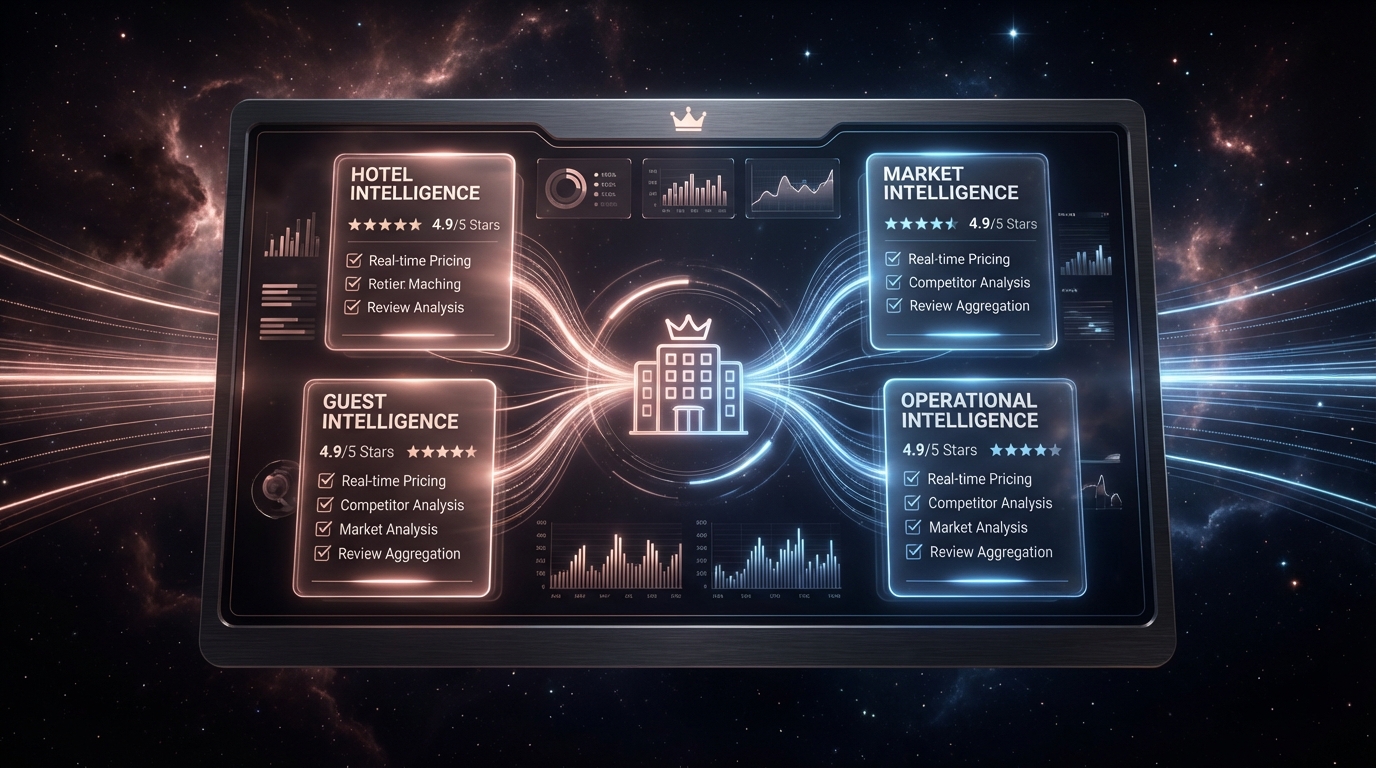
The Four Categories of Hotel Market Intelligence
Not all tools called "market intelligence" do the same thing. Understanding the categories prevents you from buying a rate shopping tool when you need a demand intelligence platform — or investing in an enterprise revenue management system when a purpose-built intelligence tool would serve you better at a fraction of the cost.
Category 1: Rate Shopping Tools
What they do: Monitor competitor rates across OTA channels and alert you to pricing changes. Most update once or twice daily. Output is typically a dashboard showing your rate versus competitors for a rolling window of future dates.
Who they're built for: Properties that need competitive pricing visibility but don't require deeper demand analysis. Good for hotels with stable competitive sets and predictable markets.
Leading tools: OTA Insight (now Lighthouse), RateGain, Duetto (enterprise)
What they miss: Rate shopping tools show you prices — not the why behind them. They don't tell you whether a competitor rate change is driven by demand signals, distressed inventory, rate parity corrections, or OTA algorithm positioning. Without context, rate data can mislead as easily as it informs.
Price range: $150–$500/month for independent hotel scale
Category 2: Revenue Management Systems (RMS)
What they do: Automate pricing recommendations and, in some cases, automatic rate updates based on rules and algorithms. An RMS ingests your PMS data, historical performance, and sometimes external demand signals to suggest or set optimal rates.
Who they're built for: Properties with sufficient booking volume (typically 50+ rooms) to generate statistically meaningful data. The algorithm improves with more data — smaller properties often find the recommendations too generic to be useful.
Leading tools: IDeaS, Duetto, Atomize, RoomPriceGenie, Cloudbeds Intelligence
What they miss: Most RMS platforms are backward-looking by design — they optimize based on your own historical data, not the live market signals happening around you. They're excellent at answering "what should I charge based on my past performance?" and weaker at answering "what is the market signaling right now?"
Price range: $300–$1,500/month depending on scale and features
Category 3: Market Intelligence Platforms
What they do: Analyze live market data from multiple external sources — OTA rates, competitor availability, short-term rental supply, search trends, event calendars — to surface demand signals and competitive insights. The focus is on understanding the market, not just your own performance.
Who they're built for: Independent hotels and boutique properties that need to compete based on market knowledge rather than scale. Particularly valuable in volatile markets, seasonal destinations, or locations with significant short-term rental competition.
Leading tools: RevPARGenius, Transparent, and select features within Lighthouse's newer platform
What they deliver that others don't: Forward-looking demand signals drawn from the market rather than backward-looking pattern recognition from your own data. This is the critical difference — you're watching the market move in real time rather than extrapolating from your own history.
Price range: $200–$600/month
Category 4: STR Data Providers
What they do: Track Airbnb, Vrbo, and other short-term rental supply and demand data at the market level. Provide occupancy rates, average daily rates, revenue per available listing, and market health scores for your destination.
Who they're built for: Hotels in markets with significant short-term rental competition (urban boutiques, resort destinations, leisure markets). Also used by real estate investors and destination management organizations.
Leading tools: AirDNA, Key Data, Transparent
What they miss: STR data providers give you the short-term rental picture but typically don't integrate hotel competitive data. You get half the demand picture without the other half.
Price range: $50–$300/month depending on market and features
Why Most Independent Hotels Use the Wrong Tool
The most common mistake: independent hotels buy a rate shopping tool because it's the most visible category, and then wonder why their pricing intelligence still feels incomplete.
Rate shopping tells you where competitors are pricing. It doesn't tell you why they're pricing there, whether that pricing is sustainable, or what demand signals are driving the market. For a 40-room independent hotel without a revenue manager, a rate shopping dashboard can actually create false confidence — you see competitive data and assume you have hotel market intelligence.
The second most common mistake: buying an enterprise RMS designed for large chain properties. These systems optimize well for high-volume, data-rich environments. Applied to a 35-room independent hotel, they often produce recommendations that are too conservative (not enough local market context) or too aggressive (insufficient property-specific data to calibrate the algorithm).
What Independent Hotels Actually Need
A practical market intelligence stack for an independent hotel with 20–80 rooms should include:
Core requirement: A market intelligence platform that monitors live OTA data and competitor availability across your specific competitive set — not global averages. Your intelligence needs to reflect your market, your comp set, your demand drivers.
Essential addition: Short-term rental context. Even hotels that don't compete directly with Airbnb are affected by STR demand patterns. When Airbnb occupancy is high, hotel demand typically follows. When STR supply contracts, hotel demand often increases.
Useful enhancement: A basic event calendar and search trend monitoring to provide the demand forecasting layer. This can be as simple as a curated alerts setup or as sophisticated as dedicated demand forecasting software.
What you don't need: Enterprise RMS functionality until you have the booking volume (typically 3,000+ room nights per year) to make the algorithm meaningful. Before that threshold, local market intelligence makes a bigger impact than algorithmic optimization.
The Intelligence vs. Automation Trade-Off
A choice that many independent hotels face: spend on market intelligence (understanding the market) or spend on automation (acting on pricing automatically).
Choose intelligence first if: You or your team actively manage pricing and want better data to make decisions. Intelligence tools improve the quality of your decisions. You stay in control.
Consider automation if: Pricing management is falling through the cracks because no one has time to actively manage it. An RMS that auto-updates rates based on rules is better than rates that never get updated.
The best outcome: Intelligence and a light automation layer. Understand the market signals through a dedicated intelligence platform, then set pricing rules in your channel manager that reflect what you've learned. This gives you market awareness with operational efficiency.
5 Questions to Ask Before Buying Any Hotel Intelligence Tool
- Is the data from my specific market, or is it regional/global averages? Global benchmarks mean nothing to a 45-room hotel in Cebu. Ask vendors specifically how their data is localized to your competitive set.
- How often does the data refresh? Daily minimums are non-negotiable for pricing intelligence. Once-weekly reports are historical data, not competitive intelligence.
- Does it include short-term rental data? In most markets, ignoring Airbnb and Vrbo means ignoring 20–35% of the competitive landscape.
- Does it show demand signals or just current rates? Current rates tell you where the market is. Demand signals tell you where it's going. Prioritize the forward-looking capability. Look for platforms that combine both, similar to how OTA availability patterns reveal demand pressure before it shows in your booking pace.
- What does the pricing look like at independent hotel scale? Enterprise tools priced for chain hotels routinely cost 5–10x what an independent property should pay for equivalent intelligence. Ask for independent hotel pricing specifically.
Frequently Asked Questions
What is hotel market intelligence?
Hotel market intelligence is the collection and analysis of external data — competitor rates, OTA availability patterns, short-term rental supply, search trends, and demand signals — that helps hotels understand their market position and pricing opportunities. It's distinct from internal reporting (which analyzes your own performance) because it focuses on what's happening outside your property.
Do small hotels need market intelligence tools?
Yes — arguably more than large properties. Small independent hotels lack the scale to generate sufficient internal data for meaningful analysis, and they typically don't have dedicated revenue managers. Market intelligence tools level the playing field by giving small properties the same external market visibility that large chains build expensive in-house teams to produce.
What is the difference between rate shopping and market intelligence?
Rate shopping monitors competitor prices and alerts you to changes. Market intelligence analyzes the signals behind those prices — demand patterns, OTA algorithm behavior, short-term rental dynamics, booking pace — to give you context for pricing decisions. Rate shopping tells you what the market is doing. Intelligence tells you why and where it's heading.
How much should an independent hotel spend on market intelligence?
A practical range for a 20–80 room independent hotel is $200–$600/month for a dedicated market intelligence platform. This typically yields a positive ROI within the first month if pricing decisions improve by 5–10%. The RevPARGenius ROI Calculator can help you estimate the specific return for your property size and current ADR.