What Hotel Pricing Intelligence Actually Means
Hotel pricing intelligence is the ability to make forward-looking rate decisions based on real-time market data rather than historical patterns or competitor imitation.
The word "intelligence" is important. It implies synthesis — taking raw data from multiple sources and combining it into actionable insight. Monitoring your competitor's rate on Booking.com is not pricing intelligence. Understanding why that rate changed, what it signals about market demand, and how you should respond is.
True pricing intelligence has three components:
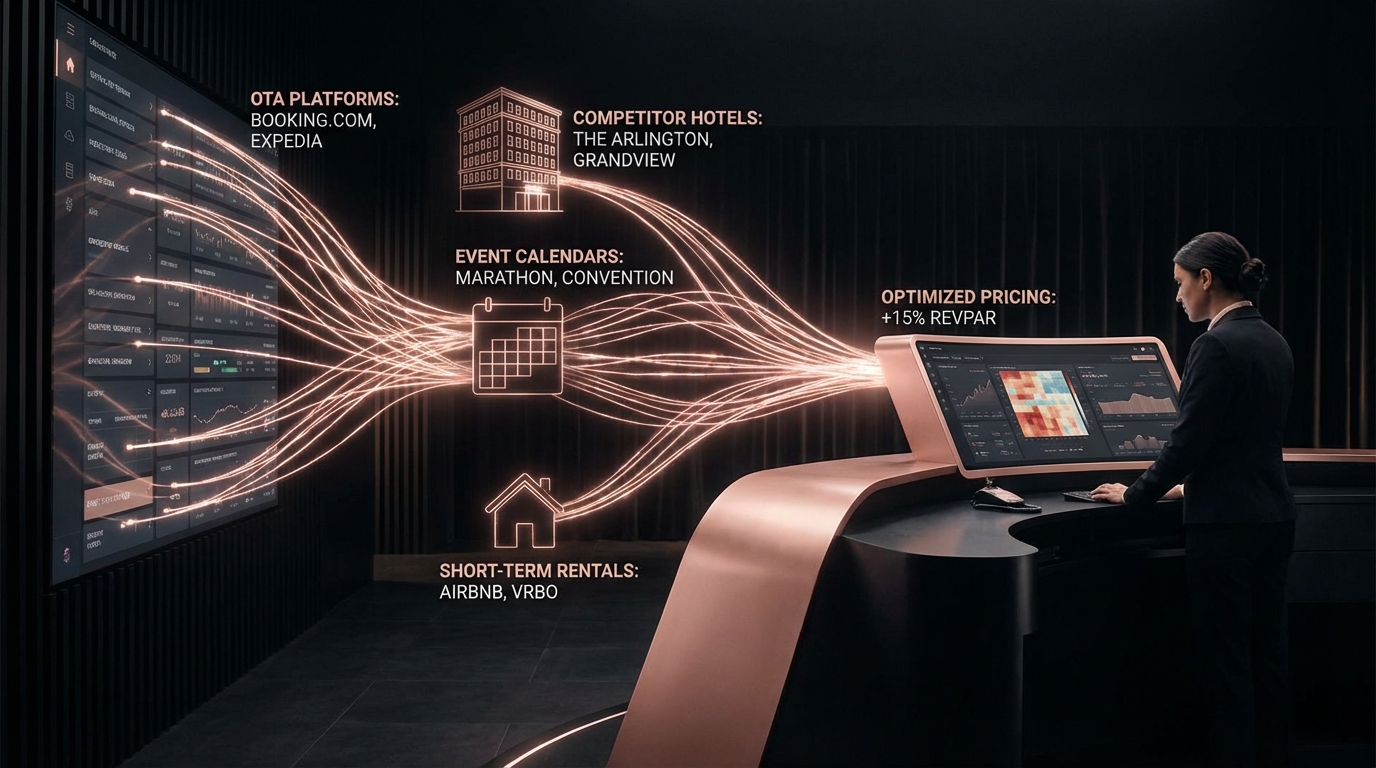
- Data: Real-time inputs from OTA rates, competitor availability, short-term rental supply, search trends, and event calendars.
- Analysis: Identifying patterns and signals within that data that indicate where demand is heading.
- Action: Translating those signals into specific rate decisions with confidence and speed.
Most hotels have some version of data. Very few have systematic analysis. Almost none have a structured action process. The gap between data and action is where pricing intelligence lives.
The Reactive Pricing Problem
Reactive pricing is the industry default, and it's expensive. Here's what it looks like in practice:
A hotel checks competitor rates on Monday. The rates look similar to last week. The hotel holds its rates. On Wednesday, a convention is announced for a date three weeks out. By Thursday, four competitors have raised rates by ₱800–₱1,200. By Friday, two competitors have sold out of standard rooms. The hotel finally notices the demand signal on Saturday and raises rates — but the early-booking window has already filled at the old price.
Revenue missed: every booking taken at Monday's rate for a date that the market eventually valued significantly higher.
This happens not because hotel operators are careless — it's because reactive pricing is what you do when you're managing by feel and spot checks rather than intelligence systems.
The Proactive Pricing Model
Proactive pricing intelligence doesn't require predicting the future perfectly. It requires reading available signals faster than your competitors do.
The same scenario with a pricing intelligence system:
Monday: The system flags that search volumes for your destination are 34% above seasonal norms for dates three weeks out. A short-term rental occupancy alert shows Airbnb availability for that weekend is at 71% — unusually low for the advance window. The signal isn't a confirmed event, but it's a demand anomaly worth investigating. The hotel raises rates modestly (₱400) as a test while investigating the cause.
Tuesday: The convention is announced. The hotel is already positioned above where it started. The system confirms the demand signal.
Wednesday: Rates are raised aggressively to capture the demand curve early. Inventory is protected at the premium rate level.
Result: The hotel captures significantly more revenue on early bookings, maintains pricing power throughout the booking window, and closes the period at a higher average rate than reactive competitors.
Building a Hotel Pricing Intelligence System
You don't need a large technology budget to implement pricing intelligence. You need a structured approach to data collection, signal identification, and rate action.
Layer 1: Competitive Rate Monitoring (Data Foundation)
The baseline: know what your competitive set is charging across at least two OTA channels, updated daily. This is the minimum viable intelligence setup. Without this, you're flying completely blind.
What to track: Standard room rates for the next 30 days, across Monday, Wednesday, Friday, and Saturday (as representative day types), for your 8–12 core competitors. Use OTA monitoring tools or a market intelligence platform that includes rate shopping.
Layer 2: Demand Signal Monitoring (Intelligence Layer)
Beyond rates: track the signals that explain rate movements and predict future demand.
- OTA availability compression: How many competitors have inventory restrictions? On which dates? Tracking availability (not just rates) across your comp set is one of the most reliable leading indicators available.
- Short-term rental occupancy: Monthly check of AirDNA occupancy rates for your immediate market. Weekly check during high-demand periods.
- Search volume trends: Google Trends for your destination + "hotel" as a monitoring shortcut. Spikes above seasonal norms signal building demand.
- Event calendar: Maintain a running 90-day calendar of confirmed demand generators for your market. Update within 24 hours of any new announcement.
Layer 3: Booking Pace Analysis (Your Own Signals)
Your reservation data is a demand signal most hotels underuse. Track:
- Booking pace vs. prior year: For each future week, how does your current reservation count compare to the same period last year? Running 20%+ ahead = consider rate increases. Running 20%+ behind = investigate whether your pricing is competitive or demand is genuinely soft.
- Cancellation velocity: A spike in cancellations for a future date is a demand signal — either the market is repricing or an external factor is suppressing demand.
- Lead time distribution: Are bookings coming in earlier or later than usual? Earlier booking for a specific date indicates confidence in demand.
Layer 4: Rate Action Framework (Decision Layer)
With signals in hand, you need a decision framework that translates them into rate actions. A simple signal-to-action matrix:
| Signal | Strength | Action |
|---|---|---|
| Competitors restricting inventory | 3+ competitors | Raise rates 10–15% |
| Search volume spike (30%+ above norm) | Sustained 3+ days | Raise rates 8–12%, monitor closely |
| Booking pace ahead 25%+ of prior year | Current week | Raise rates 10–20% |
| STR occupancy above 80% (60+ days out) | Confirmed via AirDNA | Raise rates 5–10% for that date |
| Rate velocity (competitors raising 15%+ in 48 hours) | Multiple competitors | Match or exceed, hold firm |
| Booking pace behind 25%+ | No event explanation | Review value positioning; consider targeted promotions |
The matrix doesn't replace judgment — it structures it. You still decide whether to act; the framework tells you which signals warrant action and in what direction.
The Confidence Problem in Hotel Pricing
The biggest hidden obstacle to pricing intelligence isn't data — it's confidence. Many hotel operators see the same market signals that justify a rate increase but don't act because they're afraid of being wrong.
The fear sounds like: "What if I raise rates and get no bookings? I'll lose the business."
The intelligence response: set your rates with defined decision points. If rates are raised 15% and booking pace doesn't decline within 72 hours, the market is accepting the increase. If booking pace drops immediately and sharply, you've found the resistance level — adjust accordingly.
Pricing intelligence removes the binary "right or wrong" fear by creating a feedback loop. You raise rates, observe the market response, and calibrate. Done systematically, this is how hotels discover their true rate ceiling — not through guesswork, but through structured experimentation backed by market data.
From Reactive to Proactive: A 30-Day Transition Plan
- Week 1: Establish your monitoring baseline. Set up daily rate tracking for your top 8 competitors across two OTA channels. Build your 90-day event calendar. Identify your current booking pace vs. prior year for the next 30 days.
- Week 2: Add the demand signal layer. Set up Google Trends monitoring for your destination. Access AirDNA for a one-month occupancy snapshot of your market. Begin tracking competitor availability restrictions (not just rates).
- Week 3: Build your action framework. Create your signal-to-action matrix based on your market's typical demand patterns. Apply it to one or two forward dates as a test. Observe results.
- Week 4: Review and refine. What signals proved predictive? Where did you miss? Adjust your matrix thresholds based on what you observed. By week 4, you'll have a functioning intelligence cycle — imperfect but infinitely better than reactive management.
Use the RevPARGenius ROI Calculator after week 4 to quantify the revenue difference your new approach has already generated.
The Competitive Advantage That Compounds
Pricing intelligence compounds over time. Each market cycle teaches you more about your specific demand patterns. Each signal you track correctly adds confidence to future decisions. Each rate optimization improves your cash position and your ability to invest in guest experience.
Hotels that build systematic pricing intelligence in year one outperform their market by 8–15% in RevPAR. By year three, the gap widens further because the intelligence — and the confidence to act on it — has become deeply embedded in operations.
Your competitors who are still reactive won't even notice you pulling ahead until the gap is too large to close quickly. Pair pricing intelligence with rigorous hotel pricing analysis and hotel demand analysis and you have a complete, compounding system.
Frequently Asked Questions
What is hotel pricing intelligence?
Hotel pricing intelligence is the ability to make forward-looking pricing decisions based on real-time market data, demand signals, and competitive analysis. It combines data from OTA monitoring, short-term rental platforms, search trends, and booking pace analysis to give hotels a clear picture of where demand is heading — and what rates to charge before demand peaks rather than after.
How is pricing intelligence different from dynamic pricing?
Dynamic pricing is the practice of changing rates based on rules or algorithms — typically responding to occupancy thresholds or time-based triggers. Pricing intelligence is the underlying understanding of the market that informs which dynamic pricing rules to set and when to override them. You can have dynamic pricing without intelligence (automated but blind) or intelligence without automation (informed but slow). The best systems combine both. A market intelligence platform gives you the informed side of that equation.
How quickly should hotels respond to pricing signals?
For strong signals — multiple competitors restricting inventory, confirmed major event announcement, booking pace running 25%+ ahead — response should happen within 24 hours. For softer signals like search volume trends or early OTA availability movements, 48–72 hours is acceptable while you monitor whether the signal strengthens.
Can I implement pricing intelligence without a revenue manager?
Yes. Revenue managers are valuable but not required to implement pricing intelligence at an independent hotel scale. A structured monitoring routine (30–60 minutes daily), a clear signal-to-action framework, and access to a market intelligence platform like RevPARGenius are sufficient for most independent properties to implement proactive pricing effectively.