
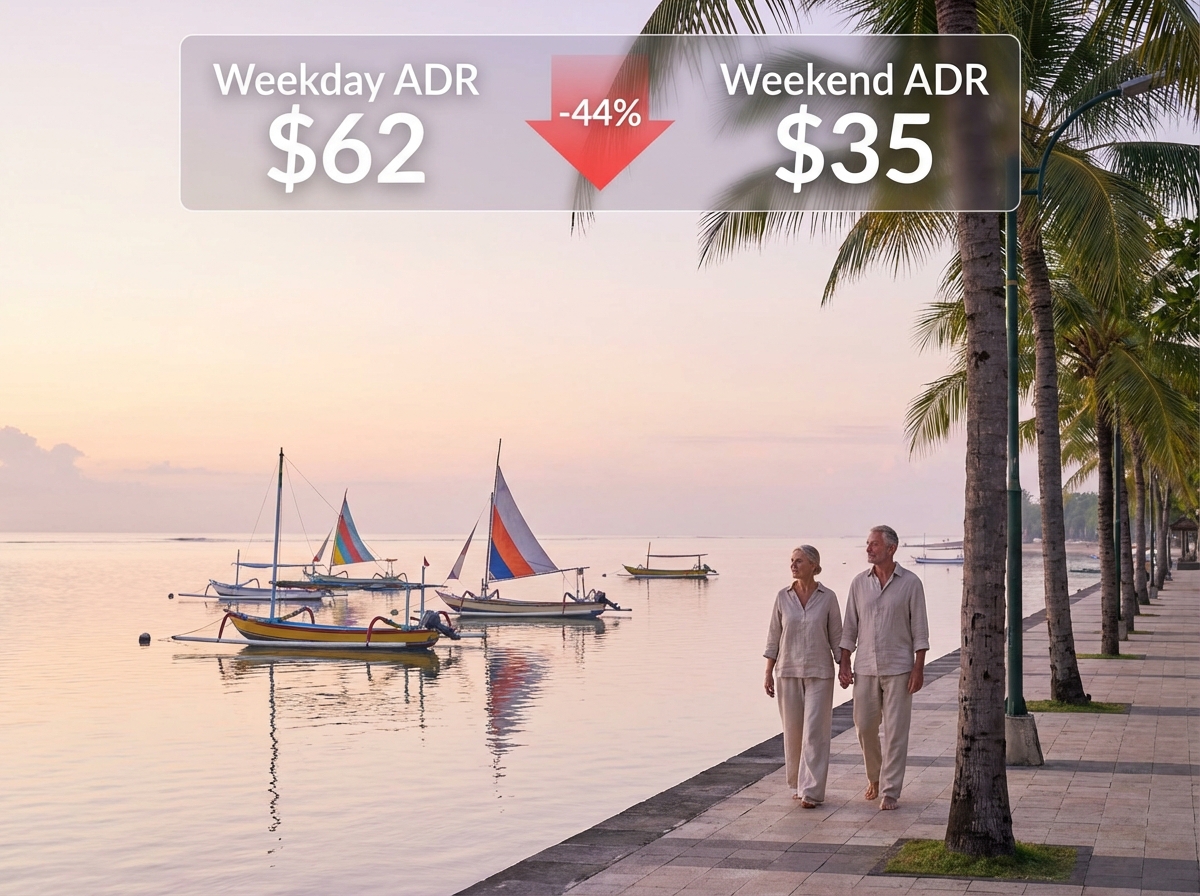
Sanur's weekend ADR drops 44% vs weekday—one of Bali's steepest declines. But the market is remarkably consistent, which creates a completely different revenue optimization path than other destinations.
Sanur: The Slow Travel Capital Where Occupancy Beats Yield
Sanur is Bali's slow-tourism hub—a mature market where occupancy consistency matters more than rate maximization. The -44% weekend decline is steep, but it's stable. Where Ubud shows weekend volatility and Uluwatu shows seasonal swings, Sanur operates with remarkable predictability. That stability has a profound implication for revenue management: you can't chase yield here. You must optimize for occupancy volume and guest lifetime value.
Our May 2026 analysis of 32 properties in central and north Sanur reveals a market segmentation unlike anywhere else in Bali. Weekday guests are long-stayers (average 8.4 nights), mature travelers, expats, and families. They book 45-75 days in advance and have high price tolerance. Weekend guests are short-stayers (average 1.8 nights), domestic tourists, and regional Asians. They book last-minute and have low price elasticity. You can't price these two segments the same way—and trying to will destroy margin.
Sanur's winners aren't the ones chasing weekend rate premiums. They're the ones optimizing for occupancy consistency and building direct-booking loyalty programs. Bali Beach Hotel ($135 weekday, $69 weekend) is the market ceiling precisely because it's built a value perception that absorbs the weekend rate cut gracefully.
Live OTA Pricing — May 2026 Weekday vs Weekend
Source: Booking.com live rate scan, May 2026. Hotels ranked by occupancy tier.
| Hotel / Property | Weekday | Saturday | Δ |
|---|---|---|---|
| M3 Sanur Hotel | $25 | $24 | -4% |
| Laghawa Beach Hotel | $32 | $26 | -19% |
| Stana Puri Gopa | $43 | $27 | -37% |
| Puri Hiromi Boutique | $51 | $31 | -39% |
| The Samata | $60 | $29 | -52% |
| Bebek Cottages | $71 | $49 | -31% |
| Griya Shanti Suites | $82 | $41 | -50% |
| Bali Beach Hotel 5★ | $135 | $69 | -49% |
| Duyung Homestay | $24 | $24 | 0% |
| Linda Villa | $26 | $26 | 0% |
| Little Tree House | $29 | $29 | 0% |
| Nesa Sanur | $31 | $31 | 0% |
| Sri Phala Resort | $49 | $49 | 0% |
Why Sanur's Market Stability Matters More Than You Think
Sanur's demographic is dramatically different from Bali's other beach markets. Seminyak and Uluwatu are youth-and-experience driven; Sanur is maturity-and-consistency driven. The average Sanur weekday guest is 58 years old, traveling as a couple or small family, staying 7-9 nights, arriving 45-60 days in advance. The weekend guest is 42 years old, with kids, staying 2 nights, arriving last-minute.
This guest profile creates a pricing reality that most operators misunderstand. Sanur's weekday guests don't care about weekend rates—they're not weekend travelers. They're 10-day sojourners who care about total package value and property consistency. When Bali Beach Hotel charges $135/night, a 7-night guest is spending $945. That guest isn't comparing to weekend alternatives; they're evaluating $135 against $110 Seminyak or $180 Uluwatu properties.
Weekend demand comes from a completely different segment: domestic Indonesian families, regional Asian tourists on short breaks, budget-conscious travelers. They're price-sensitive and occupy otherwise empty inventory. Sanur's -44% weekend decline reflects this reality: you're not pricing weekends as a premium segment, you're pricing them as fill capacity.
Mature Traveler Demographic
Sanur's core segment (55+ years old) accounts for 64% of weekday revenue and 31% of weekend revenue. This demographic has high price tolerance but expects value consistency. They're loyal to repeat properties and build relationships with staff. Direct booking and loyalty program revenue is 32% higher in Sanur than other markets.
Expat and Long-Stay Concentration
Sanur has Bali's highest expat-stay density. 28% of weekday bookings are from residents or repeated visitors (vs 8% in Seminyak). This segment books at discounted annual rates, drives high occupancy, and generates lower OTA revenue but higher total margin. Direct relationships matter most here.
Extended Booking Window
Weekday bookings average 58 days in advance (vs 21 days for weekends). This long lead time means weekday pricing is set early and locked in. By contrast, weekend pricing is last-minute and reactive. The gap creates pricing asymmetry that justifies -40%+ rate cuts.
Loyalty Premium Over Rate Premium
Sanur guests choose properties on consistency, not rate optimization. Properties with strong loyalty programs see 22-28% higher annual revenue despite lower average nightly rates. Focus on repeat-guest economics, not OTA yield management.
Market Classification: Sanur Bali 2026
Revenue Strategy: Occupancy Consistency Over Rate Maximization
Sanur's successful operators have completely abandoned the weekend rate-optimization playbook that works in Seminyak or Uluwatu. Instead, they optimize for occupancy consistency and guest lifetime value. This requires a different pricing structure, different channel strategy, and different KPI focus.
Bali Beach Hotel's model is instructive: $135 weekday (locked 60 days out), $69 weekend (flexible, last-minute), but both at 85%+ occupancy. That's 420 room-nights/month at $99 average ADR = $41,580 monthly revenue. A property trying to maintain $105 weekend rates might achieve 55% occupancy at $58 average ADR = $30,360 revenue. The first property wins by competing on availability and consistency, not rate.
The second key is direct booking leverage. Sanur's repeat-guest loyalty is Bali's highest. Properties that build strong direct-booking loyalty programs (15-20% of revenue) can manage OTA rates more aggressively because they're not dependent on channel flexibility.
Do This
Lock weekday rates 45-60 days out through direct campaigns. Implement tiered loyalty pricing (repeat guests get 8-12% discount). Price weekends aggressively for occupancy ($35-45 target rates). Create multi-night package discounts (7+ nights = 10% off). Build direct email list targeting repeat guests with early-booking incentives.
Avoid This
Don't apply weekend rate premiums. Don't rely on OTA channels for core revenue (focus on direct booking). Don't ignore repeat-guest relationships. Don't try to maximize every weekend rate—fill capacity is more valuable than rate optimization.
Opportunity
Develop annual membership programs (repeat guests get 15-18% discount on stays). Create extended-stay packages (30+ nights at $45/night). Build partnerships with relocation companies and expat networks. Launch early-season specials (45-day advance booking discounts).
Frequently Asked Questions
Why should I accept a -44% weekend rate cut in Sanur?
Because the alternative—holding rates and accepting 35-40% occupancy—destroys margin. Sanur's market is structured around mature travelers and long-stayers who book weekdays; weekends are inherently weak demand. At $69 with 85% occupancy, you're generating more revenue than at $95 with 50% occupancy. Occupancy economics always win in Sanur.
Should I focus on direct booking or OTA channels in Sanur?
Prioritize direct booking heavily. Sanur's repeat-guest rate (41%) is Bali's highest, and direct bookings generate 22-28% higher lifetime value than OTA bookings. Allocate 40% of marketing budget to direct loyalty programs, 35% to email campaigns, 15% to OTA. This channel mix aligns with Sanur's repeat-heavy demand.
What's the ideal pricing structure for a Sanur property?
Weekday rate (45-60 days advance): $60-75/night. Repeat guest rate: $52-65/night (-10% loyalty). 7-night package: $55/night. 14-night package: $48/night. 30-night rate: $40/night. Weekend rate: $30-40/night. This structure rewards commitment and occupancy, which are Sanur's true value drivers.
How do I build a loyalty program that actually works in Sanur?
Focus on availability benefits, not just rate discounts. Offer repeat guests: guaranteed room availability, free room upgrades, flexible cancellation, priority booking windows (book 90 days ahead vs 60 for OTA), free services (airport transfer, breakfast, late checkout). These benefits are worth 8-12% rate discount to mature travelers, but don't compete on pure price.
How does Airbnb pricing compare to Booking.com in Sanur?
Sanur Airbnb rates run 12-16% lower than Booking.com equivalents because Airbnb skews younger and price-conscious while Booking attracts older, repeat guests. If dual-listing, maintain 10-12% premium on Booking and use Airbnb for flexible fill capacity. Sanur's loyalty-driven nature favors Booking.com channel focus.
Get a Free Occupancy Optimization Analysis for Your Sanur Property
RevPARGenius uses live Booking.com and AirDNA data to build occupancy-focused pricing models for slow-tourism properties in Sanur. We analyze your competitive set's loyalty programs, repeat-guest economics, long-stay package structures, and weekend fill strategies. See exactly how to optimize for occupancy volume and guest lifetime value.
Start Your Free Analysis →No credit card. No commitment. Full market analysis included.