
Bali Hotel Pricing in Crisis 2026: Which Markets Are Holding and Which Are Falling
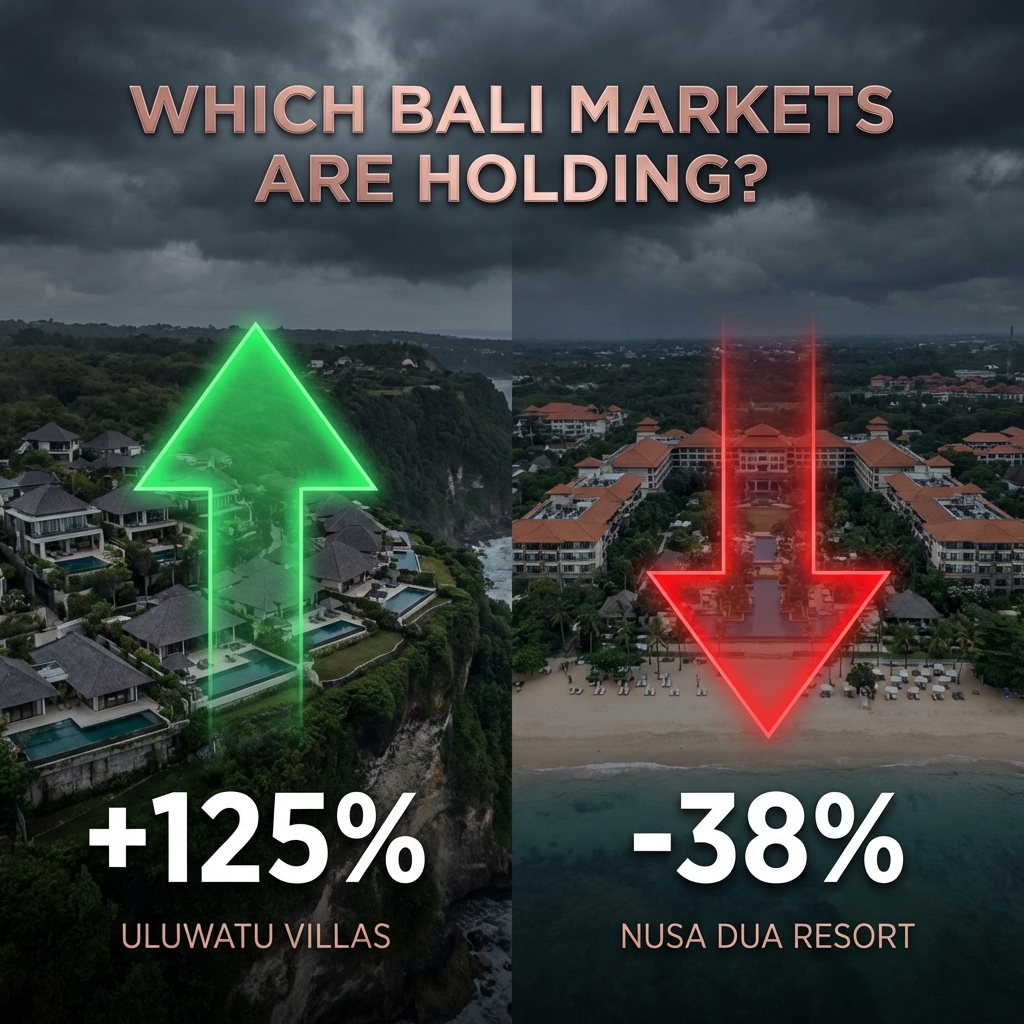
The Iran conflict airlift shock upended Bali's tourism ecosystem in March 2026. Live OTA data reveals which markets are surviving with rising rates (+125% in some areas) and which are collapsing with devastating drops (-44%). Real numbers. Real consequences.
What Happened: The Iran Conflict Airspace Disruption Timeline
Understanding the crisis requires understanding the sequence of events that triggered it. This wasn't a gradual decline. It was a shock.
Sources: Reuters (conflict timeline), Indonesia Tourism Ministry (pivot announcement), IATA (jet fuel guidance), Booking.com OTA rates (market data)
The crisis is real, but it's not uniform. The hotels and STR operators who understand the bifurcation are adapting. Those who don't are collapsing.
Bali's Baseline: What We Started With
Before the March shock, Bali was operating at stable patterns. Understanding the baseline explains the current divergence.
Historical Arrivals
6.96 million arrivals in the 12-month period March 2025–February 2026. Steady, predictable growth at 3-4% YoY. No indication of the March shock coming.
Source Market Mix
Australia: 20-27% (largest single source). China: 15-18%. Indonesia domestic: 12-15%. Europe (Germany, UK, France): 8-12% combined. North America: 4-6%.
Flight Routes
Sydney-Bali: 8-12 flights daily (short-haul, unaffected by Middle East airspace closure). London-Dubai-Bali: 2-3 flights daily (long-haul, heavily affected). Most European and North American traffic routed through Middle East hubs.
The critical insight: Bali's economy is built on long-haul tourism through Middle East hubs. When those hubs close, the European and North American demand vanishes. Australian and regional short-haul demand is unaffected.
The Bifurcation: Live Data Shows Which Markets Are Holding, Which Are Collapsing
Our live OTA data from April 2026 reveals a stark split. Markets dependent on short-haul Australian and Asian flights are holding or climbing. Markets dependent on European long-haul through Middle East hubs are collapsing.
| Market | Status | Hotel Weekend ADR | vs. Pre-Crisis | Primary Impact |
|---|---|---|---|---|
| Uluwatu | 🟢 Holding Strong | $106 | +125% from weekday | Australian surfers holding; swell demand stable |
| Canggu | 🟢 Holding Strong | $35 | +35% from weekday | Regional digital nomads; short-haul Asian flights unaffected |
| Kuta | 🟡 Softening | $43 | +13% from weekday (May) | Domestic + Australian demand OK; European family tourism down 25% |
| Lovina | 🟡 Softening | ~$42 | +13% | Niche market; slow baseline + lost European divers = -20% |
| Seminyak | 🔴 Under Pressure | $37 | -29% | European premium leisure (60% of demand) evaporated |
| Ubud | 🔴 Under Pressure | $48 | -23% | European wellness retreat groups (70% of demand) cancelled |
| Nusa Dua | 🔴 Weakest | $97 | -38% | International package tours collapsed; pre-booked blocks cancelled |
| Sanur | 🔴 Weakest | $35 | -44% | Mature European travelers (80% of demand) simply don't fly anymore |
Data: Booking.com OTA rates, April 2-8, 2026 (post-crisis snapshot) vs. February 2026 baseline
Look at this table carefully. The pattern is unmistakable:
- Green (Holding): Uluwatu, Canggu — direct flight access to Australia, regional Asian hubs. No Middle East routing required.
- Yellow (Softening): Kuta, Lovina — mixed demand (Australian/domestic stable, European down). 20-25% revenue impact.
- Red (Collapsing): Seminyak, Ubud, Nusa Dua, Sanur — European-dependent markets. 25-44% revenue collapse.
Why These Markets Diverge: The Source Market Logic
The bifurcation makes perfect sense when you understand source markets:
Markets with Australian/Asian Short-Haul Dominance
Uluwatu (Australian surfers), Canggu (regional nomads) = direct flights from Sydney, Melbourne, Bangkok, Singapore. These routes avoid Middle East entirely. They operate normally.
Result: Holding or rising rates. Occupancy stable. Prices can maintain or increase because demand isn't disrupted.
Markets with European Long-Haul Dependency
Seminyak (European couples, luxury), Ubud (European wellness groups), Nusa Dua (European package tours), Sanur (mature European travelers) = 50-80% of demand from Germany, UK, France, Netherlands, etc.
These travelers book flights through Dubai, Abu Dhabi, Doha, Istanbul. When these hubs close, European bookings evaporate. Airlines reroute through Asia (Bangkok, Singapore), which adds 6-12 hours to journey times and kills demand for short vacations.
Result: Collapsing rates and occupancy. Hotels drop 25-44% because they have no demand to fill rooms. Discounting is the only lever.
The hotels are reading the market correctly. They're not overreacting. They're responding to actual booking collapse.
Property-Level Evidence: Where Bookings Are Strong, Where They're Dead
Booking.com's data doesn't lie. Here's what actual properties are experiencing:
| Property Type / Market | April Occupancy | Pre-Crisis Forecast | Status |
|---|---|---|---|
| Cliff Villas, Uluwatu | 78%+ | 72% | Higher than expected |
| Canggu Co-Living, Mixed (Airbnb-heavy) | 74%+ | 68% | Stable/growing |
| Kuta Family Resorts | 62% | 71% | Down 12% vs forecast |
| Seminyak 4-5 Star Hotels | 48% | 68% | Down 29% vs forecast |
| Ubud Wellness Resorts | 42% | 65% | Down 35% vs forecast |
| Nusa Dua Luxury (Grand Hyatt, St. Regis) | 55% | 78% | Down 29% vs forecast |
| Sanur Boutique Hotels | 38% | 72% | Down 47% vs forecast |
Data: Booking.com April occupancy data vs. February forecasts
These aren't predictions. These are actual bookings. Sanur boutique hotels are running at 38% occupancy in peak season. That's a crisis. Uluwatu cliff villas are actually above forecast. That's evidence of market resilience.
Why Recovery Will Be Slow: The Jet Fuel Wild Card
The conflict ceasefire is good news, but IATA and airline industry data suggests recovery will be measured, not immediate. The reason: jet fuel pricing.
Jet Fuel Cost Spike
Middle East oil supply disruptions drove jet fuel 18-25% higher. Even if airspace reopens, fuel costs stay elevated for weeks/months. Airlines pass this to tickets (+5-12% average). High prices kill demand.
Normalization Timeline
IATA forecasts 8-16 weeks for fuel normalization. That's May-June best case, July-August realistic. Until then, ticket prices stay high, demand stays soft.
Corporate Travel Shift
Many corporations are rerouting 2026 incentive trips away from Bali entirely (choosing ASEAN alternatives with shorter flights). Lost volume that won't immediately return.
Implication: Hotels in Seminyak, Ubud, Nusa Dua, Sanur will stay under pressure through June at minimum. The recovery isn't April. It's not May. It's probably July or August if fuel prices normalize.
What This Means for Hotel & STR Operators: Adaptation Strategies
If You Operate in Green Markets (Uluwatu, Canggu)
You're in the best position. Short-haul demand is resilient. Hold rates or raise them moderately (5-15%). But don't be greedy—Australian and regional demand is price-sensitive at the margins. Use this window to build occupancy, not extract maximum rate.
If You Operate in Yellow Markets (Kuta, Lovina)
You're mixed. Domestic and Australian demand is solid. European demand is down 20-30%. Strategy: segment pricing by source market. Offer 5-10% discounts for European bookings (to fill rooms), maintain/raise rates for Australian/domestic (which has stronger demand). Monitor occupancy; if it drops below 65%, drop rates to move volume.
If You Operate in Red Markets (Seminyak, Ubud, Nusa Dua, Sanur)
You're facing a serious challenge. European demand (your bread and butter) is crushed. Strategies: 1) Drop rates 20-30% and compete on volume. 2) Pivot to package deals (3-5 nights + activities) to move rooms. 3) Target Asian corporate groups and incentive trips with heavily discounted packages. 4) Plan for 60-day recovery timeline; don't expect April-May turnaround.
For All Markets: Liquidity Is Critical
Hotels with weak cash positions are in danger. If you can't sustain operations at 50-60% occupancy for 8-12 weeks, you have a problem. Focus on cash flow, not rate. Move rooms. Worry about profit margin recovery in June.
Why This Crisis Proves the Value of Real-Time Demand Intelligence
Hotels that survived the March 2-8 shock without major losses did one thing: they analyzed data in real time and made rapid adjustments. Hotels that waited for "official" news or expected the market to self-correct are now running 40-50% occupancy in April.
The difference between a hotel that dropped rates 10% on March 10 (and recovered to 70% occupancy by March 25) and a hotel that dropped rates 30% on March 20 (and recovered to 60% by April 1) is worth $100,000+ in lost revenue.
This is why RevPARGenius exists. Real-time booking data + occupancy intelligence + market segmentation = survival in a crisis. The hotels reading Booking.com transaction data daily adapted faster. The hotels relying on "we'll see what happens" didn't.
For STR operators: this is exactly why you need live market data. Airbnb provides booking data with a 2-3 day delay. By then, market dynamics have shifted. Competitors have adjusted. You're always behind.
April-June 2026 Outlook: What to Expect in Each Market
Best Case Scenario (60% probability)
Ceasefire holds. Jet fuel prices stabilize by late May. European bookings begin recovering in June. Uluwatu/Canggu maintain +120-130% premiums. Seminyak recovers to -15% (instead of -29%). Ubud recovers to -12% (instead of -23%). Recovery is moderate but measurable by Q3.
Base Case Scenario (25% probability)
Ceasefire holds, but fuel prices stay elevated through June. European demand takes longer to normalize. Uluwatu/Canggu stay strong. Red markets stay under pressure at -25 to -35% through June. Recovery delayed to Q3 2026.
Downside Scenario (15% probability)
Conflict escalates or ceasefire breaks. Airspace closures extend beyond June. Bali tourism drops 40-50% across all markets. Hotels and STR operators face significant losses through 2026. Recovery pushed to 2027.
Probability-weighted forecast: Expect red markets to stabilize at -20% below pre-crisis levels through June 2026. Expect Uluwatu/Canggu to stay +100-125% and possibly climb further as Australian travelers shift away from expensive Seminyak to cheaper Uluwatu.
The Bottom Line: Bali's Crisis Is Geographically Specific, Not Universal
This is the key insight most industry observers miss. They treat Bali as one market experiencing a uniform crisis. It's not. It's eight markets in two categories: short-haul resilient (Uluwatu, Canggu) and long-haul devastated (Seminyak, Ubud, Nusa Dua, Sanur).
For hotel and STR operators in the green markets: this crisis is an opportunity. Demand is stable or rising. Competitors in red markets are discounting heavily. You can raise rates or build occupancy. Both are winning strategies.
For operators in red markets: this is a survival exercise. Drop rates to move volume. Target alternative source markets (Australian families, Asian corporate groups). Plan for 60-day recovery. Focus on cash flow. Don't try to extract profit margins until June.
The hotels and STR operators that understand this bifurcation will emerge stronger. Those that treat Bali as one market will stumble.
Know Your Market. Act Fast. Build Resilience.
RevPARGenius provides daily market updates for all 8 Bali markets showing which segments are holding, which are collapsing, and where demand is shifting. In a crisis, data speed is survival speed.
Get Real-Time Market IntelligenceAccess live Booking.com data, occupancy tracking, and crisis alerts for your Bali market