Hotel Intelligence Series · RevParGenius · Lighthouse · Amadeus Demand360 · PredictHQ
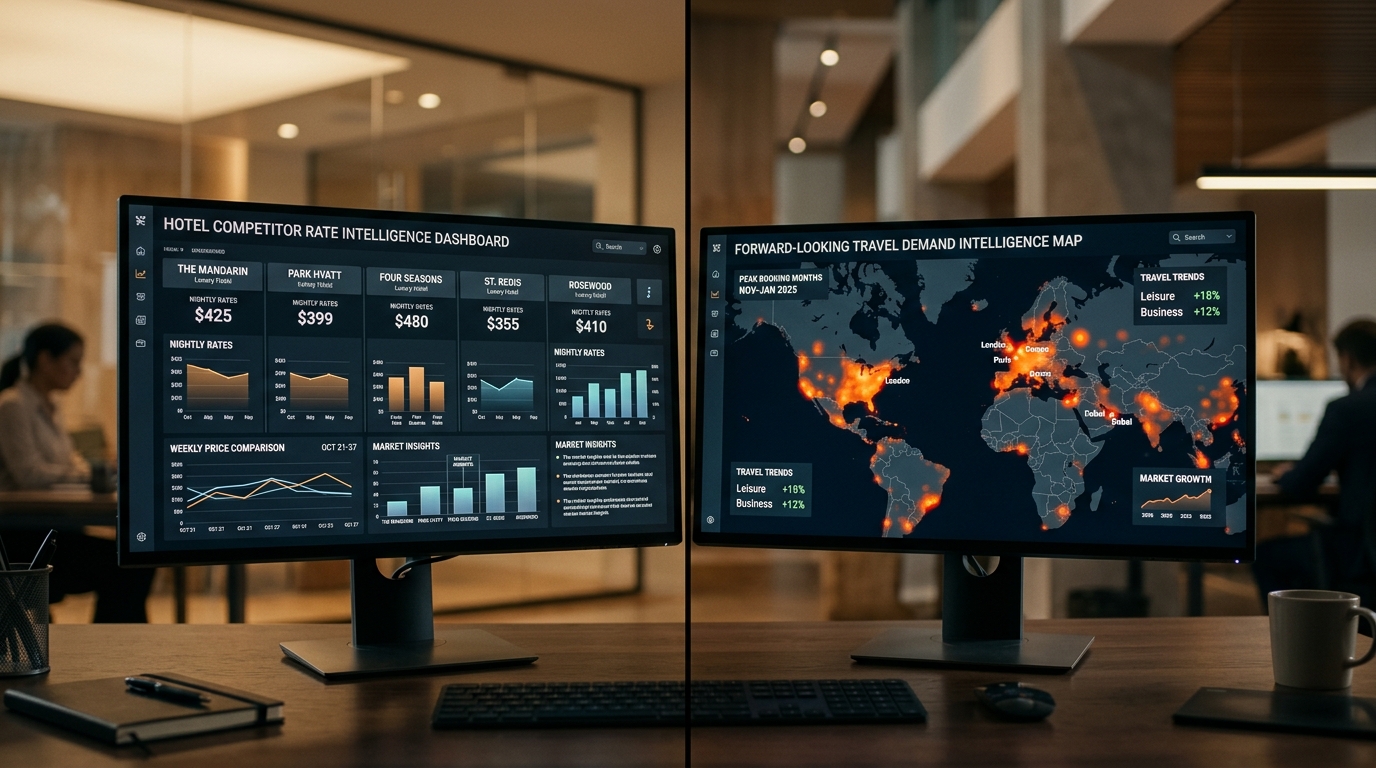
Hotel market intelligence and hotel rate shopping are not the same tool doing the same job. Rate shopping tells you what your competitors are charging right now. Market intelligence tells you why demand is moving, where it is heading, and what your rates should be before the compression window opens or the inversion arrives. Confusing the two — or using only one — is one of the most consistent revenue management errors that independent hotels make.
The distinction matters commercially. Lighthouse, whose Market Insight product combines forward-looking demand data with competitive rate monitoring, reports that hotels using both dimensions together achieved 2.3% higher RevPAR and 4.7% higher occupancy than comparable hotels in the same market using rate shopping alone. That gap compounds. Across a 90-day window with four genuine compression weekends, the difference between seeing demand coming and reacting to it after it peaks is measurable in revenue per room per night — not rounding errors.
Rate Shopping vs Market Intelligence — Side by Side
What Hotel Market Intelligence Actually Covers
Hotel market intelligence is the broader picture of what is happening in your market: forward-looking demand from corporate and leisure segments, competitor behavior across channels, event calendars and their compression impact, benchmark trends from STR and AirDNA, rate parity visibility, and total performance context. It is not a single data feed — it is the synthesis of multiple signals into a picture of where demand is heading and what it will support.
The clearest modern description of the full intelligence stack comes from Lighthouse's platform: forward-looking demand data, competitive pricing, benchmarking, parity visibility, and direct-channel optimization in one place. Duetto's Advance product adds Amadeus Demand360, STR historical performance, and PredictHQ event signals on top of its dynamic pricing engine. BEONx frames its platform around total profitability — combining forecasting, automation, competitor prices, and destination events into what it calls a complete commercial intelligence layer.
Amadeus Demand360 pulls forward-looking on-the-books data from 44,000 hotels and 35 million short-term-rental properties, covering booking pace up to 12 months ahead. In 2025, Amadeus integrated Gen AI into the platform — its Advisor Chat feature has saved analyst teams approximately a day each week at customer hotels such as Omni Atlanta, handling tasks like RFP demand assessment that previously required manual data gathering (Amadeus newsroom, June 2025). Rate shopping tells you what competitor rates are today. Demand360 tells you what corporate and leisure demand is booking 90 days from now.
Hotel Rate Shopping: What It Covers and Where It Stops
Rate shopping is the practice of monitoring competitor room prices across OTA channels so your hotel can make pricing decisions relative to the market. Modern rate shopping tools do more than show a BAR rate — they track promotions, mobile rates, geo-specific rates, member rates, and restrictions like minimum length of stay. Lighthouse profiles more than 300,000 competitor hotels and collects 1.7 billion hotel rates daily. RateGain's OPTIMA adds real-time intra-day intelligence, market compression indicators, and geo-rate tracking.
Where rate shopping stops is the question of why. If a competitor drops their rate 15% on a specific Saturday three weeks out, a rate shopper shows you the drop. It does not tell you whether that competitor is responding to a genuine demand collapse, testing a promotional strategy, or making a pricing error. Without forward-looking demand context, a hotel that mirrors every competitor move is making strategy out of other people's reactions rather than the market signal underneath them.
A hotel relying only on rate shopping sees a competitor drop Saturday rates 20% three weeks out and follows the move — protecting OTA ranking position by staying competitive on price. What it doesn't see: the market compression signal building in forward booking pace that explains why the competitor's drop was a mistake they'll reverse by Thursday. The hotel that sees the demand signal holds rate. The hotel that only sees the competitor move drops rate into a compression weekend and leaves revenue on the table from every booking that comes in before Friday's correction. That is the practical cost of rate shopping without market intelligence.
Hotel Pricing Intelligence: The Layer Between the Two
Hotel pricing intelligence sits between rate shopping and full market intelligence. It focuses on how prices are moving across channels, room types, geographies, and competitors — not just what the BAR is today, but how rates are trending across the booking window and what pricing patterns your competitors are running. It is narrower than full market intelligence but more analytical than basic rate monitoring.
In practice, pricing intelligence tools pull in OTA rate trends, channel-by-channel rate comparison, and pickup pace data alongside competitor rates. The distinction from rate shopping is that pricing intelligence synthesizes the pattern — showing that your competitor is consistently pricing weekday corporate demand 12% above their weekend rate, a pattern that tells you something about their demand mix — rather than just reporting the number on a given date.
Event-Driven Hotel Demand Forecasting: Where Most Hotels Still Underperform
Event-driven demand forecasting is the practice of using confirmed event data — conferences, concerts, sporting fixtures, exhibitions, public holidays — to inform forward pricing decisions. PredictHQ, which supplies event data to multiple RMS platforms including Duetto, IDeaS, and Lighthouse, says most accommodation businesses do not struggle with knowing that events matter. They struggle with converting event noise into model-ready demand signals.
The practical problem is scale and qualification. A city hotel's events calendar might include 200 events in a 90-day window. Most of them are irrelevant to hotel demand. Some — large conventions, major concerts, international sporting events — drive genuine compression. A few create demand displacement rather than demand addition: IDeaS notes that major events can fill meeting space demand while actually suppressing transient leisure bookings if the event crowd skews day-visitor rather than overnight traveler.
RevParGenius market scans classify events by demand impact: confirmed demand-driving events (large conventions, verified major concerts), unclassified high-profile events requiring investigation before pricing, and low-impact noise. The Jun 13 Hobart compression anomaly — where the market cleared at A$459 Saturday ADR from just 5 matched comps — is treated as "investigate before pricing," not "price into immediately." That classification discipline is the difference between useful event intelligence and rate guesswork dressed as data.
Causal AI: The Next Layer Beyond Demand Forecasting
The most sophisticated hotel pricing systems in 2026 are moving beyond traditional time-series forecasting — ARIMA models, Prophet algorithms, seasonal indices — toward Causal AI, which attempts to understand not just what demand is doing but why. Standard forecasting models identify patterns from historical data. Causal AI integrates four live input streams simultaneously to model the underlying drivers of booking behavior in real time: internal PMS data (booking pace, pickup, cancellations), forward search signals (flight volume, metasearch query volume), competitive positioning (comp set pricing and OTA visibility), and external demand drivers (event calendars, localized holidays, corporate travel patterns).
Causal AI analysis has revealed a commercially significant and counterintuitive insight about corporate travel booking behavior that changes how smart systems price weekday nights. Monday travelers book significantly closer to their arrival date — with a pronounced reservation surge in the final 72 hours before check-in. The correct pricing response: hold lower, competitive Monday rates in the early booking window to secure baseline occupancy, then execute aggressive rate increases in the final 72 hours to capture late corporate yield at premium. Wednesday travelers show the opposite pattern — highly structured early reservation curves driven by pre-planned corporate travel budgets. The correct response: raise Wednesday rates earlier in the booking cycle and hold them steady, capturing pre-planned corporate demand before the booking window compresses. A revenue manager reviewing rates once a week cannot execute either of these patterns with the precision required. A system monitoring booking velocity by day-of-week in real time can.
Spatial-temporal neural networks — used by platforms like Duetto and FLYR for Hospitality — add another dimension by analyzing how rate changes in one submarket instantly shift demand into adjacent submarkets. When a luxury resort raises rates aggressively during a compression event, boutique properties in the same city capture displaced demand within hours. A Causal AI system sees this displacement forming in metasearch query data and adjusts boutique-property rates before the spillover bookings arrive. This is demand intelligence operating at a speed and granularity that no weekly market intelligence review can replicate.
Real-Time Hotel Demand Tracking: What It Means in Practice
Real-time hotel demand tracking means monitoring live booking pace, market OTA movement, competitor availability changes, and event signals continuously — not on a weekly review schedule. This is the logic behind tools like Atomize (continuous rate optimization), Duetto's GameChanger (rates updated multiple times per hour), and RevParGenius (live OTA scans showing current comp-set pricing and weekend uplift in real time).
The commercial value of real-time tracking is asymmetric: it matters most on the 15–20 days per quarter where demand moves fast. The Jun 27 Kigali Saturday that returned $202 directional ADR against an $88 weekday — a +130% uplift signal — was only visible in real-time OTA data. A hotel checking rates weekly on Friday would have seen it the week before arrival, with the early-booking window already partially closed. Real-time tracking sees it building from six weeks out and allows pre-positioning before competitors notice the same signal.
Frequently Asked Questions
Hotel market intelligence is the combination of forward-looking demand data, competitive behavior analysis, event calendar impact, benchmark performance against the comp set, and channel-level pricing context. It tells you why demand is moving and where it is heading — not just what competitors are charging today.
Hotel rate shopping is monitoring competitor room prices across OTA channels in real time. Modern tools also track promotions, mobile rates, geo-specific rates, and minimum length-of-stay restrictions. It is reactive — it shows the current price but not the demand signal behind it.
Revenue intelligence combines pricing data, demand forecasting, benchmarking, market signals, and profitability context into a single decision layer. Platforms like Duetto, IDeaS, and BEONx frame their products around revenue intelligence rather than basic rate monitoring — the distinction being that revenue intelligence informs the full commercial strategy, not just today's BAR.
An event-driven demand forecasting tool pulls verified event data — conferences, concerts, sporting fixtures, public holidays — and maps each event's expected impact on hotel booking pace and ADR. Tools like PredictHQ (which supplies data to Duetto, IDeaS, and Lighthouse) qualify events by attendance and demand-driving likelihood rather than just listing them. The goal is to distinguish genuine compression events from calendar noise before pricing decisions are made.
RevParGenius Take
The smartest question is not which rate shopper is best. It is what intelligence stack helps your team see demand early, benchmark reliably, and act without jumping between five disconnected tools. Rate shopping is a necessary input. It is not a sufficient strategy.
Hotels that treat rate shopping as their market intelligence capability are pricing from other people's reactions rather than the underlying demand signal. The properties consistently outperforming their RGI are the ones that see demand building — from event detection, from forward booking pace, from live OTA movement in the comp set — and pre-position their rates before the compression window opens, not after it peaks.
Free Hotel Market Intelligence
See Your Market's Demand Signal Before Your Comp Set Does.
RevParGenius runs live OTA demand scans for your hotel market — weekday vs. weekend ADR, compression signals, event impact, and comp-set pricing context. No spreadsheets. No guesswork. Just the forward-looking signal your pricing decisions should be built on.
Get Your Free Market AnalysisTry Automated Dynamic Pricing Free
No commitment. Just live data at revpargenius.com
Sources: Lighthouse Market Insight performance data; Amadeus Demand360 product documentation and newsroom (June 2025); PredictHQ event-driven forecasting documentation; RateGain OPTIMA product description; BEONx platform overview; IDeaS demand forecasting definition; Duetto Advance platform documentation; RevParGenius live OTA market scan methodology. RevParGenius is an independent hotel market intelligence platform — not affiliated with any OTA, revenue management system, or hotel chain.