
Hotel Performance Series · RevParGenius Intelligence · HSMAI · STR · HotStats
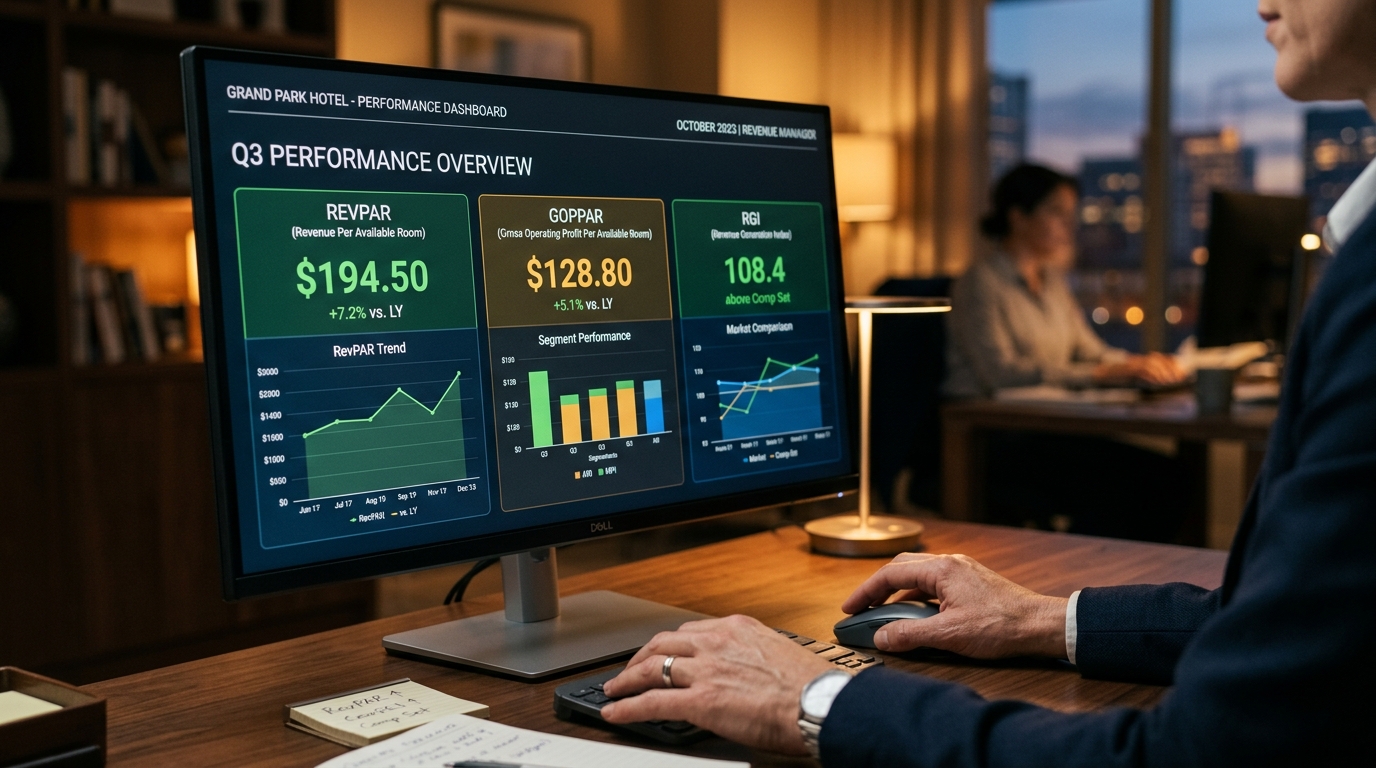
RevPAR, GOPPAR, RGI, and MPI are the four metrics that separate hotels that understand their commercial performance from those that only track how many rooms they fill. RevPAR tells you how efficiently you convert available inventory into room revenue. RGI tells you whether you are outperforming your competitive set. MPI tells you whether you are winning or losing occupancy share. And GOPPAR tells you whether any of it is actually converting into operating profit. Each one answers a different question — and knowing which question to ask, on which day, is what revenue management is actually about.
In 2025, U.S. hotel RevPAR fell 0.3% — to US$100.02 — the first non-recessionary RevPAR decline ever recorded, according to CoStar/STR data. European hotels delivered modest growth, concentrated in Spain (+5.5% RevPAR YoY), while APAC markets remained bifurcated between outperforming leisure destinations and softening urban markets. Against that backdrop, knowing what your RevPAR actually signals — and which of the four metrics should be guiding your pricing decisions — has never mattered more.
The Four Metrics at a Glance
RevPAR: What It Is, How to Calculate It, and What It Misses
RevPAR stands for Revenue Per Available Room. SiteMinder defines it as a metric that measures how much room inventory is being sold and how much revenue is being generated from those bookings. There are two mathematically equivalent ways to calculate it: Total Room Revenue ÷ Available Rooms, or ADR × Occupancy Rate. Both give the same number. The formula you use depends on which data your PMS surfaces most readily.
RevPAR = Total Room Revenue ÷ Total Available Rooms
— or —
RevPAR = ADR × Occupancy Rate
Example: A 100-room hotel sells 70 rooms at an ADR of $150. Occupancy = 70%. ADR = $150. RevPAR = $105. Simple. The interpretation is where strategy begins.
What RevPAR misses is equally important. It captures room revenue only — not food and beverage, spa, parking, or ancillary income, which can represent 30–40% of total revenue at full-service properties. It also says nothing about what it cost to generate that revenue. A hotel with $105 RevPAR and 60% labor cost is not performing the same as one with $105 RevPAR and 35% labor cost. That is why GOPPAR exists.
The ADR vs. occupancy tradeoff sits inside RevPAR and is worth understanding explicitly. A hotel can grow RevPAR by raising ADR while accepting lower occupancy, or by driving occupancy while holding rate. Neither is universally correct — the right balance depends on your market, your cost structure, and your comp set behavior. In 2025, STR data showed that hotels which defended ADR outperformed those that chased volume; U.S. occupancy fell 1.2 percentage points while ADR grew 0.9%, producing the -0.3% RevPAR outcome.
RGI: Whether You Are Winning or Losing Against Your Market
RGI stands for Revenue Generation Index, also called RevPAR Index. HSMAI defines it as your hotel's RevPAR divided by the RevPAR of your competitive set, expressed as an index where 100 means fair share. An RGI above 100 means you are capturing more than your fair share of market revenue; below 100 means competitors are outperforming you even if your absolute RevPAR is growing.
RGI = (Your Hotel RevPAR ÷ Comp-Set RevPAR) × 100
Example: If your RevPAR is $105 and the comp set RevPAR is $95, your RGI = 110.5 — meaning you are generating 10.5% more revenue per available room than your competitive set.
Benchmarks: 100–110 = healthy. 110+ = market dominance. Sub-90 triggers asset-manager reviews at most ownership groups. Sustained sub-90 RGI is a red flag regardless of absolute RevPAR growth.
RGI is particularly useful as a diagnostic. If your RevPAR is growing but your RGI is falling, the market is growing faster than you — you are losing share while feeling like you are winning. If your RevPAR is flat but your RGI is rising, you are outperforming a declining market. Many ownership groups set explicit RGI targets in management contracts, and lenders increasingly factor RGI into hotel financing decisions alongside absolute RevPAR. Track both.
MPI: The Occupancy Equivalent of RGI
MPI stands for Market Penetration Index, also called Occupancy Index. HSMAI defines it as hotel occupancy divided by comp-set occupancy, multiplied by 100. Like RGI, 100 means fair share. An MPI above 100 means your hotel is capturing more than its proportional share of market occupancy; below 100 means your occupancy is underperforming relative to the market even if your absolute fill rate looks acceptable.
MPI = (Your Hotel Occupancy ÷ Comp-Set Occupancy) × 100
The paired metric is ARI (Average Rate Index): (Your ADR ÷ Comp-Set ADR) × 100.
The dangerous combination: High MPI + Low ARI = winning occupancy by underpricing. You are buying market share with rate. This is recoverable, but it requires recognizing it. A hotel running 85% occupancy against a 70% market average is not necessarily well-positioned — if ARI is 88, you are filling rooms at a rate 12% below what your competitors charge for the same demand.
The three-index view — MPI (occupancy share), ARI (rate share), RGI (revenue share) — together give a complete picture of where you stand in your market. STR's STAR report packages all three as standard benchmarking outputs. For independent hotels without a STAR subscription, RevParGenius market scans provide directional equivalent data from live OTA pricing across your competitive set.
GOPPAR: The Metric That Tells You Whether Any of It Actually Worked
GOPPAR stands for Gross Operating Profit Per Available Room. HSMAI defines it as gross operating profit — revenue minus operating expenses — divided by available rooms. It is the profitability equivalent of RevPAR: instead of measuring how much room revenue each available room generated, it measures how much operating profit each available room generated.
GOPPAR = Gross Operating Profit ÷ Total Available Rooms
Worked example: A 100-room hotel generates $15,000 total daily revenue. Operating expenses are $6,000. GOP = $9,000. GOPPAR = $90.
2025–2026 context: HotStats reports European hotel GOP margins plateauing at approximately 36.5%, with flow-through running at just 35% — meaning for every $1 of new revenue, only $0.35 reaches the bottom line. Americas GOPPAR: US$105.42. APAC GOPPAR: US$53.20. (HotStats, 12-month rolling averages, mid-2025.)
GOPPAR has overtaken RevPAR as the metric of record at the ownership level in 2025–2026 because rising labor, energy, and food costs have decoupled revenue growth from profit growth. A hotel growing RevPAR 5% while labor costs grow 8% is moving backwards on GOPPAR — and RevPAR alone will never show you that.
Academic research comparing RevPAR and GOPPAR found RevPAR more useful at the firm level, with mixed results at the property level — one reason many operators track RevPAR daily and GOPPAR monthly rather than choosing one metric exclusively. That cadence is sensible: RevPAR drives daily pricing decisions; GOPPAR drives monthly strategic ones.
Base Occupancy: The One More Term Worth Defining
Base occupancy has two distinct meanings in hotel operations and it is worth knowing which one is being used in context. In rate-structure terms, Expedia Group's lodging glossary defines base occupancy as the number of guests contracted as the standard number of occupants per room — the occupancy level covered by the base room rate before additional-guest charges apply. If your room rate covers two guests and charges extra for a third, two is the base occupancy.
In revenue management terms, base occupancy also refers to the breakeven occupancy level needed to cover fixed costs at the current ADR — the floor below which each empty room represents a net loss rather than a missed opportunity. Neither meaning should be confused with overall hotel occupancy rate, which HSMAI defines simply as occupied rooms divided by available rooms that physically exist in the hotel.
TRevPAR and GOPPAR: Beyond RevPAR to Total Revenue and Profit
RevPAR measures room revenue efficiency. TRevPAR (Total Revenue Per Available Room) and GOPPAR go further — capturing the full commercial picture that RevPAR leaves out. At full-service properties, food and beverage, spa, parking, and resort fees contribute 20–40% of gross revenue. RevPAR ignores all of it. GOPPAR accounts for operating costs too, making it the metric that connects commercial decisions to actual profitability.
RevPAR = Room Revenue ÷ Available Rooms — room-only efficiency.
TRevPAR = Total Hotel Revenue ÷ Available Rooms — full commercial output including F&B, spa, parking, and ancillaries.
GOPPAR = Gross Operating Profit ÷ Available Rooms — the profit version. GOP = Total Revenue minus all operating expenses (labor, energy, distribution fees, F&B costs).
Required Daily GOPPAR = Target RevPAR × Target Margin % — the minimum profit floor. A hotel targeting $250 RevPAR with a 30% operational profit margin must generate at least $75 GOPPAR per available room to cover variable and fixed overheads.
Three real-world scenarios show why tracking all three metrics simultaneously matters. Scenario one: high RevPAR and low GOPPAR. A luxury property slashes rates to maintain high occupancy — the volume looks impressive but drives housekeeping overtime, increased wear and tear, and elevated utility consumption that wipes out profit margins. Scenario two: rising TRevPAR and flat RevPAR. An urban hotel launches a weekend craft-cocktail class and premium parking package. Room occupancy stays flat but ancillary spend grows significantly — and because the variable cost of a cocktail is low, that growth flows directly to GOPPAR. Scenario three: healthy GOPPAR and declining RevPAR. An operator implements smart energy management and automated check-in, reducing labor and utility costs enough to protect margins even as occupancy softens slightly. RevPAR falls; GOPPAR holds.
The 2026 events calendar is generating the sharpest compression signals in years. The Milano-Cortina Winter Olympics produced an opening ceremony ADR of EUR 552 and a 17-day average rate approaching EUR 500 per night in the host market — compression levels that no static seasonal pricing model would have anticipated. The FIFA World Cup across the United States, Canada, and Mexico is projected to lift full-year U.S. RevPAR by 0.4%, with host cities capturing concentrated demand spikes. The Harry Styles "Together, Together" residency tour is driving sustained hotel compression in Amsterdam and London across multiple weekends. In each case, the hotels that captured the full compression premium were the ones with real-time demand monitoring in place weeks before the event date — not the ones checking competitor rates on the Friday before arrival.
How to Improve RevPAR in 2026: The Four Levers That Actually Work
RevPAR improvement in 2026 is not a rate problem alone — it is a signal-reading problem. Hotels that improve RevPAR in flat or declining markets are doing four things consistently: using forward-looking demand data to anticipate compression before it shows up in their own bookings; running automated pricing that moves rates in real time rather than on a weekly review schedule; optimizing channel mix toward direct bookings (which deliver 12.5% more profit than OTA bookings, per Kalibri Labs); and tracking RGI alongside RevPAR so they can distinguish market-driven growth from genuine outperformance.
1. Demand forecasting before compression arrives. Amadeus Demand360 surfaces forward-looking booking pace from 44,000 hotels up to 12 months ahead — identifying compression dates 60 days before they appear in rate-shopping tools. RevParGenius runs live OTA scans for the same purpose at the market level.
2. Automated dynamic pricing. The market demands up to 24 pricing updates per day to stay genuinely competitive. No manual process achieves this. Real-time, demand-driven automated pricing systems deliver 8–15% RevPAR uplift within 90 days versus 5–7% from rules-based systems.
3. Occupancy-based rate triggers. Industry framework: below 30% occupancy, discount to stimulate demand; above 70%, raise rates to capture compression; above 85%, apply minimum length of stay restrictions and close low-yield rate categories.
4. Channel mix discipline. Direct bookings are 12.5% more profitable than OTA bookings (Kalibri Labs, 18,000 U.S. hotels). EU hoteliers now have legal freedom to undercut OTA rates on direct channels under the Digital Markets Act. Everywhere else, closed-user-group discounts (loyalty, mobile app) are the standard mechanism.
Frequently Asked Questions
RevPAR is Revenue Per Available Room — a measure of how efficiently a hotel converts available room inventory into room revenue. It is calculated as either ADR × Occupancy Rate, or Total Room Revenue ÷ Total Available Rooms. Both formulas are equivalent.
RGI (Revenue Generation Index) compares your hotel's RevPAR with your competitive set's RevPAR. It is calculated as (Your RevPAR ÷ Comp-Set RevPAR) × 100. A score of 100 means fair share. Above 100 means you are outperforming the market; below 100 means you are underperforming even if your absolute RevPAR is growing.
MPI stands for Market Penetration Index, also called Occupancy Index. It is calculated as (Your Hotel Occupancy ÷ Comp-Set Occupancy) × 100. A score above 100 means your hotel is capturing more than its fair share of market occupancy. HSMAI uses this definition as the industry standard.
GOPPAR is Gross Operating Profit Per Available Room, calculated as GOP ÷ Available Rooms. It matters more than RevPAR in environments where costs are growing faster than revenue — exactly the situation most hotels face in 2025–2026. European hotel GOP flow-through was just 35% in 2025 (HotStats), meaning RevPAR growth significantly overstates actual profit improvement.
The most effective levers are: (1) automated dynamic pricing that moves rates in real time rather than weekly; (2) forward-looking demand forecasting that identifies compression dates 30–60 days ahead; (3) occupancy-based rate triggers at the 30%/70%/85% thresholds; and (4) channel mix improvement toward direct bookings, which are 12.5% more profitable than OTA bookings. HSMAI emphasizes segmentation and forecasting; the market data increasingly confirms that pricing speed matters as much as pricing strategy.
RevParGenius Take
RevPAR is the daily metric. RGI is the competitive metric. GOPPAR is the truth. In a market where U.S. RevPAR fell for the first time outside a recession and European flow-through is running at 35%, tracking RevPAR alone and calling it a complete picture is the most common revenue management mistake available to make.
Use RevPAR for daily pricing decisions. Use RGI to know whether you are winning or losing against your market. Use MPI to diagnose whether your occupancy performance is genuinely strong or rate-subsidized. Use GOPPAR monthly to know whether any of it is converting into profit. The hotel that tracks all four — and knows which one to interrogate on which day — is the one that survives a flat market while competitors assume they are performing fine.
Free Hotel Market Intelligence
See What Your Market Is Actually Doing — Before Your Comp Set Does.
RevParGenius runs live OTA pricing scans for your hotel market — showing weekday vs. weekend ADR, compression weeks, inversion signals, and competitive positioning in your comp set. No subscription required to start.
Get Your Free Market AnalysisTry Automated Dynamic Pricing Free
No commitment. Just live data at revpargenius.com
Sources: HSMAI Glossary (RGI, MPI, GOPPAR, Occupancy); SiteMinder RevPAR definition; CoStar/STR U.S. hotel performance data 2025; HotStats GOPPAR benchmarks 2025; Kalibri Labs direct-booking profitability study (18,000 U.S. hotels); Expedia Group lodging glossary (base occupancy); EHL Hospitality Insights pricing strategy framework; HotelTechReport 2026 RMS analysis. RevParGenius is an independent hotel market intelligence platform — not affiliated with any OTA, revenue management system, or hotel chain.