
Here is a question worth asking honestly: how many software systems is your hotel currently paying for — and how many of them are actually making your operation run better?
After working across hotel markets in Southeast Asia, New Zealand, and the Pacific, RevParGenius consistently finds the same pattern. Independent hotels are not suffering from a lack of technology. They are suffering from too much of the wrong technology, poorly integrated, creating the manual work it was supposed to eliminate.
In 2026 the hotel technology landscape is larger, louder, and more confusing than it has ever been. Every vendor promises transformation. Every demo looks impressive. And most independent hotel owners end up with a collection of systems that do not talk to each other, require constant manual reconciliation, and consume far more time than they save.
This guide cuts through it. No vendor relationships. No affiliate rankings. Just a clear-eyed breakdown of what each category of hotel technology is actually for, which hotels genuinely need it, and how to decide what belongs in your stack.
The Right Starting Point: What Technology Is Actually For
Before looking at any specific system it is worth establishing the only framework that matters for an independent hotel owner evaluating technology.
Good hotel technology does three things and three things only. It reduces manual work. It reduces errors. It improves your visibility into how the business is performing.
If a system does not demonstrably achieve at least one of those three things for your specific operation, it is not earning its place in your budget regardless of how impressive the demo looked or how many of your competitors are using it.
This sounds obvious. In practice it is not. Hotel technology is one of the most aggressively marketed categories in the hospitality industry. Vendors are skilled at creating urgency, demonstrating features that look impressive but are rarely used, and packaging complexity as sophistication. The result is stacks that grow without the owner ever stepping back and asking whether each addition is genuinely solving a problem.
The second principle worth establishing upfront: a 25-room boutique hotel and a 250-room resort with three restaurants, a spa, and a conference centre do not have the same technology requirements. Not even close. Technology decisions made without an honest assessment of property size and complexity are almost always either over-engineered for what the property actually needs or under-resourced for the complexity it is actually managing.
The Core Stack: What Every Hotel Needs
These are the systems that are non-negotiable regardless of property size. A hotel without a functional version of each one is operating with a structural gap that will cost money, time, and guest experience quality every single day.
Property Management System
The PMS is the anchor of everything. It is the system of record for your guests, your rooms, your rates, and your revenue. Every other system in your stack will either connect to it, depend on it, or be rendered partially useless by a poor choice of it.
The most important thing to understand about PMS selection is that the right choice is the one that fits how your hotel actually operates — not the one with the most features, the most impressive enterprise credentials, or the most recognisable name. A system that requires your team to work around it rather than within it is costing you money regardless of its review scores.
For smaller independent properties — under 50 rooms — cloud-native platforms designed for operational simplicity with strong integration ecosystems are almost always the right choice. For larger properties managing multiple segments, complex distribution, and significant ancillary revenue, enterprise-grade systems with deeper configuration capability become justified.
The non-negotiable requirements for any PMS in 2026: cloud-based architecture for reliability and remote access, open API for integration with other systems, clean and usable interface that does not require extensive training to navigate, and responsive support that does not disappear after implementation.
Channel Manager
A channel manager keeps your rates and availability synchronised across every OTA and distribution platform you sell through — automatically and in real time.
Without one, the choice is between manually updating multiple extranets — which is time-consuming, error-prone, and completely untenable at any meaningful scale — or accepting the risk of overbooking, rate inconsistency, and the operational chaos that follows.
In some modern PMS platforms channel management is embedded natively, which simplifies the integration layer and reduces the number of separate vendor relationships to manage. Whether native or standalone, the functional requirement is the same: rate and availability changes made once should propagate instantly and accurately across all connected channels.
Direct Booking Engine
In 2026 a direct booking engine is not a nice-to-have. It is a core revenue infrastructure component.
Every booking made through an OTA costs you 15 to 25 percent of the room rate in commission. Every direct booking generates the same or better revenue at full margin. Beyond the immediate financial case, direct bookings give you the guest relationship — the data, the communication channel, and the ability to personalise — that OTA bookings route through the platform and away from you.
A direct booking engine needs to be fast, mobile-optimised, visually consistent with your property's brand, and integrated seamlessly with your PMS so availability and rates are always accurate. If it feels like a separate system bolted awkwardly onto your website, guests will hesitate and convert back to the OTA they were already comfortable with.
The direct booking strategy matters as much as the technology. A great booking engine with no direct booking positioning — no value-add offer, no rate parity, no clear reason to book direct — will underperform regardless of its technical quality.
Payment Gateway
Payments are invisible when they work and catastrophic when they do not.
A modern payment setup in 2026 needs to handle pre-authorisations, deposits, refunds, multiple currencies, and the variety of local payment methods that guests in different source markets expect — particularly relevant for properties in Asia Pacific receiving travelers from markets with distinct payment preferences.
The integration requirements are non-negotiable. Your payment gateway must connect cleanly with your PMS, your point of sale system if you have one, and your accounting software. When payments flow automatically into financial records without manual reconciliation steps, your finance operation becomes routine. When they do not, finance becomes a daily fire drill that pulls attention from everything else.
Security is not optional. PCI compliance and tokenisation of card data are baseline requirements that no property should be cutting corners on regardless of size.
Accounting Software
Accounting software is not a compliance tool. It is how you understand whether your hotel is actually making money.
The most common failure mode RevParGenius observes in independent hotel technology stacks is an accounting system that is too disconnected from operational reality — requiring manual data entry from PMS reports, producing numbers that are always slightly behind current performance, and creating a situation where the owner never has a truly current picture of the business.
Cloud-based accounting platforms that integrate directly with your PMS and payment gateway eliminate most of this friction. When revenue posts automatically from reservations, expenses reconcile against procurement, and financial dashboards update in real time, the accounting function shifts from reactive reporting to proactive business intelligence.
The specific platform matters less than the integration quality. A well-integrated mid-market accounting platform will outperform a sophisticated enterprise system sitting in isolation every time.
The Recommended Stack: What Most Hotels Benefit From
These systems are not universally essential but are appropriate for most hotels beyond the boutique tier and genuinely improve performance when implemented correctly.
Point of Sale System
If your hotel has a restaurant, bar, pool bar, room service operation, or any food and beverage outlet, a properly integrated POS system is effectively essential.
The operational requirement is automatic room posting — charges made at any outlet flowing directly to the guest folio without manual transfer. The revenue requirement is clean reporting that separates F&B revenue from accommodation revenue without manual extraction. The management requirement is real-time inventory visibility and shift reconciliation that does not require your staff to close with spreadsheets.
POS systems range from simple tablet-based solutions appropriate for small outlets to complex enterprise platforms managing multiple revenue centres simultaneously. Match the complexity to the operation — a single restaurant does not need the same system as a resort with six outlets.
Guest Messaging and Communication
The way hotels communicate with guests has shifted fundamentally in the past five years. Phone calls for pre-arrival communication have largely given way to automated email sequences, WhatsApp messaging, and SMS. In-stay requests increasingly come through messaging channels rather than front desk calls. Post-stay feedback is now collected digitally and in real time rather than through paper comment cards collected weeks after departure.
A guest communication system that automates pre-arrival information delivery, enables in-stay messaging, and captures feedback while the guest is still on property serves three goals simultaneously — reducing front desk workload, improving service recovery speed, and generating the review volume that drives OTA visibility and direct booking trust.
For smaller properties basic CRM functionality embedded within the PMS may be sufficient. For larger properties or those with strong repeat guest programs, a dedicated guest communication and CRM platform enables the segmentation and personalisation that meaningfully differentiates the guest experience.
Reputation Management
Your online reputation is your most visible marketing asset and your least controllable one. Guests are reviewing your property on platforms you did not choose, at timings you cannot predict, with visibility to every future guest who considers booking.
Reputation management platforms aggregate reviews across Google, TripAdvisor, Booking.com, and other platforms into a single dashboard, surface sentiment patterns that identify recurring service gaps, and enable systematic response management that demonstrates engagement to prospective guests.
For independent hotels without the brand recognition of chain properties, strong review scores are one of the primary competitive differentiators. A reputation management tool that makes monitoring and responding to reviews systematic rather than sporadic is a marketing investment with direct RevPAR impact.
Housekeeping and Maintenance
For any hotel operating above boutique scale with consistent occupancy, a digital housekeeping and maintenance system is genuinely transformative.
The core function is simple — replacing printed room lists, radio communications, and verbal status updates with real-time digital task tracking. Room readiness updates instantly as housekeeping completes each room. Maintenance issues are logged at point of discovery and assigned automatically rather than written on a notepad and potentially forgotten. Management visibility into property readiness requires a dashboard check rather than a walk through every corridor.
At high occupancy the efficiency gains from eliminating the communication overhead of manual systems are significant. For hotels with high staff turnover the reduced dependency on institutional knowledge held by individual employees — and the structured workflow that digital systems provide — reduces training time and error rates simultaneously.
The Specialist Stack: What Larger Properties and Specific Operations Need
These systems are not appropriate for all hotels but are important or essential for hotels operating at scale or with specific operational complexity.
Revenue Management System
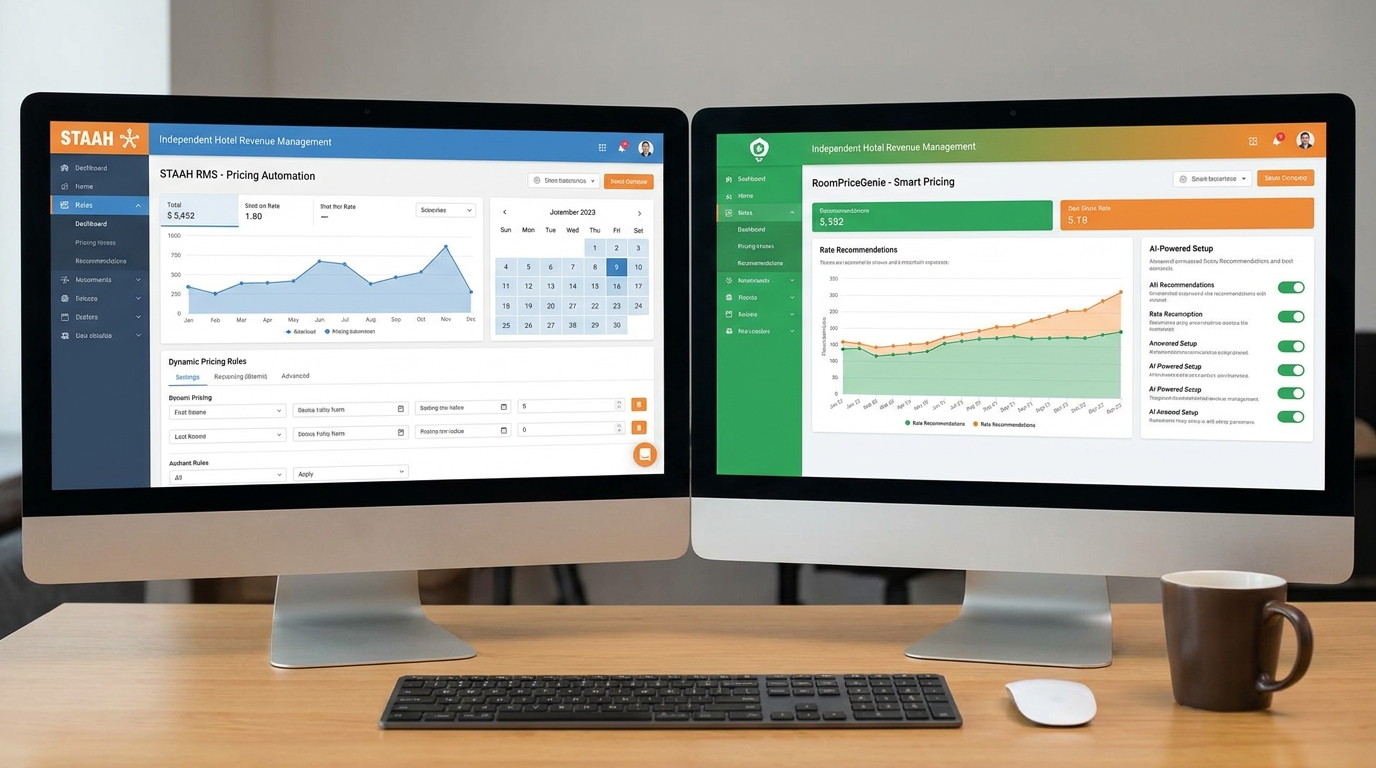
A revenue management system uses historical data, booking pace analysis, competitor pricing signals, and demand forecasting to recommend or automatically set room rates.
The case for RMS becomes stronger as hotel complexity increases. A 20-room boutique hotel managed by an owner with good market awareness and a clear pricing strategy may not need automated revenue management — the RevParGenius market intelligence framework can provide sufficient demand context for manual decision-making. A 150-room property managing multiple segments, corporate accounts, group business, and leisure distribution simultaneously needs the data processing capacity that only an automated system can provide.
The most important caveat about RMS is data quality dependency. A revenue management system that is fed poor data — inconsistent historical rates, incomplete booking records, or inaccurate competitor data — will produce poor recommendations. The system amplifies the quality of the data it receives. Implementing an RMS on top of a PMS with data integrity issues creates false confidence, not better pricing.
For independent hotels researching RMS options the RevParGenius comparison of the leading platforms — including IDeaS, Duetto, Atomize, and others — is available in the RevParGenius technology series.
Business Intelligence and Reporting
As hotel tech stacks grow, the question becomes how to see the whole picture without running twelve separate reports from twelve separate systems.
Business intelligence platforms aggregate data from PMS, POS, accounting, distribution, and marketing into unified dashboards that give owners and revenue managers a single view of property performance. In 2026 the most advanced BI tools are beginning to incorporate AI-driven pattern recognition that surfaces insights humans would not identify through manual analysis — demand anomalies, revenue leakage, pricing opportunities — automatically.
For smaller properties the reporting built into a well-integrated PMS may be sufficient. For larger properties or groups managing multiple hotels the BI layer is increasingly non-negotiable for maintaining genuine performance visibility.
Sales and Events Management
Hotels with meeting rooms, event spaces, or significant corporate group business operate in a fundamentally different rhythm from pure leisure properties. Group blocks, function space contracts, banquet event orders, and the complex billing that accompanies corporate events cannot be managed efficiently through the standard PMS reservation workflow.
Sales and catering platforms manage this complexity — coordinating space availability, contract generation, catering management, and group billing in a system designed specifically for the B2B and events revenue stream. For properties deriving meaningful revenue from this segment these platforms are not optional. Without them, the operational overhead of managing events manually through email chains and spreadsheets is both a guest experience risk and a revenue leakage point.
Workforce Management
Labour is consistently one of the two largest cost lines in any hotel's P&L. Workforce management platforms help forecast staffing needs based on occupancy and operational requirements, generate optimised schedules that reduce both understaffing and over-rostering, and track actual hours against forecast to identify and address cost overruns in real time.
For smaller properties where the owner or a small management team has direct operational visibility, workforce management software may be overhead without sufficient return. For larger properties with departmental teams, complex scheduling requirements, and labour costs that represent 30 percent or more of total revenue, the cost control case is compelling.
The Decision Framework: Which Stack Is Right for Your Hotel
Rather than prescribing a specific stack, RevParGenius recommends evaluating technology decisions against three questions every time a new system is being considered.
What specific problem does this solve? If the answer is not clear and concrete — not "it will help us be more efficient" but "it will eliminate the two hours per day we spend manually updating OTA extranets" — the system does not have a justified place in the budget yet.
How does it integrate with what we already have? A new system that requires manual data transfer to connect with your PMS, accounting software, or channel manager creates as much manual work as it eliminates. Integration quality is more important than feature quality in most purchasing decisions.
Can we implement and use it properly given our team's capacity? The most common technology failure mode RevParGenius observes is not poor software — it is good software implemented without adequate training, configuration, or operational change management. A system that is 30 percent implemented and 70 percent ignored is worse than no system at all because it costs money, creates false confidence, and produces unreliable data.
The Stack at a Glance
Essential for every hotel regardless of size: Property management system, channel manager, direct booking engine, payment gateway, accounting software.
Recommended for most hotels above boutique scale: Point of sale system if F&B outlets exist, guest messaging and communication, reputation management, housekeeping and maintenance tracking.
Appropriate for larger hotels and specific operational needs: Revenue management system, business intelligence and reporting, sales and events management, workforce management, energy and IoT management for large resorts.
The Bottom Line
There is no prize for having the most technology. There is no competitive advantage in a stack that impresses vendors but baffles your team.
The hotels that extract the most value from technology in 2026 are not the ones with the longest vendor lists. They are the ones that have identified specifically what each system needs to do, implemented it cleanly, integrated it properly, and trained their team to actually use it.
Start with the core. Add complexity only when a specific operational or revenue problem justifies it. And evaluate every system you currently pay for against the same test you should apply to any new one — is it reducing manual work, reducing errors, or improving your visibility into the business?
If the honest answer is no, it is probably time to have a conversation with that vendor about whether it deserves a renewal.
RevParGenius Market Intelligence | Hotel Technology Series | 2026 Independent analysis. No sponsorships. No affiliate rankings. Just signal.