AI Search Series · Part 4 · April 2026 · RevPARGenius Intelligence · Based on OpenAI GPT platform documentation
Hotels can build a custom ChatGPT that sends guests clickable direct booking links — prefilled with dates, room type, promo codes, and UTM tracking — without a single line of backend code. It is technically feasible right now, it costs $20 per month for ChatGPT Plus, and it directly attacks the 15–25% OTA commission margin that erodes independent hotel profitability.
This guide covers exactly how it works, the three implementation approaches available to hotels, the step-by-step setup checklist from OpenAI's platform documentation, and the security and UX constraints every hotelier needs to understand before building.
What the Platform Actually Supports
Can Hotels Actually Send Booking Links Through ChatGPT?
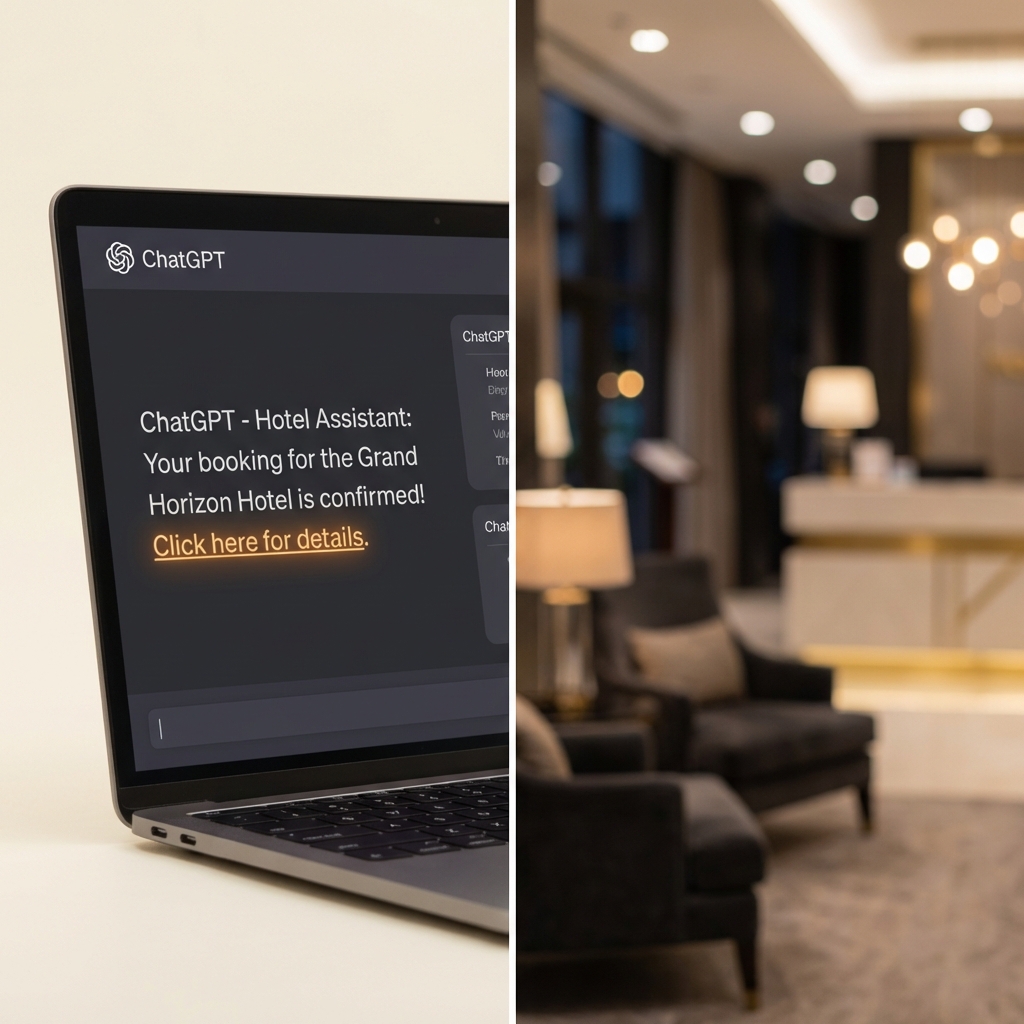
Yes — hotels can use custom ChatGPT GPTs to send direct, clickable booking links to guests inside a ChatGPT conversation. Links must be formatted in Markdown to render as clickable hyperlinks. OpenAI's own support documentation explicitly recommends instructing GPTs to format all links as [text](url) to ensure they are clickable in chat.
What it is not: a full embedded booking widget inside ChatGPT. The link takes guests to the hotel's own booking engine — the same engine they would use if they booked direct on the website. ChatGPT is the top-of-funnel conversational layer that qualifies the guest and generates the deeplink. The checkout happens on the hotel's domain.
What Is Confirmed Possible
- Clickable booking links with pre-filled dates, occupancy, and promo codes
- UTM tracking parameters so analytics attributes the booking to the GPT channel
- Real-time availability via GPT Actions calling your booking engine API
- Dynamic checkout session links generated per conversation
- Upsell guidance directing guests to breakfast, parking, and room upgrade packages
The Three Implementation Approaches
OpenAI's platform supports three distinct approaches to hotel booking via GPTs. Choose based on your technical resources and the depth of integration you need.
Static Booking Links
Complexity: Low · No API required
The GPT outputs a fixed booking URL — optionally with deeplink parameters for dates, guests, and promo codes — but makes no live API calls. It asks the guest for their dates then constructs the link from a URL template in its instructions.
Pros
Fastest to launch. No engineering work. Robust even if booking engine API is unavailable. Low security risk.
Cons
Cannot confirm live availability. Risk of GPT describing inventory rather than linking if instructions are vague.
Dynamic API-Driven Booking via GPT Actions
Complexity: High · Requires backend middleware
The GPT uses Actions to call your hotel's middleware, which connects to your booking engine or PMS. The middleware returns real-time availability, generates a secure checkout session link, and the GPT presents that link to the guest. OpenAI explicitly recommends building a middleware layer rather than exposing your booking engine API directly.
Pros
Real-time availability. Tailored offers. Secure session links. Can support confirmation flows.
Cons
Significant engineering effort. Action timeouts (45s max). TLS required. Rate limiting, monitoring, and privacy disclosures needed.
Redirect to Hotel Booking Widget
Complexity: Medium · Best of both worlds
The GPT links to a page on the hotel's own website that embeds a booking widget. The hotel's web analytics, payment security, and brand consistency are all maintained. Checkout stays inside the booking engine while ChatGPT handles the top-of-funnel conversation.
Pros
Keeps guests on hotel domain. Full web analytics. Brand consistency. Booking engine handles checkout securely.
Cons
Still a click-out. Less conversational automation than API-driven. Widget reliability depends on hotel website performance.
Step-by-Step Setup Checklist
Based on OpenAI's GPT platform documentation. Steps below are vendor-neutral — fill in your specific booking engine URLs and parameters.
Foundation and Governance
- Decide distribution model: internal-only, shared link, or public GPT Store
- Assign ownership: revenue/marketing owner + tech/security owner + front desk/reservations
- Prepare a privacy policy URL if you plan to include Actions and publish publicly
GPT Build and Content Design
- Create the GPT in the ChatGPT web editor (building and editing is web-only — not mobile)
- Add this instruction to force clickable links: "When you include any URL, ALWAYS format it as a Markdown link: [link text](url). Never output raw URLs unless the user explicitly asks."
- Add conversation starters focused on booking intent: "Check availability," "Book a stay," "Ask about parking/breakfast"
- Add policy-safe guidance: never request CVV or card data in chat
Booking Link Configuration
- Get your booking engine's base URL and supported deeplink parameters (dates, guests, promo code)
- Standardise date format as ISO
YYYY-MM-DD— this is consistent across Cloudbeds, Mews, and most major engines - Add UTM parameters for campaign attribution:
utm_source=chatgpt&utm_medium=gpt&utm_campaign=direct_booking - Create a fallback: if user won't share dates, provide the base booking page URL
Testing and Monitoring
- Test link clickability and date parameter correctness across device types
- Verify UTM parameters are passing through to your booking engine analytics
- Set up link health checks and alerts for booking engine downtime
- Add an analytics dashboard to track GPT-attributed sessions and conversion rate
Ready-to-Use GPT Response Templates
Copy these directly into your GPT instructions. Replace the example URLs with your property's booking engine base URL.
Template 1 — Static Deeplink with Tracking
Great — what dates and how many guests?

If you already know your dates, book direct here:
[Book direct — prefilled dates](https://booking.example.com/reserve?
checkin=2026-06-10&checkout=2026-06-13&guests=2
&utm_source=chatgpt&utm_medium=gpt&utm_campaign=direct_booking)

If you're still flexible, use our standard booking page:
[Book direct — choose your dates](https://booking.example.com/reserve?
utm_source=chatgpt&utm_medium=gpt&utm_campaign=direct_booking)
Template 2 — Fallback When Availability Cannot Be Confirmed
I can't reliably confirm live availability in this chat right now.
To see real-time rooms and exact pricing, please use our
official booking page:

[Check real-time availability and book direct]
(https://booking.example.com/reserve?
utm_source=chatgpt&utm_medium=gpt&utm_campaign=fallback_availability)

Share your dates and budget and I can still recommend
the best room types and packages to check.
Security and Privacy: What You Must Get Right
OpenAI's platform documentation flags several security and trust considerations specific to hotel booking flows. These are not optional — get them wrong and you introduce friction, data risk, or compliance exposure.
Minimise URL Parameters
Put only what is needed in URLs — dates, occupancy, promo code, UTM tags. Never embed guest names, email addresses, or personally identifying information directly in query strings. Use short-lived server-generated tokens if guest details must be prefilled.
Never Collect Card Data in Chat
Payment must happen on a hosted checkout page — your booking engine or payment provider. Redirect the guest to a secure payment page rather than attempting to collect card data inside the ChatGPT conversation.
Use HTTPS and Stable Domains
OpenAI notes that generated links can transmit location data to the destination service. Keep booking on a consistent, official hotel domain. Ensure all booking pages are HTTPS. Unstable or unfamiliar domains trigger link approval prompts that add friction.
Disclose Data Sharing if Using Actions
When GPT Actions call external APIs, relevant parts of the guest's input may be sent to that third-party service. Your GPT must clearly inform guests when it is about to call an external service and link to a privacy policy for any publicly published GPT with Actions.
How to Measure Whether It's Working
UTM parameters connect GPT conversations to booking engine outcomes. With proper tagging, your analytics platform can attribute sessions and conversions directly to the GPT channel.
KPI Dashboard for Hotel GPT Performance
Booking Link Click-Through Rate (CTR)
Clicks on "Book direct" links ÷ GPT sessions that reached a booking CTA
Booking Engine Conversion Rate from GPT Traffic
Bookings ÷ sessions where utm_source=chatgpt is present in your analytics
Gross Booking Value and Net Contribution Margin
Net revenue from GPT-attributed direct bookings vs OTA bookings. The difference is commission avoided — typically 15–25% per booking.
Drop-off by Funnel Step
Landing → date selection → room selection → guest details → payment → confirmation. Identify where guests exit and optimise the GPT conversation to reduce pre-click friction.
Upsell Attach Rate
Ancillary revenue per booking (breakfast, parking, upgrades) measured in booking engine reporting where GPT traffic is attributable.
RevPARGenius Take
Start with Approach 1 — static deeplinks. You can have a functional hotel GPT sending tracked direct booking links live in under a day, with zero engineering work and $20/month. The business case is immediate: every booking it captures instead of Booking.com saves you 15–25% commission on that reservation.
Move to Approach 2 (API-driven Actions) only when you have a developer resource and enough GPT traffic to justify the middleware build. Approach 3 (redirect to widget) is the safest middle ground for properties that already have a strong direct booking page and want to keep web analytics clean.
Free Hotel Market Intelligence
Know What Your Market Is Doing Before You Build
A hotel GPT drives direct bookings most effectively when your rates are already competitive with your live comp set. We run free OTA and STR demand analyses across APAC markets.
Request Your Free Demand AnalysisNo commitment. Just live data at revpargenius.com
Sources: OpenAI GPT platform documentation and support guidance (2026), OpenAI GPT Actions production documentation, OpenAI privacy FAQ for GPT builders. RevPARGenius is an independent hotel market intelligence platform and is not affiliated with OpenAI, ChatGPT, or any named booking engine provider.