Reviewed by Michael Andrews, Hotel Market Intelligence Researcher · May 2026 · 8 min read
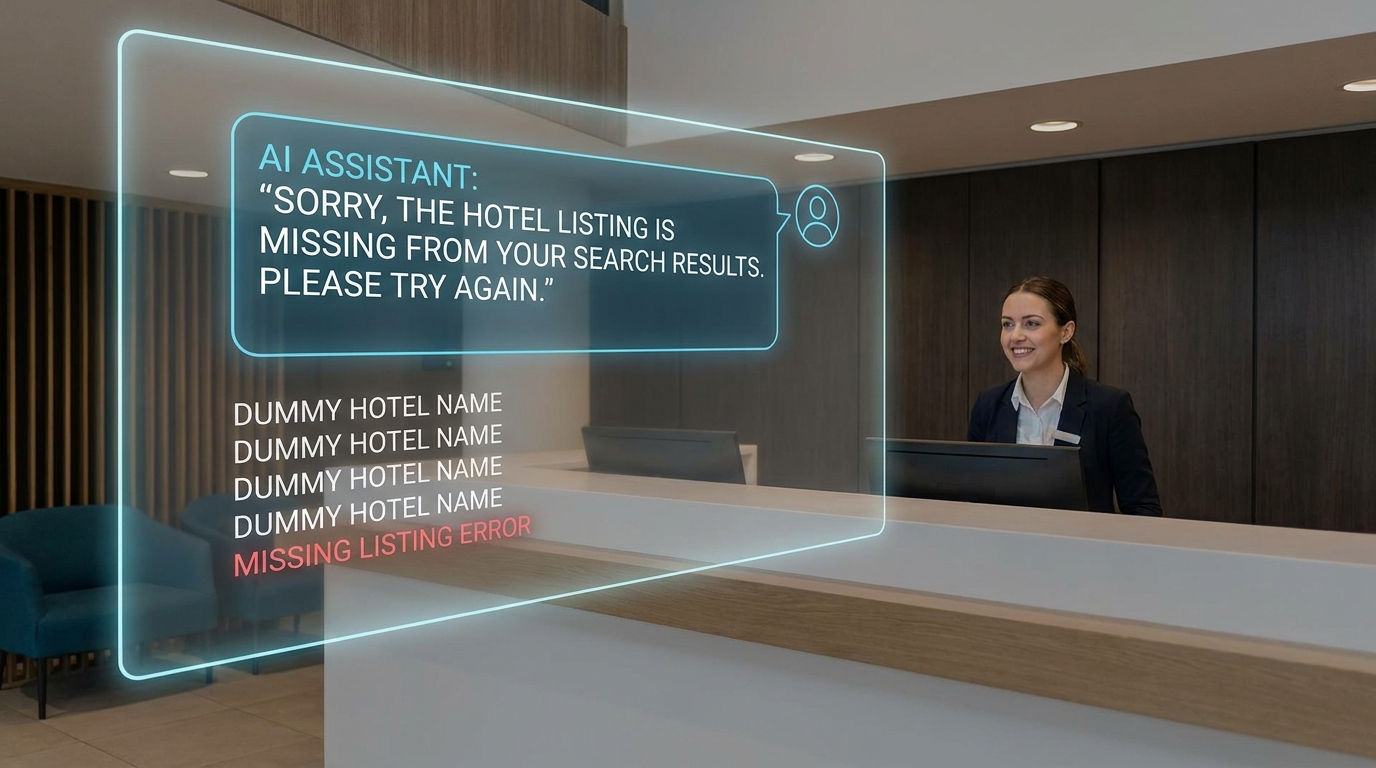
A hotel can be fully booked on a Saturday night, have 400 reviews on TripAdvisor, and still be completely invisible when a traveller asks ChatGPT "What's the best boutique hotel in [city]?" It happens more than most operators realise. Since ChatGPT integrated directly with Booking.com and Expedia in October 2025 (OpenAI, 2025), the stakes of AI invisibility shifted from theoretical to financial. Rooms that AI engines don't mention don't get booked — and the problem almost never fixes itself.
The reason your hotel is not showing in ChatGPT is almost always one of seven structural gaps: missing Hotel schema markup, website copy that doesn't match how travellers phrase questions, a stale or incomplete Google Business Profile, thin review volume, no on-page FAQ, no destination-level content, or competitor properties that have already done the work. According to Skift Research (2024), 56% of US travellers now use AI tools to plan trips — every gap in your AI presence is a direct leak in your demand pipeline.
Why are hotels suddenly invisible in ChatGPT and Perplexity answers?
The short answer is that AI engines are not search engines with a hotel directory. They are language models trained to synthesise information from sources they can parse, trust, and verify. When a traveller asks ChatGPT for a hotel recommendation, the model draws on its training data, live web retrieval (where enabled), and structured data feeds from integrated partners. If your hotel is structurally invisible to any of those three pipelines, you don't appear — regardless of how good the property actually is.
The acceleration is real. For most of 2023 and 2024, AI hotel recommendations were a curio — entertaining but inconsequential to actual bookings. That changed the moment ChatGPT activated its Booking.com and Expedia plugins in October 2025. Now, a conversational query like "find me a four-star hotel near the waterfront in Auckland under $250" can resolve directly into a booking link inside the chat window. Hotels that AI systems recognise get sent to the top of that flow. Hotels that don't are simply not presented as options, no matter how competitive their rate.
Perplexity operates differently — it retrieves live web sources and cites them — but the outcome is the same. If your website content doesn't answer the questions Perplexity is retrieving answers to, it won't cite you. The research on this is now clear. The Princeton/IIT Delhi GEO study (Aggarwal et al., KDD 2024) found that pages anchored to dated statistics achieve a +31% citation rate lift in generative AI responses, and pages featuring named expert quotes achieve +41%. Content structure, in other words, is destiny. To understand the full scope of what AI engines are actually reading when they assess your property, see our complete breakdown of how hotel AI visibility works.
What are the most common reasons a hotel disappears from AI recommendations?
After auditing dozens of hotel websites, the same seven structural gaps appear over and over. Not all of them are present in every property, but most hotels have at least four. Here is what they are.
- 1 No Hotel schema markup — AI engines can't confirm your property category, location, price range, or amenities from structured data.
- 2 Non-conversational website copy — marketing language that doesn't mirror how travellers actually phrase questions.
- 3 Stale or incomplete Google Business Profile — outdated hours, missing attributes, unanswered Q&As, no recent photos.
- 4 Thin review volume — fewer than 50 substantive reviews across major platforms signals low authority to retrieval models.
- 5 No on-page FAQ — no structured Q&A content means no extractable snippet for AEO surfaces.
- 6 No destination-level content — no blog posts, local guides, or area pages means the property isn't associated with real traveller queries.
- 7 Competitors already stronger — nearby properties have done the work, and AI engines default to the option they can verify most completely.
The first gap — schema markup — is often the most jarring to discover. Hotels spend thousands on website design and nothing on the machine-readable layer underneath. Without Hotel schema, an AI engine retrieving your site sees a page of text with no confirmed @type, no priceRange, no amenities array, no geo coordinates. It cannot confirm with confidence that you are even a hotel, let alone what kind. For a visual walkthrough of what a verified AI audit actually surfaces on a real property, the real hotel AI visibility report explained breaks this down gap by gap.
How do AI engines decide which hotels to mention — and which to skip?
AI engines don't run a hotel directory lookup. They make a probabilistic judgment about which properties they can describe accurately enough to recommend with confidence. That judgment is based on three things: how clearly the property is identified in structured data, how thoroughly it appears across authoritative sources, and how well its content matches the conversational form of the query.
Structured data is the foundation. When a hotel has valid Hotel schema — or at minimum LodgingBusiness schema — the AI engine can confirm its entity type, location, star rating, and core amenities from a machine-readable source rather than inferring them from unstructured copy. Here is what the key fields of that schema look like in practice:
{
  "@context": "https://schema.org",
  "@type": "Hotel",
  "name": "The Harrington Auckland",
  "description": "Boutique waterfront hotel in Auckland CBD with harbour views.",
  "url": "https://theharrington.co.nz",
  "telephone": "+64-9-000-0000",
  "priceRange": "$$",
  "starRating": { "@type": "Rating", "ratingValue": "4" },
  "address": {
    "@type": "PostalAddress",
    "streetAddress": "12 Quay Street",
    "addressLocality": "Auckland",
    "addressCountry": "NZ"
  },
  "geo": {
    "@type": "GeoCoordinates",
    "latitude": -36.8440,
    "longitude": 174.7633
  },
  "amenityFeature": [
    { "@type": "LocationFeatureSpecification", "name": "Free Wi-Fi", "value": true },
    { "@type": "LocationFeatureSpecification", "name": "Fitness Centre", "value": true }
  ],
  "checkinTime": "15:00",
  "checkoutTime": "11:00"
}
If that block is absent from your site, an AI engine must piece together your property details from unstructured text — and it will default to a property whose details it can confirm. Our guide to schema markup for hotels covers every field worth implementing, with implementation notes for the most common CMS platforms.
Content match is the second filter. If a traveller asks "is there a family-friendly hotel near [airport] with a pool and a kids' club?", a hotel whose website copy uses phrases like "an exceptional experience for all guests" will not score as well as a competitor whose page reads "we're two kilometres from [airport] — families love our outdoor pool and supervised kids' club." The language on your site needs to mirror the language in the query. This is not keyword stuffing — it is honest, specific, conversational description of what you offer.
Cross-source corroboration is the third filter. AI engines weight properties more heavily when they appear consistently and accurately across multiple authoritative sources: the hotel's own website, Google Business Profile, major OTAs, travel publications, and review platforms. A property that appears on its own site but nowhere credible gets treated as low-confidence. The Google Business Profile gap matters here more than most operators expect — GBP is a primary retrieval source for location-grounded queries, and a profile that hasn't been updated since 2022 signals a property that may no longer be operating as described.
How quickly can a hotel fix its AI visibility gaps?
This depends on which gaps you're addressing and how fast your technical team can move. The schema fix is the fastest — a properly structured Hotel schema block can be live on your site within hours, and Google's indexer typically picks it up within 3–5 days. The GBP refresh is equally fast on the input side: update your attributes, answer outstanding Q&As, add recent photos, and those changes are live within 24–48 hours. AI engines that retrieve from live web sources — Perplexity being the clearest example — can pick up those changes within days.
Content rewrites take longer. Revising your website copy to be more conversational, adding an FAQ section with FAQPage schema, and building out destination-level blog content is a 4–8 week project for most hotels, assuming a working relationship with a content team. The good news is that the content work compounds — each piece of destination content widens the surface area AI engines can draw on when they're answering travel planning queries that relate to your city or neighbourhood.
The review gap is the slowest to close. Review volume is a function of guest volume and post-stay prompting discipline. If you have 200 rooms and an average occupancy of 75%, you are generating 55,000 guest stays per year — and most hotels with thin review counts simply haven't built a systematic process for prompting happy guests to leave detailed reviews. That's a revenue management and operations problem as much as a marketing one, and it typically takes 2–4 months to see meaningful movement in review volume across platforms.
For a side-by-side comparison of the tools available to diagnose and monitor these gaps as you work through them, our hotel AI visibility tools compared covers the current landscape across automated audit platforms.
What should you do first if your hotel doesn't appear in AI answers?
The first step is diagnosis, not action. Before rewriting content or implementing schema, you need to know which specific gaps you have and how your property compares to the competitors who are being mentioned in your place. Running an AI visibility audit gives you a gap-by-gap breakdown — schema status, GBP health, review metrics, content analysis, FAQ presence, destination content depth — so you can sequence fixes by impact rather than guesswork.
Once you have that audit, the sequencing is straightforward. Fix schema first — it is the fastest, most durable structural signal. Update GBP immediately after, because it feeds the location-grounded queries that represent the majority of AI hotel searches. Then move to FAQ content: a visible FAQ on your key pages, backed by FAQPage JSON-LD schema, directly addresses the AEO extraction layer that produces Quick Answer–style responses. The content and review gaps are addressed in parallel over the following weeks.
The one thing that rarely works is starting with a content rewrite without knowing whether your schema and GBP are the actual bottleneck. Hotels spend money on new website copy only to discover that the issue was a 404'd GBP listing or a missing @type in their JSON-LD. Audit first. The data tells you where to spend the effort.
RevPARGenius AI Visibility
Find out exactly why your hotel isn't appearing in AI recommendations
The free audit scans your schema, GBP, review profile, and content against AI engine requirements — and shows you what to fix first.
Run My Free AI Visibility Audit →Frequently Asked Questions
Why is my hotel not showing up in ChatGPT?
The most common reason your hotel is not showing in ChatGPT is a combination of missing Hotel schema markup and content that doesn't match how travellers phrase questions. ChatGPT draws on structured data and web retrieval to form recommendations — if your property isn't clearly identified in machine-readable format and your content doesn't answer conversational queries, the model defaults to properties it can describe with confidence. Run an AI visibility audit to confirm which specific gaps apply to your property.
How long does it take for a hotel to appear in AI answers after fixing the gaps?
Schema fixes and GBP updates are picked up within 3–7 days by systems that retrieve live data, including Perplexity. ChatGPT's training-data-based answers update more slowly — on the order of weeks to months — but its live retrieval layer (when active) responds faster. Content and review improvements compound over 4–8 weeks. The fastest wins come from schema and GBP because they are structural signals that take hours to implement.
Does having a Google Business Profile help with AI visibility?
Yes — significantly. Google Business Profile is a primary retrieval source for location-grounded queries ("hotels near [landmark]", "hotels in [neighbourhood]"). A complete, recently updated GBP with accurate attributes, current photos, and active Q&A responses increases the confidence score AI engines assign to your property. A stale or incomplete GBP — particularly one with unanswered reviews or missing amenity data — actively reduces your chances of appearing in AI-generated location recommendations.
Can small independent hotels appear in AI recommendations against larger chains?
Yes, and this is one of the underappreciated advantages of GEO. AI engines don't inherently favour chain properties — they favour the properties they can describe most accurately and completely. An independent boutique hotel with valid Hotel schema, a fully updated GBP, a healthy review profile, and conversational website copy will outperform a chain property that has ignored its structured data. The playing field is more level than it is in traditional OTA ranking, where marketing spend dominates.
What is the single most important fix for hotel AI invisibility?
Implementing valid Hotel (or LodgingBusiness) schema markup on your website. It is the fastest fix, has the longest-lasting structural impact, and it removes the most fundamental barrier — an AI engine's inability to confirm what your property is. All other improvements (content, GBP, reviews, FAQ) compound on top of a solid schema foundation. Without it, the other fixes produce partial results at best.
Sources: Skift Research, 2024 AI Travel Planning Adoption Survey (56% of US travellers use AI to plan trips); Aggarwal et al., Generative Engine Optimization, Princeton / IIT Delhi, KDD 2024 (+31% citation lift for dated statistics; +41% lift for named expert quotes); OpenAI, ChatGPT plugin integrations with Booking.com and Expedia, October 2025. Last reviewed May 2026.