Reviewed by Michael Andrews, Hotel Market Intelligence Researcher · 31 May 2026 · 9 min read · RevPARGenius · STAAH RMS vs RoomPriceGenie for independent and boutique hotels
STAAH RMS and RoomPriceGenie are not direct head-to-head competitors — RoomPriceGenie actually integrates natively with STAAH's channel manager. The decision comes down to your existing stack: hotels already operating inside the STAAH distribution ecosystem get the tightest integration from STAAH RMS, while hotels on any other channel manager or PMS will find RoomPriceGenie the faster, simpler path to automated pricing. RoomPriceGenie claims up to 19% revenue uplift and starts at €198/month; STAAH RMS is priced as part of the STAAH suite and targets hotels that want a single-vendor distribution-plus-pricing stack.
Both STAAH RMS and RoomPriceGenie set out to solve the same fundamental problem: hotel pricing that reacts to demand faster than a human checking rates twice a day can manage. They reach that goal from different starting points — one as part of a distribution ecosystem, one as a standalone RMS built from the ground up for simplicity. The right choice depends almost entirely on where your property is already anchored in its technology stack.
This comparison covers what each system actually does, where each one performs best, and the specific hotel profile for which each is the stronger choice. It draws on publicly documented feature sets, verified pricing data, and RevPARGenius market intelligence across APAC and global independent hotel markets. For a deeper look at how hotel market intelligence connects to pricing decisions, the full methodology is documented across the RevPARGenius Insights library.
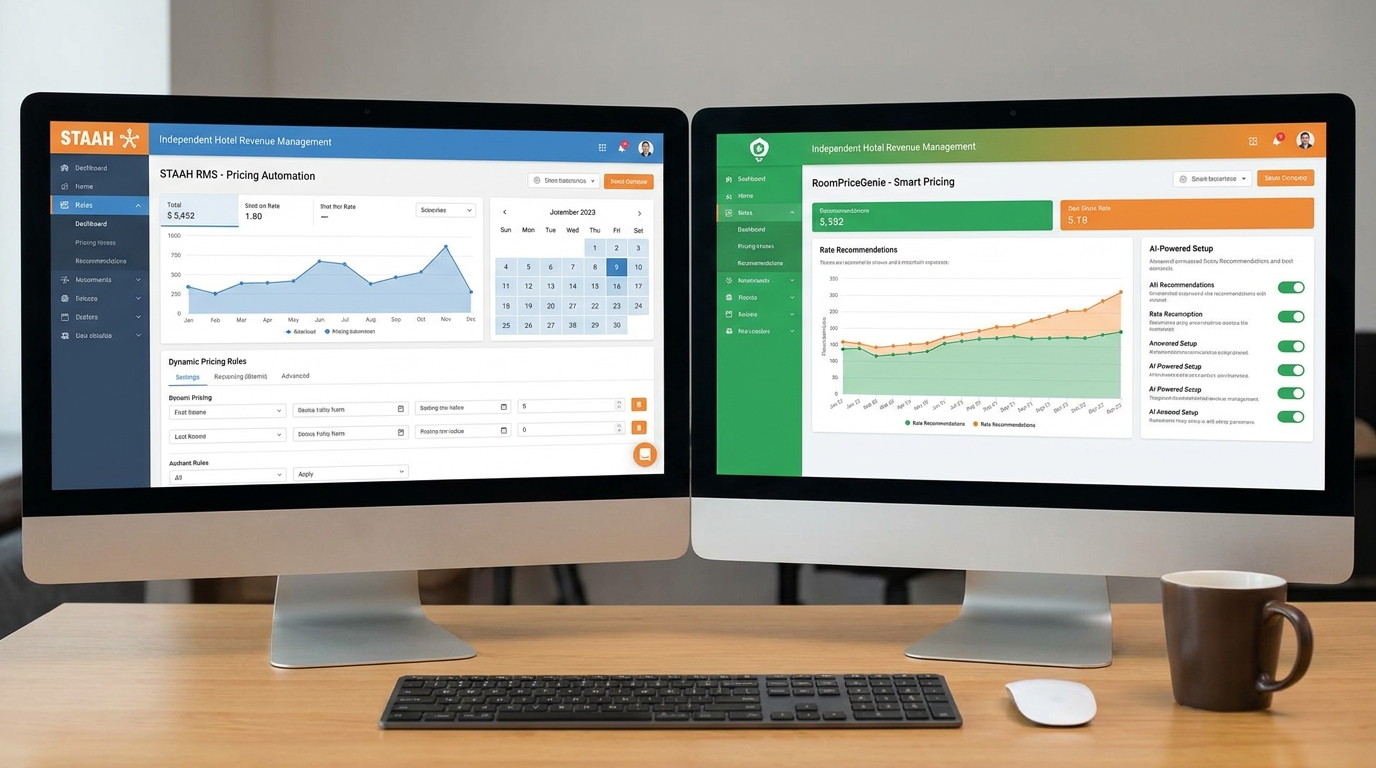
STAAH RMS vs RoomPriceGenie — at a glance
What is STAAH RMS and who is it built for?
STAAH RMS is a cloud-based revenue management system built as part of the STAAH distribution ecosystem — a suite that includes channel management, booking engines, and connectivity to 200+ OTAs. The RMS layer adds AI-enabled demand forecasting, automated pricing recommendations, and a Strategy Builder that lets revenue teams define rules and thresholds to guide AI decisions without switching automation off entirely.
STAAH RMS is most naturally suited to hotels that are already operating within the STAAH ecosystem. The tight integration between STAAH's distribution data and the RMS layer means pricing decisions draw on live channel performance data without an additional integration step. Hotels managing complex distribution across dozens of channels, with existing investment in STAAH's channel manager or booking engine, get the most from this architecture.
The pain points STAAH RMS is designed to solve are documented clearly in the system's own positioning — and they represent the standard challenges every independent hotel faces with manual revenue management.
| Hotelier Pain Point | How STAAH RMS Addresses It |
|---|---|
| Rates updated manually using spreadsheets | Automates pricing recommendations using live demand and performance data |
| Slow reaction to market and demand changes | Continuously monitors booking pace and market signals in real time |
| Guesswork-driven pricing decisions | Provides data-backed insights based on historical trends and forecasts |
| Difficulty tracking competitor rates | Includes built-in rate shopping for market visibility |
| Static rates that do not adapt to demand | Supports dynamic pricing that adjusts automatically |
| Limited visibility into future demand | Forecasting highlights upcoming high and low demand periods |
| Time-consuming daily rate management | Reduces manual work so teams focus on strategy |
| Risk of underpricing or missed revenue | Optimises ADR and RevPAR through smarter rate positioning |
| RMS feels complex or hard to adopt | Designed to complement existing STAAH workflows |
What is RoomPriceGenie and who is it built for?
RoomPriceGenie is a standalone revenue management system built specifically for independent hotels, boutique properties, and small groups that want automated pricing without the configuration burden of enterprise RMS tools. Its headline positioning is simplicity: a system designed to be set up in hours, not weeks, and to run without a dedicated revenue manager watching it daily.
The RoomPriceGenie pricing engine reads historical data, booking pace, local demand signals, and competitor rates, then pushes updated pricing recommendations to a property's PMS or channel manager up to seven times per day. One of its most-cited differentiators is transparency: unlike some RMS tools that produce recommendations from an unexplained black-box model, RoomPriceGenie shows the specific signals driving each price suggestion — occupancy level, pickup pace, competitive positioning, and demand index — so a revenue manager can understand and trust what the system is doing.
RoomPriceGenie integrates natively with STAAH's channel manager, meaning properties using STAAH for distribution can layer RoomPriceGenie's pricing intelligence on top without switching channel management systems. The two products are complementary by design. Hotels running STAAH's channel manager do not have to choose between them — they can run both. The comparison question becomes: if you need an RMS and you're already on STAAH, which pricing layer makes more sense?
Pricing is documented publicly: Core Plan starts at €198/month per property. Premium Plan at €297/month adds advanced revenue maximisation features. No enterprise platform fee, no hidden per-seat costs. For independent hotels evaluating total cost of ownership, this pricing transparency is itself a differentiator against enterprise-tier systems. For a broader market intelligence picture of what pricing decisions look like from the outside, the RevPARGenius AI visibility data shows how pricing signals feed into how AI engines assess and cite hotel properties.
How do STAAH RMS and RoomPriceGenie compare feature by feature?
The two systems share the same core mission — automating hotel pricing from reactive to data-led — but differ significantly in scope, integration model, and target buyer. The comparison below covers the dimensions that matter most for independent hotel decision-makers.
| Dimension | STAAH RMS | RoomPriceGenie |
|---|---|---|
| Product type | RMS module within STAAH ecosystem | Standalone pure-play RMS |
| Best fit | Hotels on STAAH distribution stack | Any hotel, any channel manager |
| Pricing transparency | AI recommendations; strategy rules | Full signal visibility per recommendation |
| Human control layer | Strategy Builder — rules & thresholds | Accept/override per recommendation |
| Rate push frequency | Real-time / continuous | Up to 7× per day |
| Competitor rate shopping | ✓ Built-in | ✓ Built-in |
| Demand forecasting | ✓ Historical + forward-looking | ✓ Booking pace + demand index |
| Pricing (entry) | Part of STAAH suite (contact sales) | €198/month (Core Plan, public) |
| Setup complexity | Medium — STAAH ecosystem knowledge helps | Low — designed for hours not weeks |
| Integrates with STAAH CM | ✓ Native (same vendor) | ✓ Native integration available |
Does STAAH RMS explain how it sets prices — or is it a black box?
Based on STAAH's own published documentation, the RMS monitors five core signals: booking pace (rate of reservations coming in), seasonality (recurring demand patterns), historical data (past segment performance), competitor pricing (via built-in rate shopping), and real-time demand signals from the market. Machine learning algorithms continuously adjust prices based on those inputs, with the Strategy Builder acting as a human layer that sets rules and thresholds to constrain what the ML can do.
What is not clearly documented is how these factors are weighted relative to each other, the exact forecast time horizon the model uses, how the Strategy Builder rules interact with ML outputs when they conflict, or how the system handles data-sparse scenarios — new hotels, highly seasonal properties, or markets with limited historical baseline. This is not unusual. Most RMS vendors — IDeaS, Duetto, Atomize — operate the same way. The algorithm is proprietary and the documentation describes inputs and outputs, not the model mechanics.
The practical implication: STAAH RMS requires a degree of trust in its AI layer. The Strategy Builder gives experienced revenue managers the ability to constrain outputs, but the logic connecting inputs to recommendations is not exposed to the user. For hotels with a dedicated revenue manager who is comfortable working within a rule-configured AI system, that is an acceptable operating model. For hotels without a revenue manager who need to understand why a rate was set, it introduces friction.
This is where RoomPriceGenie's architectural decision becomes commercially significant. Rather than generating a recommendation from an opaque model, RoomPriceGenie surfaces the specific signals that drove each price suggestion — occupancy level, pickup pace, competitive positioning, demand index — at the point of recommendation, before the hotelier accepts or overrides it. The algorithm is still proprietary, but the output is explained in the language of hotel operations rather than hidden behind a final number.
The most common reason independent hoteliers disengage from an RMS within the first 90 days is not price or features — it is distrust of unexplained recommendations. When a system tells a hotelier to drop rates on a Friday night in peak season without explaining why, the hotelier overrides it and stops using the automation. Transparency of pricing rationale is not a cosmetic feature. It is the variable that determines whether automation actually gets used.
Which hotels should choose STAAH RMS?
STAAH RMS is the natural choice for hotels that are already embedded in the STAAH distribution ecosystem and want a single-vendor stack managing both distribution and pricing. The tightest integration advantage comes from using STAAH's channel manager alongside STAAH RMS — distribution and pricing data live in the same system, rule changes propagate without a third-party sync layer, and support is handled by one vendor relationship rather than two.
STAAH RMS also suits properties where revenue management maturity is higher — where a revenue manager or revenue director wants to define custom pricing logic through the Strategy Builder rather than accepting fully automated recommendations. The ability to run fully automated or semi-automated, and to configure the rules that govern AI decisions, gives more sophisticated revenue teams the control layer they typically demand.
The profile: an established independent hotel or small group with 50+ rooms, already on STAAH's channel manager, with a revenue manager who wants to guide automation rather than simply trust it. Regional hotel groups managing multiple properties across APAC through STAAH's distribution network are a particularly strong fit, because the pricing and channel data consolidation benefit compounds across properties.
Which hotels should choose RoomPriceGenie?
RoomPriceGenie is the stronger choice for independent hotels and boutique properties that want automated revenue management without needing to be on a specific distribution platform first. Because it connects to most PMS and channel manager providers — including STAAH, SiteMinder, Cloudbeds, Mews, and dozens of others — it is not a locked-in choice. Hotels on any existing stack can add RoomPriceGenie without displacing anything already working.
The transparency of RoomPriceGenie's pricing rationale is a meaningful differentiator for hotel owners and GMs who are stepping into RMS automation for the first time and are not yet comfortable trusting a system that does not explain itself. Being shown exactly which signals are driving a pricing recommendation — and being able to accept or override each one — removes the black-box anxiety that causes many independent hoteliers to disengage from their RMS within weeks of onboarding.
RoomPriceGenie — verified hotelier review data (Hotel Tech Report, 2026)
Top hotel types by review volume
- Boutique Hotels — 304 reviews
- Bed & Breakfast / Inns — 257 reviews
- City Centre Hotels — 194 reviews
- Small (10–49 rooms) — 430 reviews (dominant segment)
Category rankings (2026)
- #1 of 30 — Best RMS for Small Hotels
- #1 of 29 — Best RMS for Limited Service Hotels
- #1 of 19 — Best RMS for Extended Stay
- HT Score: 100/100
Source: Hotel Tech Report verified review data, Q1 2026. Reviews submitted by verified hoteliers only.
The profile: an independent hotel or boutique property of any size, on any channel manager, managed by an owner or small team without a dedicated revenue function, looking for an RMS that produces demonstrable uplift quickly and does not require weeks of configuration to function. The public pricing starting at €198/month also removes the barrier of an enterprise sales process for properties evaluating total cost of ownership before committing. For understanding how pricing decisions connect to market demand signals in your specific market, RevPARGenius market intelligence tools cover the demand context that feeds both systems.
STAAH RMS and RoomPriceGenie are not mutually exclusive. Hotels on STAAH's channel manager can — and do — run RoomPriceGenie as their pricing layer on top of STAAH's distribution infrastructure. The comparison is not "STAAH or RoomPriceGenie" — it is "STAAH RMS or RoomPriceGenie as your pricing engine, given your existing stack."
RevPARGenius Take
If you are already inside the STAAH ecosystem and your revenue manager wants to configure pricing logic rather than accept it on autopilot, STAAH RMS is the coherent choice. If you are on any other stack, or if simplicity and setup speed are the priority, RoomPriceGenie wins on both counts.
The more important context: both systems address the same structural problem — hotels pricing reactively and missing revenue because they cannot keep up with demand signals manually. The choice of tool matters less than the decision to move from manual to data-led pricing at all. Either system will outperform a spreadsheet and a twice-daily rate check. The differentiation between them is about fit, not quality.
Frequently asked questions about STAAH RMS and RoomPriceGenie
Are STAAH RMS and RoomPriceGenie direct competitors?
They are partially complementary and partially competing, depending on your stack. RoomPriceGenie integrates natively with STAAH's channel manager, meaning a hotel using STAAH for distribution can choose either STAAH RMS or RoomPriceGenie as its pricing engine without changing its distribution infrastructure. The competition is for the pricing layer specifically, not the full distribution stack.
What is STAAH RMS best at?
STAAH RMS is best for hotels already operating within the STAAH distribution ecosystem who want a single-vendor stack managing both distribution and pricing. The Strategy Builder is a meaningful advantage for revenue managers who want to configure rules and thresholds that guide AI decisions, rather than running fully automated pricing without the ability to influence its logic. The tight channel data integration is also a structural advantage not available to standalone RMS tools.
What is RoomPriceGenie best at?
RoomPriceGenie is best for independent hotels and boutique properties that want automated pricing without being locked into a specific distribution platform. Its transparency — showing exactly which signals drive each recommendation — makes it the preferred choice for owner-operators and small teams new to RMS automation who need to understand and trust the system before fully delegating pricing decisions to it. Publicly documented pricing from €198/month also removes the enterprise sales barrier.
Can a hotel use both STAAH and RoomPriceGenie together?
Yes. A hotel using STAAH's channel manager for distribution can run RoomPriceGenie as its pricing intelligence layer without replacing STAAH. RoomPriceGenie integrates natively with STAAH's channel manager, pushing pricing recommendations to STAAH which then distributes them across connected OTAs and booking channels. This combination gives hotels STAAH's distribution breadth with RoomPriceGenie's pricing transparency and simplicity.
What should an independent hotel evaluate before choosing between them?
The primary evaluation question is: what channel manager are you already on? If you are on STAAH's channel manager, compare the integration depth and pricing logic control of STAAH RMS against RoomPriceGenie's transparency and setup speed. If you are on any other channel manager, RoomPriceGenie is the more straightforward path — it connects to most PMS and channel manager providers without requiring a switch. Secondary questions: how much configuration do you want to do yourself, and is public pricing transparency important to your evaluation process?
Market intelligence for independent hotels
See what AI engines say about your hotel — and what the market is doing around you.
RevPARGenius provides the market intelligence layer that sits above your RMS — live OTA demand data, competitor rate signals, and AI visibility scoring across ChatGPT, Perplexity and Google AI.
Run My Free AI Visibility CheckRequest Market Demand Analysis
No credit card · First check free · app.revpargenius.com
Feature comparisons based on publicly documented product information from STAAH (staah.com) and RoomPriceGenie (roompricegenie.com) as of May 2026. RoomPriceGenie pricing: Core €198/month, Premium €297/month (documented May 2026). Revenue uplift claim of up to 19% is RoomPriceGenie's own marketing claim — RevPARGenius has not independently verified this figure. STAAH RMS pricing available on application. Review data sourced from Hotel Tech Report (hoteltechreport.com): 732 verified hotelier reviews, 4.8/5 rating, 96% recommendation rate, Q1 2026. HTR verifies all reviewers are active hoteliers. RevPARGenius is an independent hotel market intelligence platform — not affiliated with, endorsed by, or sponsored by STAAH, RoomPriceGenie, or Hotel Tech Report. Last reviewed May 2026.