
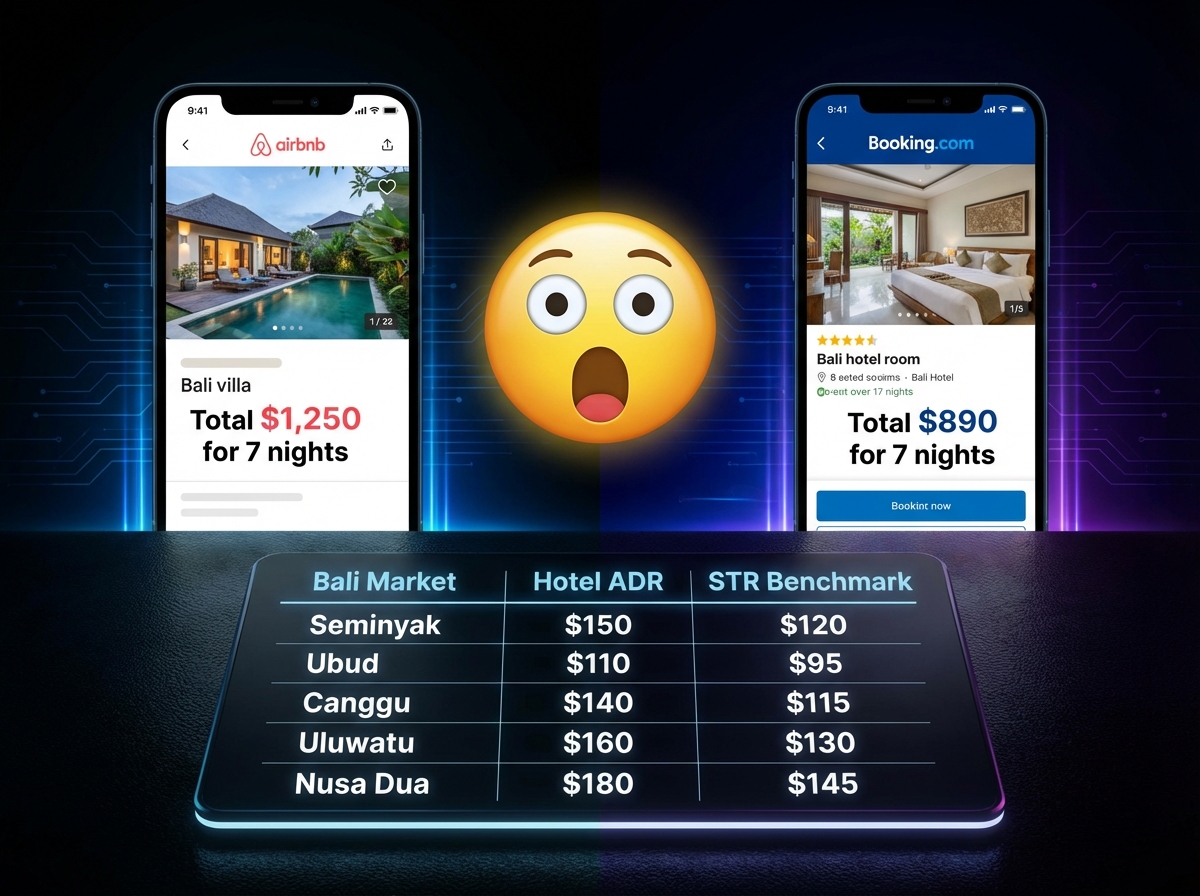
Side-by-side Bali Airbnb vs hotel OTA pricing across 5 markets reveals where STR hosts are over-pricing, under-pricing, and leaving money behind. Real numbers. Real strategy.
The Real Problem: Airbnb Hosts Are Playing a Different Game Than Hotels
Most Airbnb hosts in Bali compare themselves to other Airbnbs. They look at what their neighbor's villa is priced at, then apply a small adjustment. This is fundamentally wrong. Your true market competition isn't other Airbnbs. It's hotels and OTA-listed properties with dynamic pricing engines and dedicated revenue teams.
Hotels in Bali use channel managers, revenue management systems, and real-time demand data to adjust prices multiple times per day. Most Airbnb hosts adjust once per month. This asymmetry creates massive pricing gaps where STR hosts either leave thousands on the table or price themselves out of the market entirely.
Our latest AirDNA + Booking.com data across 5 major Bali markets reveals exactly where these gaps live. And the results are shocking: in some markets, STR hosts should be pricing 40-80% higher than they are. In others, they're pricing 50-100% too high and wondering why occupancy is collapsing.
The 5-Market Snapshot: STR vs Hotel Pricing
Here's the data that most Bali hosts never see. We've aggregated hotel weekend ADR (average daily rate) from Booking.com's top OTA listings against STR benchmarks from AirDNA across 5 key markets:
| Market | Hotel Weekend ADR | STR Benchmark | STR Positioning |
|---|---|---|---|
| Uluwatu | $106 | $120-$180 | STR Premium +13% to +70% |
| Canggu | $35 | $40-$55 | STR Premium +14% to +57% |
| Ubud | $62 | $50-$65 | STR Discount -19% to +5% |
| Seminyak | $52 | $40-$50 | STR Discount -4% to -23% |
| Nusa Dua | $156 | $120-$145 | STR Discount -7% to -23% |
Data: Booking.com weekend rates (April 2026) + AirDNA STR benchmarks for comparable properties
Look at these positioning gaps. In Uluwatu and Canggu, STR hosts should be pricing at or above hotel rates because villas offer amenities and experience premiums hotels can't match. In Ubud, Seminyak, and Nusa Dua, most STR hosts are overpriced relative to their hotel competition.
Market-by-Market Analysis: Where You Stand
Uluwatu: STR Premium Justified
Hotel weekend ADR: $106
STR villa benchmark: $150–$197
Uluwatu is the rare Bali market where Airbnb hosts should price above hotel rates. The reason is simple: a clifftop infinity pool villa at Padang Padang beach is not competing with a standard hotel room. It's competing with a luxury experience. Weekend rates of $120–$180 for mid-tier villas and $150–$200+ for premium cliff villas are justified by amenity premium (pools, ocean views, private spaces) that hotels can't replicate.
Host strategy: If you own a villa in Uluwatu, aim for STR pricing 15-70% above comparable hotel rates depending on quality. Dolce Suites ($137 weekday) and Vanara ($197 weekday) set the premium ceiling. Use these as benchmarks, not your Airbnb neighbor's rate.
Canggu: STR Captures Hotel-Plus Premium
Hotel weekend ADR: $35
STR villa benchmark: $40–$55
Canggu's hotel market is flooded with budget chains and mid-market offerings. STR villas and private rooms command a modest premium (15-60%) because they offer personality, location control, and kitchen access that chain hotels don't. Digital nomads—Canggu's core demand—will pay more for a villa with workspace than a standard hotel room.
Host strategy: Most Canggu Airbnb hosts are correctly positioned. If you're pricing below $40 on weekends, you're likely leaving money on the table. If you're above $55, you're pricing out the digital nomad core. The $40-$55 range is the sweet spot for occupancy + revenue.
Ubud: Where STR Hosts Are Overpriced (Critical Warning)
Hotel weekday ADR: $62
Hotel weekend ADR: $48
STR benchmark: $50–$65
This is the market where most Airbnb hosts are making a catastrophic mistake. Ubud's hotel market shows a clear pattern: weekday rates ($62) exceed weekend rates ($48). This is the opposite of what most STR hosts assume. Why? Ubud attracts wellness retreat groups and corporate bookings mid-week. Weekends see only weekend tourists.
Yet most Airbnb hosts in Ubud apply platform-default weekend premiums and end up pricing weekend stays at $55–$70 when hotels are pricing at $48. Result: Lost bookings, collapsed occupancy, guests booking hotels instead.
Red Flag: If you own an Ubud Airbnb and you're applying a weekend premium to your base rate, you're doing it wrong. Maximize Tuesday–Thursday rates instead. Use weekend pricing to move occupancy, not maximize ADR.
Seminyak: STR Hosts Are Overpriced by 20%+
Hotel weekday ADR: $52
Hotel weekend ADR: $37
STR benchmark: $40–$50
Seminyak shows an even starker pattern than Ubud: hotels are dropping rates by 29% on weekends. This signals low-margin weekend tourism (local Indonesian families, budget Europeans). Yet most Seminyak Airbnb hosts price their villas at $50–$65 with weekend premiums, believing they can capture tourists willing to pay higher rates.
The data proves otherwise. Hotels have room 400-500 rooms per property and use revenue teams to optimize rate. They would not drop 29% if guests were willing to pay premium weekend rates. They're dropping rates because demand requires it. STR hosts are overpriced and losing occupancy to hotels.
Host strategy: Cap your weekend rates at hotel pricing. Apply modest premiums ($45–$55 total) and compete on amenity, not price. Use weekday targeting for revenue optimization instead.
Nusa Dua: Resort Pricing Collapse, STR Hosts Overpriced
Hotel weekday ADR: $156
Hotel weekend ADR: $97
STR benchmark: $120–$145
Nusa Dua is Bali's resort capital—the Grand Hyatt, St. Regis, Intercontinental cluster. Hotel weekend pricing at $97 is a 38% markdown from weekday rates. This collapse signals a specific market dynamic: Nusa Dua is booked mid-week by package tour operators, business travelers, and corporate groups. Weekends are left to discount. Airbnb hosts near resorts are seeing the same pattern but aren't adjusting.
Many Nusa Dua STR hosts price at $130–$160 on weekends, thinking they can capture luxury weekend travelers. They can't—not at those rates. Hotels have already discounted 38%. STR hosts are 30-60% overpriced.
Host strategy: Price Nusa Dua STR properties at $120–$145 and compete on package deals, early-bird discounts, and multi-night incentives. Don't try to undercut hotels on nightly rate; they have operational leverage you don't.
Why Hotels Can Afford to Undercut (Or Overprice) You
Dynamic Pricing
Hotels adjust rates every 2-6 hours using revenue management systems that read booking pace, competitor pricing, and demand signals. Airbnb hosts adjust once per month. By the time you change rates, the market window has closed.
Channel Management
Hotels distribute inventory across 8-12 OTA channels simultaneously. A single room appears on Booking.com, Expedia, Agoda, etc. STR hosts use primarily Airbnb and miss long-tail booking sources that hotels capture.
Market Intelligence
Hotels subscribe to STR (Smith Travel Research), RevPAR benchmarking, and competitive sets of 10-20 competing hotels. They know exactly what the market will bear. Most Airbnb hosts guess based on feel.
Volume Economics
A hotel with 200 rooms can sustain 60-70% occupancy and still hit revenue targets. An Airbnb host with 1 villa needs 85%+ occupancy. This means hotels can afford to discount more aggressively than you can without losing money.
The implication is clear: you can't compete with hotels on price sophistication. What you can do is use their data to inform your positioning. When hotels in Ubud are dropping weekend rates, you should too. When hotels in Uluwatu hold premium weekend pricing, you can too.
The Core Mistake: Platform Defaults Over Market Reality
Airbnb's default weekend premium is 10-20%. This makes sense in markets with true weekday peaks (business travel destinations, ski resorts, coastal towns in peak season). It makes no sense in Bali, where market dynamics vary wildly by location.
Hosts who accept the 10-20% default in Ubud, Seminyak, and Nusa Dua are overpriced. Hosts who apply 10-20% in Uluwatu and Canggu are leaving money on the table. The solution isn't to find a magic percentage. It's to benchmark against hotels in your specific market and price accordingly.
Benchmark Weekly
Check hotel weekend rates in your market every Sunday. This is your price ceiling. Price at or below it depending on your amenity premium.
Segment by Market
Don't apply the same premium across all Bali. Use high premiums (+50-100%) in Uluwatu/Canggu, modest premiums (+15%) in Ubud/Seminyak, and discounts (-20%) in Nusa Dua.
Test & Learn
Price 10% higher one week. Measure occupancy impact. Price 10% lower the next week. Measure bookings. Find your elasticity ceiling. Most hosts never do this.
Real Property Examples: What You Should Actually Charge
| Property Type / Market | Hotel Benchmark | Recommended STR Rate | Why |
|---|---|---|---|
| 2BR Cliff Villa, Uluwatu | $106 hotel ADR | $130-160 | Premium position + swell demand justifies 23-51% premium over hotel |
| 3BR Beachfront Villa, Canggu | $35 hotel ADR | $45-60 | Digital nomad premium + workspaces justify 29-71% over hotel |
| 2BR Ubud Wellness Villa | $62 weekday / $48 weekend | $60 weekday / $45 weekend | Match weekday hotel rates, undercut weekend to win occupancy |
| 1BR Seminyak Beach Apartment | $37 hotel ADR | $38-45 | Match to slightly-above hotel pricing; avoid premiums |
| 3BR Nusa Dua Resort-Adjacent Villa | $97 weekend ADR | $110-135 (with package incentives) | Slight premium but compete on value packages and early-bird deals, not nightly rate |
Your 5-Step Action Plan This Week
Step 1: Identify Your Market (By Hotel Demand Pattern)
Check the hotel ADR data for your market above. Does your market show weekday peaks (Ubud, Seminyak, Nusa Dua) or weekend peaks (Uluwatu, Canggu)? This determines your entire pricing strategy.
Step 2: Find Your Competitive Hotel Set
Go to Booking.com. Search your area. Identify 5 comparable hotels (similar quality, location, amenities). Screenshot their rates for a typical weekend and weekday. This is your benchmark. These are the properties guests are comparing against.
Step 3: Calculate Your Amenity Premium (or Discount)
Is your villa better than those hotels? (More spacious, pool, privacy, views?) Add 20-70% premium. Worse? (Older, less convenient, fewer amenities?) Price at a 0-20% discount. Don't guess—test.
Step 4: Adjust Your Weekday vs Weekend Pricing
If your market has weekday peaks (Ubud, Seminyak, Nusa Dua): maximize weekday rates, use weekends to move volume. If your market has weekend peaks (Uluwatu, Canggu): maximize weekend rates, use weekdays to fill gaps.
Step 5: Monitor & Adjust Every 4 Weeks
Hotel pricing changes seasonally. Your benchmark isn't static. Check hotel ADR monthly. Adjust your rates quarterly to stay competitive. Most hosts adjust once per year. That's why they're always off.
The Bottom Line: Stop Comparing Yourself to Airbnbs
Your real competition isn't your neighbor's Airbnb. It's the hotel down the street with a revenue team. They're reading market data every day. They're adjusting prices to optimize profit. They're winning bookings because their pricing is smarter than yours.
The good news: you now have the same data. Use it. Price like a hotel (smart, data-driven, market-informed). You don't need their revenue team. You need their benchmarking discipline.
In Bali's 5 major markets, the difference between data-driven pricing and guessing is 15-40% of your annual revenue. That's not a small optimization. That's a complete reset.
Know Your Market Like Hotels Know Theirs
RevPARGenius provides live OTA hotel benchmarking, weekly market updates, and pricing recommendations for every Bali market. Price with competitive intelligence. Stop leaving money on the table.
Get Competitive Pricing DataCompare your pricing against hotels in your market — real-time, real data