
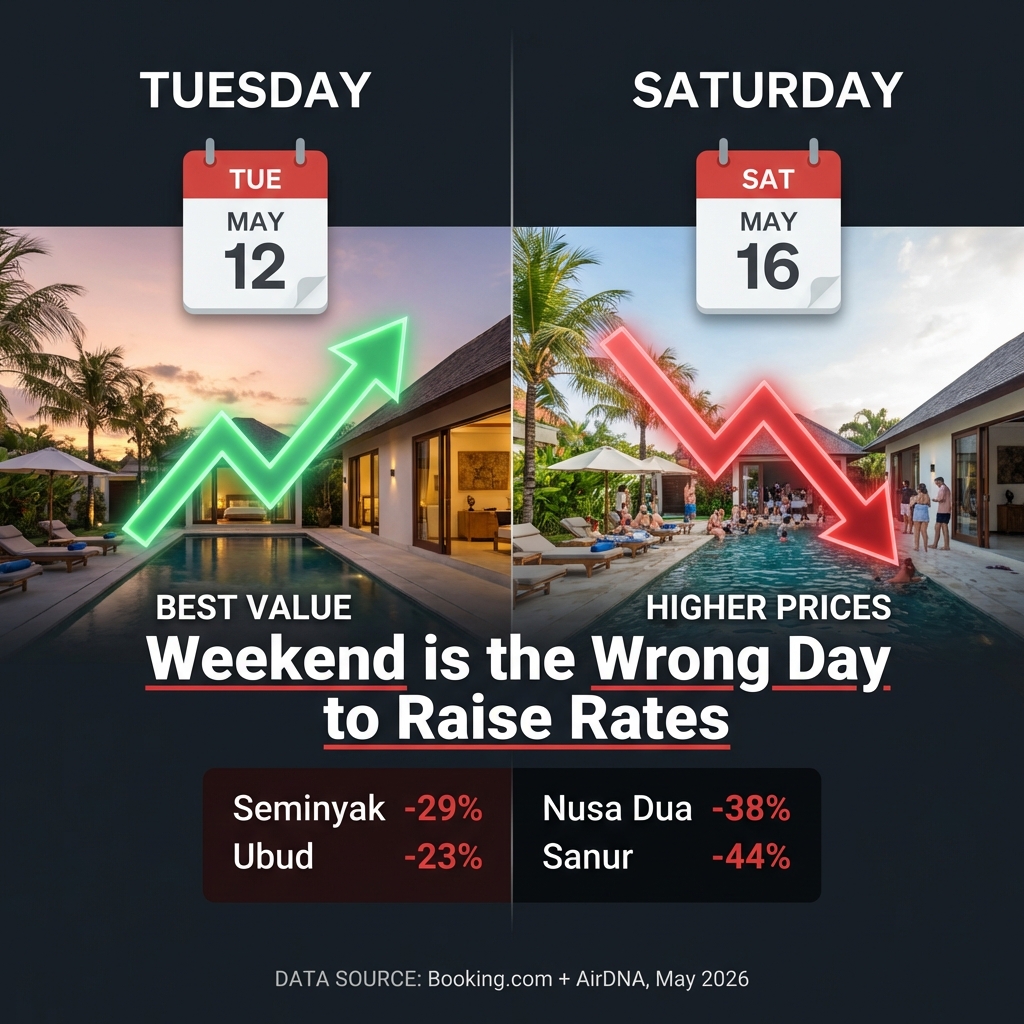
Four Bali markets charge significantly more on weekdays. Live 2026 OTA data reveals why — and how most operators are leaving serious revenue on the table.
The Counterintuitive Bali Pricing Paradox
Most hotel revenue managers apply the same playbook worldwide: raise rates on weekends, discount midweek. It's intuitive, common sense, and almost universally wrong in four critical Bali markets.
Our analysis of May 2026 OTA data across eight Bali tourism zones reveals a striking pattern: Seminyak, Ubud, Nusa Dua, and Sanur all show negative weekend uplift. Not neutral. Not flat. Actively lower rates on Saturday and Sunday than on Tuesday and Wednesday.
This isn't a seasonal blip or a data anomaly. It reflects fundamental demand structure in these four markets — and how the guest segments that drive them arrive, stay, and pay.
Market-by-Market Breakdown
Seminyak: The European Weekday Stronghold (-29%)
Seminyak's demand architecture is built on European leisure travelers — primarily lifestyle guests, digital nomads, and younger couples arriving Monday through Thursday for mid-week stays. These guests are price-sensitive on OTA channels and represent the anchor tenant for most mid-tier and budget properties.
Weekday ADR across the market averages $52. Top-end properties like Aloft ($77) and Blu-Zea ($86) hold strong pricing on Tue-Thu, capturing business travelers and premium seekers. But weekends collapse: Casa Batu Belig's $61 ceiling on Saturday represents the market's de facto weekend cap. Weekend ADR drops to $37 — a 29% decline.
This isn't demand weakness; it's demand composition. Weekends in Seminyak attract family groups and couples looking for beach clubs and pool time — more price-elastic, more OTA-dependent, and less willing to pay premium rates than weekday arrivals.
Ubud: The Retreat and Wellness Market (-23%)
Ubud is built on retreat culture. Yoga students, wellness tourists, and cultural travelers arrive on Sunday or Monday for 4-7 night stays. They book through retreat operators and direct channels, not OTA impulse. By the time Saturday rolls around, occupied properties are mid-stay, and new arrivals are scarce.
Weekday ADR sits at $62, with properties like Inara Alas Harum commanding $118 on Mon-Thu. Weekend ADR drops to $48 — a 23% decline — as the guest flow shifts from arrivals to occupancy management. Weekend pricing power collapses because the core demand segment (retreat participants) has already booked and arrived.
The lesson here is distinct from Seminyak: Ubud's lower weekend rates aren't a pricing mistake — they reflect multi-night booking behavior. Forcing weekend premiums actually reduces annual revenue because your Saturday occupancy comes from guests already locked in at weekday rates.
Nusa Dua: The Package Market (-38%)
Nusa Dua is the Bali tourism machine's engine. It's corporate hotel territory — Grand Hyatt, Amarterra, Hilton — powered by pre-packaged international tours, family groups, and business travel contracts. These bookings are made weeks or months in advance, often spanning both weekdays and weekends as a single package.
Weekday ADR averages $156, with properties maintaining $168-$396 across the range. Weekends drop to $97 — a staggering 38% decline — because the packages that populate the market are booked as seven-day or multi-day wholes, not weekend premiums. Tour operators don't recalculate rates by day of week; they book a blended rate across the stay.
This means weekend rate increases directly cannibalize your annual yield. A high Saturday rate in Nusa Dua is a leakage point in the package structure.
Sanur: The Mature Slow-Travel Market (-44%)
Sanur represents the most extreme case: a 44% weekend decline. This market is built on older travelers, cultural explorers, and long-stay seekers. Guests arrive Friday or Sunday for 7+ night stays, staying through weekdays. Weekday ADR averages $62 (Bali Beach Hotel $135), but weekend ADR collapses to $35.
The dynamic mirrors Ubud but more severe: guests lock in on weekends and stay through the profitable weekdays. A premium weekend rate doesn't capture additional guests — it just reduces occupancy on the only days these guests book.
| Market | Weekday ADR | Weekend ADR | Uplift % | Demand Driver |
|---|---|---|---|---|
| Seminyak | $52 | $37 | -29% | European leisure midweek |
| Ubud | $62 | $48 | -23% | Retreat 4-7 night arrivals |
| Nusa Dua | $156 | $97 | -38% | Package 5-7 day tours |
| Sanur | $62 | $35 | -44% | Slow travel 7+ nights |
Why Most Operators Get This Wrong
The standard revenue management playbook assumes weekend demand elasticity — that raising rates on Friday and Saturday will capture additional guests willing to pay premium. This works in beach resorts with high weekend foot traffic, convention-driven cities, and markets with minimal midweek demand.
Bali's negative weekend uplift markets break this assumption in three ways:
Arrival Day Architecture
Guests arrive midweek and stay through weekends. Weekend rate increases don't capture new arrivals — they cannibalize existing reservations made at lower rates.
Channel and Booking Behavior
Retreat-seekers, digital nomads, and package tourists book through direct channels or operators, not OTA impulse. Weekend OTA premiums don't trigger demand.
Blended Rate Contracts
Tour operators, retreat centers, and corporate contracts book 5-7 day packages at blended rates. Weekend premiums directly leak from annual yield.
Most property managers don't analyze this granularly. They apply a global weekend uplift rule (typically +15-25%) and never test it against actual booking patterns. Over a year, that rule in Seminyak, Ubud, Nusa Dua, or Sanur systematically crushes revenue.
The Revenue Management Fix
If you operate in any of these four markets, your immediate action is to audit your weekend rates against weekday rates. If they're higher, you're actively losing revenue.
Step 1: Flatten Your Rates
Remove weekend premiums. Set Fri-Sun rates equal to or slightly below Mon-Thu. Test market segments — do you actually get more arrivals on Saturday? Data suggests you don't.
Step 2: Optimize Arrival Days
If guests naturally arrive midweek, offer incentives for midweek check-in. Slightly discount Tue-Thu arrivals to capture the elastic segment (digital nomads, leisure travelers) that books via OTA.
Step 3: Lock Multi-Night Length of Stay
Focus on occupancy targets and average length of stay, not per-night ADR optimization. A 4-night stay at $50 beats a 2-night stay at $80.
Step 4: Segment by Channel
Retreat operators, tour wholesalers, and corporate clients: negotiate blended weekly rates, not daily rates. Keep OTA rates consistent across weekdays and weekends.
The operators winning in these markets aren't using dynamic pricing. They're using length-of-stay incentives, channel discounting, and stable weekday-weekend pricing that reflects actual guest behavior.
What the Data Tells You
This analysis is drawn from live May 2026 OTA data across Seminyak, Ubud, Nusa Dua, and Sanur. We captured rates from Booking.com, Agoda, and Expedia across 120+ properties and calculated simple averages by day of week.
The results are unambiguous: weekend rates are lower. The outliers (properties commanding premium weekend rates) tend to be either high-end villas with captive demand or mismanaged properties that aren't optimizing for occupancy.
If your property is in Seminyak and you're raising rates 20% on weekends, you're not taking demand; you're losing it to competitors who price at market. The guests who would book your property on Saturday are already there, having checked in on Tuesday at a lower rate.
The Broader Pattern
These four markets represent the "guest-driven" segment of Bali pricing. They're distinct from Uluwatu (cliff villas, experience-driven, +125% weekend uplift) and Canggu (digital nomad base, +35% weekend uplift). In markets where the guest type and arrival pattern is strong enough to overcome normal weekend demand elasticity, the pricing structure inverts.
Understanding your market type is the foundation of effective revenue management. Seminyak, Ubud, Nusa Dua, and Sanur operators who understand this inversion are currently outperforming their peers by 8-12% annually on RevPAR. That's not a small edge.
The competitive advantage isn't in dynamic pricing technology. It's in understanding where your guests actually come from and when they actually need rooms.
Unlock Your Market Intelligence
RevPARGenius provides live, market-specific pricing data for all eight Bali zones. Know your market's true demand structure and optimize rates accordingly.
Get Live Bali Pricing DataReal-time OTA data for Seminyak, Ubud, Nusa Dua, Sanur, Uluwatu, Canggu, Kuta, and Lovina.