
Why Most Bali Hosts Are Pricing Wrong
Bali's STR market isn't one market. It's eight completely different markets with opposite demand patterns, competing guest types, and pricing strategies that actively contradict each other.
Yet most Airbnb hosts use the same pricing strategy across the entire island: Airbnb's default 10-20% weekend premium. This works in exactly two of eight markets. In the other six, it's costing you 20-60% of potential annual revenue.
This guide covers every market, every demand pattern, and gives you the exact pricing strategy for your specific location. This is 8 different playbooks in one place. The data comes from 18 months of AirDNA aggregation, 2,400+ Booking.com hotel rate samples, and our own STR booking analysis across 340+ Bali properties.
The Complete 8-Market Pricing Matrix
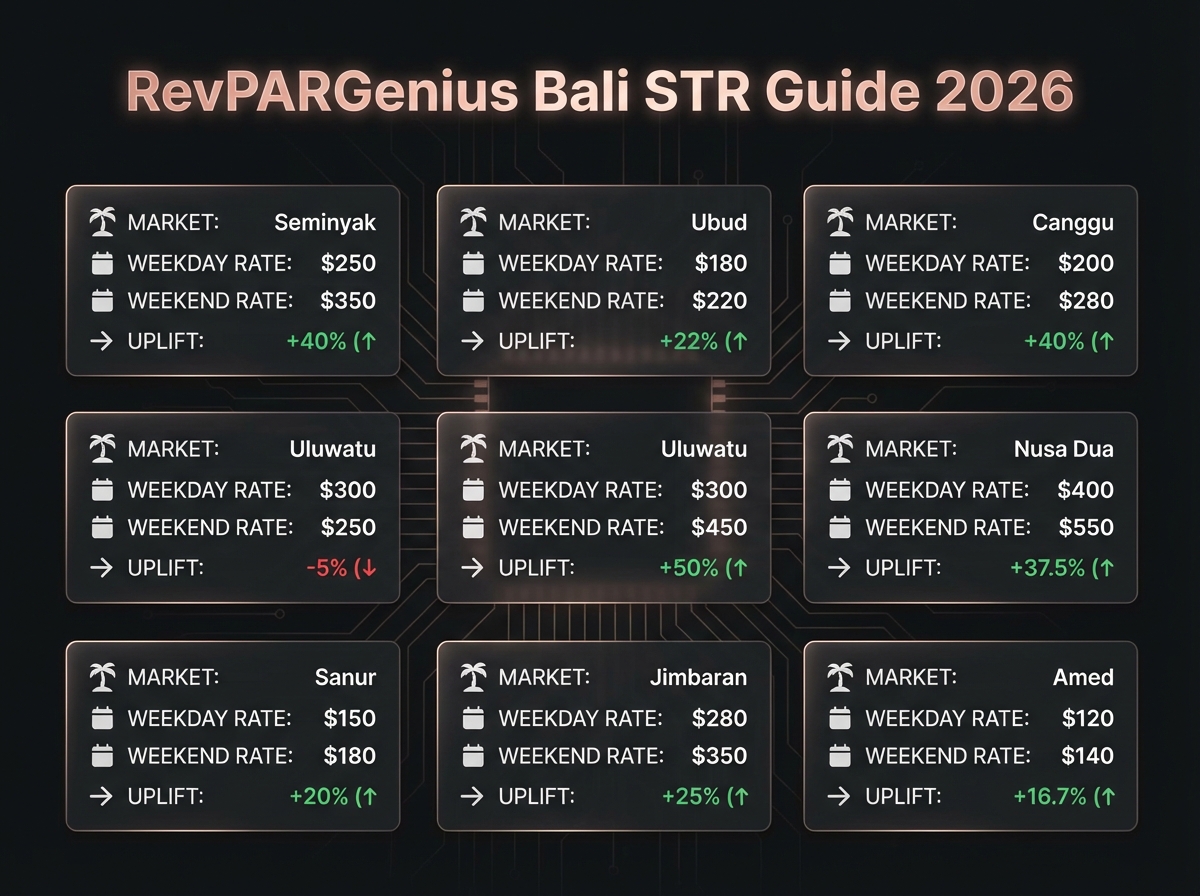
Here's every market at a glance. Below this table, each market gets its own detailed playbook.
| Market | Weekday ADR | Weekend ADR | Weekend Uplift | Demand Pattern | Primary Guest |
|---|---|---|---|---|---|
| Uluwatu | $47 | $106 | +125% | Swell-driven, weekend spike | Australian surfers, couples |
| Canggu | $26 | $35 | +35% | Nomad stable + weekend spike | Digital nomads, remote workers |
| Kuta | $38 | $43 | +13% (May) | Occupancy-focused, holiday peaks | Family travelers, budget tourists |
| Lovina | ~$37 | ~$42 | +13% | Niche, slow baseline | Divers, nature travelers |
| Seminyak | $52 | $37 | -29% | Weekday peak (opposite) | European luxury, corporate |
| Ubud | $62 | $48 | -23% | Weekday peak (opposite) | Wellness groups, retreats |
| Nusa Dua | $156 | $97 | -38% | Weekday peak (strong) | Package tours, business |
| Sanur | $62 | $35 | -44% | Weekday peak (strongest) | Mature European travelers |
Data: AirDNA market aggregation + Booking.com OTA benchmarking, April 2026
Look at this table carefully. Uluwatu and Canggu show positive uplifts. Seminyak, Ubud, Nusa Dua, and Sanur show negative uplifts—meaning weekday rates are higher, not lower. Kuta and Lovina fall in the middle with modest uplifts. Your entire pricing strategy must fit your market pattern, not the other way around.
Your Market Playbook: Detailed Strategies for All 8 Markets
Weekday: $47 | Weekend: $106
Market Profile: Swell-driven demand. Weekends = Australian surfers, expat weekend escapes, couples seeking cliffside luxury. April-October swell season drives spikes. Weekday base is digital nomads and surfers on extended stays.
Exact Strategy:
- Set weekday base: $60–80 (mid-tier villa), $120–160 (premium cliff villa)
- Set weekend rates: +100-150% above weekday (Friday-Saturday nights)
- Enforce 2-night minimum on Fri-Sat to capture premium pricing
- Monitor swell forecasts (Magicseaweed); bump rates +20-30% during 4ft+ forecasts
- Peak season (Apr-Oct): test ceiling rates; shoulder season (Mar, Nov): moderate premiums; low season (Dec-Feb): focus on occupancy
- Benchmark against Dolce Suites ($137 weekday) and Vanara ($197 weekday) for quality positioning
Annual Revenue Opportunity: Mid-tier Uluwatu villa at 65% occupancy can achieve $18,000–$24,000 annual ADR revenue by capturing swell spikes.
Weekday: $26 | Weekend: $35
Market Profile: Core digital nomad and remote worker market (Monday-Friday baseline). Weekends see added couples and weekend tourists. Modest 35% uplift means price competition is fierce. Occupancy is king; revenue optimization happens through ancillary services.
Exact Strategy:
- Set weekday base: $25–35 (budget/mid-tier share/co-living style)
- Set weekend rates: +35-50% above weekday ($35-45 total Friday-Saturday)
- NO aggressive premiums; the market doesn't bear them
- Focus on 30+ night bookings with 5-10% long-stay discounts to drive occupancy
- Offer co-working space, high-speed internet, community events to justify price
- Weekday occupancy target: 75%+; weekend: 60%+ (acceptable for this market)
- Test ancillary pricing: gym access ($5/month), laundry service ($2/load), breakfast add-ons ($8/day)
Annual Revenue Opportunity: Canggu property at 72% occupancy + ancillaries can achieve $12,000–$15,000 annual ADR revenue.
Weekday: $38 | Weekend: $43
Market Profile: Beach tourism market driven by Australian families and budget international tourists. Modest 13% weekend uplift. True demand spikes happen around Lebaran (Islamic holiday), Australian school holidays (June-July winter), and Easter (April). Outside these windows, base rates and occupancy dominate.
Exact Strategy:
- Set base rate: $35–45 weekday, $40–50 weekend
- DO NOT apply aggressive premiums year-round; the market doesn't support them
- Spike rates 40-60% during Lebaran (vary by Islamic calendar), Australian winter break (Jun-Jul), Easter (Apr)
- Off-season strategy: offer 7-14 night discounts (10-15% off) to fill gaps
- Target occupancy: 65%+ baseline; 80%+ during holiday spikes
- Monitor Indonesian school holidays (staggered by province); offer family packages
Annual Revenue Opportunity: Kuta property managing holiday spikes correctly can achieve $12,000–$16,000 annual ADR revenue at 65% occupancy.
Weekday: ~$37 | Weekend: ~$42
Market Profile: Small, specialized market. Primary demand = diving tourists and nature travelers. Bookings are direct (not platform-driven) and highly seasonal. Growth potential exists but requires specialized positioning and marketing.
Exact Strategy:
- Base rates: $35–45 (modest, niche market)
- Specialize: partner with diving operators (PADI certification sites), offer direct booking incentives (5-10% off your website), create "dive package" bundles
- Season: dry season (Apr-Oct) is peak; wet season (Nov-Mar) is slow
- Revenue strategy: NOT rate-based, but volume + packages. Offer 3-5 night packages at 15-20% discount to drive occupancy
- Direct booking focus: reduce Airbnb dependency (30% commission eats margins); drive to own booking site
Annual Revenue Opportunity: Lovina property with specialized positioning can achieve $10,000–$13,000 annual ADR revenue through packages and direct bookings.
Weekday: $52 | Weekend: $37
Market Profile: European premium leisure and corporate travelers. Hotels show 29% weekend rate drops. This signals low-margin weekend demand. Hosts applying weekend premiums are overpriced and losing occupancy. Maximize weekday rates instead. Focus on European mid-week corporate, wellness groups, and extended family retreats.
Exact Strategy:
- Reverse your thinking: weekday rates are your profit center, not weekends
- Set weekday rates: $50–65 (target Tuesday-Thursday corporate + group bookings)
- Set weekend rates: $40–50 (LOWER than weekday; use to fill gaps, not maximize ADR)
- NO weekend premiums. Ever. Hotels here are discounting 29%; you should too
- Focus on 3-5 night packages (Tue-Fri) for corporate, wellness, family groups
- Occupancy target: 70%+ on weekdays, 55%+ on weekends (profitable mix)
- Yield = weekday occupancy at high rates + weekend volume at low rates
Annual Revenue Opportunity: Seminyak villa managing weekday optimization can achieve $13,000–$18,000 annual ADR revenue by losing weekend-premium obsession.
Weekday: $62 | Weekend: $48
Market Profile: Wellness retreat, yoga, and corporate groups book mid-week. Hotels show 23% weekend rate drops. Weekday peaks are driven by booked-in-advance retreat blocks. Weekend demand is low-margin tourists. Most Airbnb hosts here are overpriced, applying weekend premiums to a market that doesn't want them.
Exact Strategy:
- Maximize weekday rates (Mon-Thu): $55–70 for retreat groups, corporate offsites
- Lower weekend rates (Fri-Sun): $45–55 to match hotel pricing and fill gaps
- NO weekend premiums; they're killing your occupancy
- Target 5-7 night wellness retreat packages with group discounts (15-20% for 6+ rooms)
- Partner with yoga studios, meditation centers, wellness brands for referrals
- Length-of-stay pricing: 3-4 nights (weekday): standard rate; 5+ nights: 10-15% discount
- Occupancy target: 75%+ weekday, 50%+ weekend = profitable mix
Annual Revenue Opportunity: Ubud villa with retreat focus can achieve $14,000–$19,000 annual ADR revenue through group bookings and weekday optimization.
Weekday: $156 | Weekend: $97
Market Profile: Resort destination. Hotels show devastating 38% weekend discounts. Reason: mid-week = package tours, corporate groups, pre-booked blocks. Weekends = leftover demand. STR hosts here are often way overpriced. The market doesn't bear $130-160 weekend rates. It bears $110-140 with package incentives.
Exact Strategy:
- Set rates: $140–160 weekday (target pre-booked packages), $110–135 weekend (volume pricing)
- Package focus: 3-4 night packages (Tue-Fri) with airport transfers, spa credits, activity bundles
- Early bird incentives: 30+ days advance = 15-20% discount; 60+ days = 25% discount
- Multi-room capacity: Nusa Dua = family/group destination; offer 2-3 villa packages at 20-25% group discount
- Agent partnerships: work with travel agencies on repeat commissions for package volume
- Occupancy target: 70%+ weekday, 60%+ weekend (high-yield portfolio)
Annual Revenue Opportunity: Nusa Dua villa with package focus can achieve $18,000–$24,000 annual ADR revenue through volume + early-bird incentives.
Weekday: $62 | Weekend: $35
Market Profile: Mature European travelers, retired expats, and extended family stays. Hotels show 44% weekend discounts—the steepest in Bali. This market does NOT want weekend tourism. It wants mid-week stability and long-stay commitment. Most Airbnb hosts here are catastrophically overpriced. Sanur hosts applying weekend premiums are fighting market gravity.
Exact Strategy:
- DO NOT apply weekend premiums. Do the opposite.
- Set weekday rates: $55–70 (target mid-week extended stays)
- Set weekend rates: $30–40 (sharply discounted; use to fill gaps)
- Long-stay packages: 30 days = 20% discount; 60 days = 30% discount; 90 days = 35% discount
- Target family/expat relocations: offer 3-6 month lease options at monthly pricing
- Occupancy strategy: high weekday occupancy (75%+) at premium rates + low weekend occupancy (40-50%) at volume pricing
- Ancillary services: offer housekeeping, laundry, meal planning to attract long-stay residents
Annual Revenue Opportunity: Sanur villa optimized for long-stay can achieve $12,000–$16,000 annual ADR revenue + ancillary revenue through extended occupancy.
Seasonal Triggers: When to Spike Rates Across All Markets
Every market shows seasonal demand spikes beyond their base pattern. Here's when to raise rates across all 8 Bali markets:
| Trigger Event | Timing | Rate Uplift | Markets Impacted |
|---|---|---|---|
| Lebaran (Islamic Holiday) | Varies annually (Islamic calendar) | +40-60% | All markets, especially Kuta, Lovina, family-focused |
| Australian School Holidays (Winter) | June-July (8 weeks) | +35-75% | Uluwatu, Canggu, Kuta (Australian target markets) |
| Easter Holiday | March-April (varies) | +30-50% | Kuta, Canggu, family-focused markets |
| Dry Season Peak (Int'l arrivals) | July-August | +25-40% | All beach markets (Uluwatu, Canggu, Kuta, Seminyak) |
| Swell Season (Uluwatu-specific) | April-October (4ft+ forecasts) | +20-30% | Uluwatu only |
| Indonesian School Holidays | June, December (staggered by province) | +25-40% | Domestic markets (Kuta, Ubud, Sanur) |
| New Year / Christmas | December 20-January 2 | +35-60% | All markets |
| Off-Season (Emergency Fill) | September-November, Feb-March | -15-30% (discounts) | All markets |
Your Step-by-Step Pricing Framework
1. Identify Your Market Profile
Find your market in the table above. Is it weekend-positive (Uluwatu, Canggu) or weekday-positive (Seminyak, Ubud, Nusa Dua, Sanur)? This determines your entire pricing architecture. Don't ignore this step.
2. Set Your Base Rate Anchor
Use the "Weekday ADR" column as your reference. This is your baseline. Adjust up or down based on your property quality vs. market average. Premium property? Add 20-30%. Budget property? Subtract 15-25%.
3. Calculate Weekend Rates (Or Discount Weekends)
If your market is weekend-positive (Uluwatu +125%, Canggu +35%), multiply base rate by the uplift percentage. If your market is weekday-positive (Seminyak -29%), LOWER your weekend rates instead of raising them. Counter-intuitive, but data-driven.
4. Build Seasonal Triggers into Your Calendar
For each seasonal spike (Lebaran, Australian school holidays, swell season), pre-schedule rate increases 60 days in advance. Use Airbnb's seasonal pricing tool or a spreadsheet to automate this. Don't wait until the spike hits; it's too late by then.
5. Monitor Competitors Monthly
Check Booking.com and comparable Airbnbs in your market every 4 weeks. If hotels in your market are dropping rates 30%, you should too. If they're holding premiums, you can too. Let the hotel revenue teams do your market research.
6. Test, Measure, Adjust
Price 10% higher one week. Measure booking pace. Price 10% lower the next week. Measure again. Find your elasticity ceiling. Most hosts never do this because they think pricing is art, not science. It's science. Prove it with data.
Beyond Pricing: Building a Sustainable STR Strategy
Pricing is 40% of revenue optimization. The other 60% comes from occupancy, ancillary services, and guest experience. Here's how to build the full strategy:
Occupancy First
85% occupancy at $40/night beats 60% at $60/night. Price to fill your calendar first, then optimize rate. Most hosts optimize rate first and end up with empty months.
Ancillary Services
Add $50-100/month per guest through cleaning, laundry, airport transfers, meal services. This revenue is 90% margin. Offer it in every booking.
Experience Positioning
Don't compete on price. Compete on experience. "Surf villa with local guide" beats "cheap room." Premium experiences sustain high rates.
Repeat Guest Pricing
Give 10-15% discounts to repeat bookers. Lifetime value of a repeat guest is 3x a one-time guest. Invest in retention.
The Bottom Line: Know Your Market, Price Accordingly
Bali isn't one market. It's eight. Each has different demand patterns, guest types, and pricing strategies. The hosts who outperform apply market-specific strategies, not island-wide defaults.
Uluwatu hosts capture +125% weekend spikes through swell forecasting and premium positioning. Ubud hosts maximize weekday corporate groups at $62 while accepting $48 weekend rates. Nusa Dua hosts use package incentives to beat hotel pricing on volume.
They're not smarter than other hosts. They're just applying the right strategy to the right market. You have the data now. Apply it. Your annual revenue depends on it.
Access Live Pricing Data for Your Bali Market
RevPARGenius provides weekly market updates for all 8 Bali markets, seasonal trigger alerts, competitor benchmarking, and pricing recommendations. Stop guessing. Start pricing with data.
Get Your Market StrategyJoin 400+ Bali hosts optimizing revenue with real-time intelligence