Breaking · June 2026
Reviewed by Michael Andrews, Hotel Market Intelligence Researcher · June 4, 2026 · 7 min read
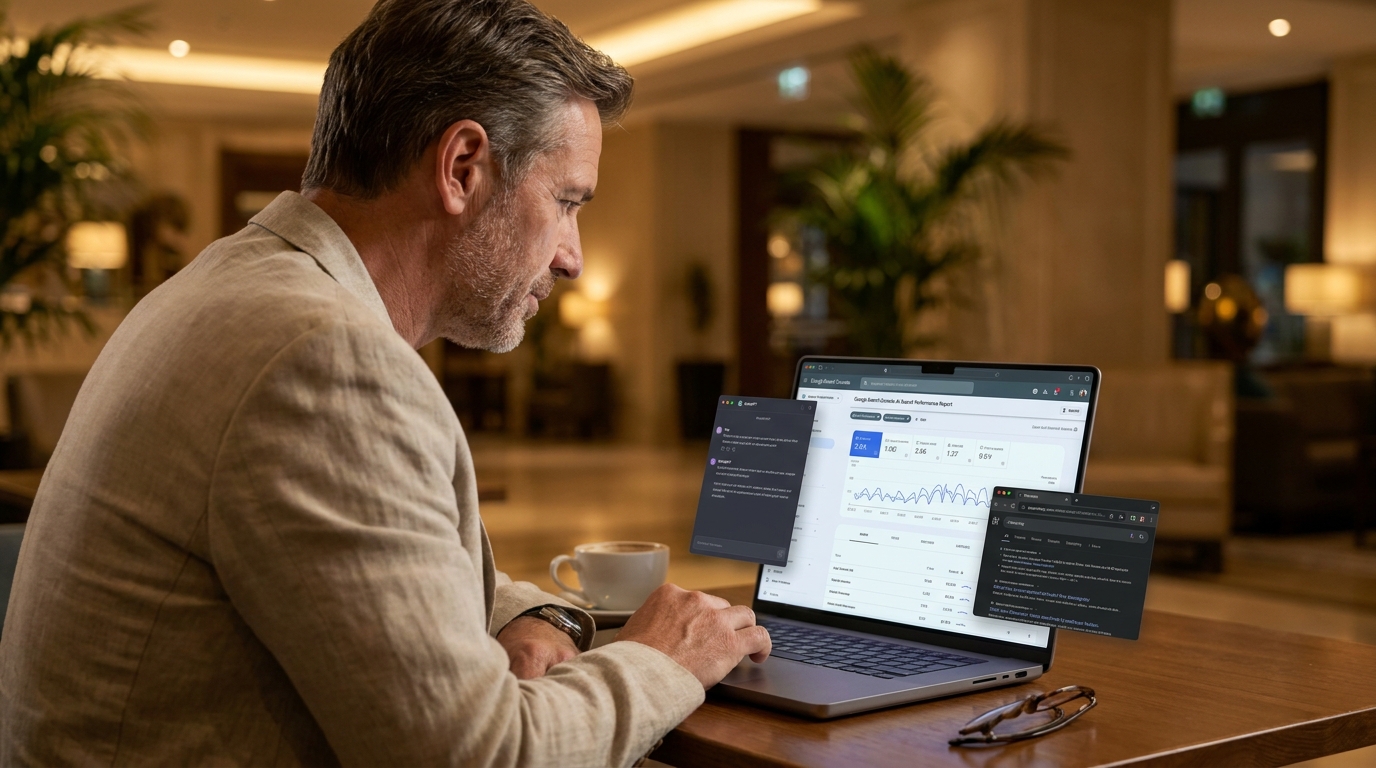
On June 3, 2026, Google launched dedicated AI performance reports in Search Console, giving site owners visibility into their impressions within AI Overviews and AI Mode. This is the clearest signal yet that AI search is now a first-class distribution channel — but the reports cover Google's features only. ChatGPT, Perplexity, and Grok, where 56% of travellers are now researching accommodation, are invisible to Search Console entirely.
On June 3, 2026, Google's Engineering Manager Hillel Maoz and Product Manager Lead Moshe Samet published a single announcement that should change how every hotel operator thinks about their digital presence.
Google Search Console — the tool every hotelier uses to track how their website performs in search — now has dedicated reports for AI features. For the first time, you can see exactly how often your hotel appears inside AI Overviews and AI Mode, broken down by page, country, device, and date.
This is not a minor update. This is Google officially treating AI search visibility as a separate, measurable performance surface — distinct from the blue-link results your website has always competed for. If you haven't thought seriously about AI visibility before now, Google just told you it's time.
But here is what the announcement does not say, and what every hotel operator needs to understand before they log into Search Console and feel reassured by whatever number they find there.
What did Google actually announce?
The new reports are straightforward. They show impressions from Google's generative AI features — specifically AI Overviews and AI Mode — with breakdowns by URL, country, device, and time period. The data is included in Search Console's overall Performance report and now has its own dedicated view.
According to Google's own documentation published alongside the announcement, appearing in these features requires nothing beyond standard SEO. No special schema markup. No new technical files. If your hotel's website is indexed and eligible for snippets, you're eligible to appear in AI Overviews and AI Mode. The same things that help you rank in traditional Google Search — helpful content, clean technical setup, good page experience — are the things that determine whether Google's AI features cite you.
That is a meaningful clarification, and it is genuinely useful. Hotels that have been wondering whether they need to do something special to appear in Google's AI results now have a clear answer: focus on the fundamentals. Google will handle the rest.
The problem is that Google is only one of five AI assistants your potential guests are using right now.
Why does this announcement matter specifically for hotels?
The hospitality industry is one of the highest-intent categories in all of AI search. When someone opens ChatGPT, Perplexity, or Gemini and asks "where should I stay in [city]?" they are not browsing. They are making a decision. The hotel that gets named in that answer has a direct line to a booking. The hotel that doesn't is invisible at the exact moment of choice.
According to Skift Research's 2024 AI Travel Planning Adoption Survey, 56% of US travellers now use AI tools to plan trips. In October 2025, OpenAI integrated ChatGPT directly with Booking.com and Expedia — meaning ChatGPT can now not only name hotels but initiate bookings. The channel is no longer experimental. It is operational.
Google's announcement validates what the data has been showing for over a year: AI search is a real distribution channel with real impressions, real clicks, and real revenue attached to it. The fact that Google has built dedicated reporting infrastructure for it is the institutional confirmation that this is permanent, not a trend.
For hotels, the urgency is sharper than for most industries. Accommodation is a local, high-consideration purchase where the AI's recommendation carries enormous weight. When Perplexity tells a traveller that a competitor is "the best boutique hotel for couples in your city," that recommendation is read as authoritative. Most travellers have no idea which sources the AI drew from, which signals influenced the answer, or whether your property was ever in contention at all.
What does Google's new report not show you about your hotel?
Everything that happens on ChatGPT, Perplexity, and Grok.
Google Search Console tracks Google. It has always tracked Google. The new AI performance reports extend that tracking to Google's AI features — AI Overviews and AI Mode — but they do not and cannot capture what is happening in AI assistants that run outside of Google's ecosystem.
ChatGPT draws from Bing's index and its own OAI-SearchBot crawler in web-connected mode. Perplexity runs its own live retrieval across the open web. Grok pulls from real-time web access and the X platform. None of those systems report to Google Search Console. None of that data appears in any report you will ever see inside Google's tools.
This is not a criticism of what Google built. It is a description of a gap that matters enormously for hotels: the three AI assistants your guests use most heavily for travel research produce answers that are entirely invisible to the performance reporting tools you currently rely on.
You could log into Search Console tomorrow, see a healthy number of AI Overview impressions, feel satisfied with your hotel's AI visibility, and be completely unaware that ChatGPT names your three nearest competitors every single time a traveller asks where to stay in your city — and never names you at all.
That scenario is not hypothetical. We ran a real scan on a Brisbane serviced-apartment property in June 2026. The property scored 0 out of 100 on AI visibility across ChatGPT, Perplexity, Gemini, and Grok — named in zero of 16 live AI engine checks — while seven competitors scored between 6% and 56% mention rates on the same queries. The hotel's own website earned zero citations. AI was reading Booking.com, TripAdvisor, and Accor about the property instead. You can see the full anonymised sample report here.
That hotel would never have found this gap in Search Console.
What is AI actually saying about your hotel right now?
The honest answer is: you almost certainly don't know.
AI assistants produce different answers depending on which engine you ask, which prompt you use, and when you ask it. They name specific hotels, describe them in specific ways, cite specific sources, and rank them in specific orders. That output is your hotel's AI reputation — and it is being formed right now, with or without your involvement.
A 2024 study from Princeton and IIT Delhi (Aggarwal et al., KDD) — the most rigorous independent research on AI content and citation — found that answer-formatted content lifts AI citation rates by 28%, and named expert quotes lift citation rates by 41%. The hotels that are winning AI recommendations are not winning randomly. They have content that AI can extract, cite, and present as an answer. They have consistent business information across every platform AI crawls. They have review signals that AI uses as quality proxies.
The hotels that are invisible in AI search typically share the same profile: marketing copy that AI cannot cite, inconsistent NAP data across directories, thin review signals, and no structured content that answers the questions travellers are actually asking. AI does not penalise these hotels. It simply ignores them and names someone else.
Understanding your current position — your mention rate, your competitors' mention rates, which sources AI is citing, and which prompts you're invisible on — is the prerequisite for doing anything useful about it. You cannot fix what you cannot measure. And Google Search Console, for all its new reporting capability, is measuring the wrong channel for this specific problem.
How do you act on this before your competitors do?
The window is real. AI search visibility is still early enough that most hotels have not begun to build the signals that drive AI recommendations. The competitors currently winning your queries are winning by default, not by strategy — because strategy requires knowing the problem exists first.
Google's announcement is going to change that. As Search Console's AI performance reports roll out to more properties, hoteliers across your market will start seeing their AI Overviews impression data and asking the obvious follow-up question: what about everywhere else? The hotels that already understand their full AI visibility position — across ChatGPT, Perplexity, Gemini, and Grok — will be in a fundamentally different position when the rest of the industry catches up to the question.
The RevPARGenius Hotel AI Visibility methodology is built specifically for this. We query ChatGPT, Perplexity, Gemini, and Grok three times per week — through their live, web-connected interfaces — using the real traveller prompts for your market and guest type. We record whether your hotel is named, at what position, how it's described, which competitors are winning the queries you should be winning, and which sources AI is reading instead of your own website. Every number links back to the actual AI answer that produced it.
The gap Google's new reports reveal — impressions inside AI Overviews — is the floor. The full picture is your mention rate on ChatGPT when a couple asks where to stay in your city, and whether that answer names your hotel or the property down the road.
Google just made AI search visibility official. Your competitors are about to start paying attention. The question is whether you measure your full position now — while it's still early — or wait until the gap has compounded and closing it requires three times the effort. This is also directly connected to the broader shift in how travellers research hotels in the AI era, which we've been tracking across our entire insights library.
Find out now
See how ChatGPT and Perplexity describe your hotel today
RevPARGenius tracks your hotel across ChatGPT, Perplexity, Gemini and Grok — automatically, 3× per week — with the exact actions to close the gap before your competitors do.
Check My Hotel's AI Visibility — Free →No credit card. First check is free.
Frequently Asked Questions
What are Google's new AI performance reports in Search Console?
Launched June 3, 2026, the reports give site owners dedicated views of their impressions within Google's AI features — specifically AI Overviews and AI Mode. They show how often your URLs appeared in these features, broken down by page, country, device, and date. The data was previously included in the overall Search Console performance report; it now has its own dedicated section. Google is rolling the reports out to a subset of websites initially before wider availability.
Does Google's AI search data include ChatGPT and Perplexity?
No. Google Search Console only tracks Google's own properties and features. ChatGPT draws from Bing's index and OpenAI's own crawler. Perplexity runs its own live web retrieval. Grok draws from the open web and the X platform. None of these systems report to Google, and none of their data appears in Search Console. To measure your hotel's visibility on ChatGPT, Perplexity, and Grok, you need a tool that queries those platforms directly.
Does a hotel need special schema markup to appear in Google's AI Overviews?
No. Google's own documentation states there are no additional technical requirements beyond standard indexability and snippet eligibility. No special schema, no new markup files, no AI-specific structured data needed for Google AI Overviews or AI Mode. Standard SEO fundamentals — helpful content, clean technical setup, good page experience — are the levers for Google's AI features. Schema markup remains important for ChatGPT, Perplexity, and Bing-grounded AI systems, which use their own retrieval logic where structured data provides meaningful signal.
Why should hotels care about AI visibility beyond Google?
Because 56% of US travellers now use AI tools to plan trips, and those tools span multiple platforms — not just Google. ChatGPT integrated directly with Booking.com and Expedia in October 2025, meaning it can not only recommend hotels but initiate bookings. Perplexity is the highest-citation AI assistant for hotel queries. A hotel invisible on those platforms is invisible at the exact moment of booking intent — and that invisibility does not show up anywhere in Google Search Console.
How does RevPARGenius Hotel AI Visibility differ from Google Search Console's AI reports?
Google Search Console measures your impressions within Google's AI Overviews and AI Mode — one company's features, using Google's own data. RevPARGenius Hotel AI Visibility measures your mention rate across ChatGPT, Perplexity, Gemini, and Grok — queried live, three times per week, using real traveller prompts for your market. It also shows you your competitors' mention rates on the same queries, which sources AI is citing instead of your own website, and the specific content and schema actions that close the gap. They are complementary tools measuring fundamentally different things. Search Console is the Google layer. RevPARGenius is everything else.
Sources: Google Search Central Blog, June 3, 2026 (Hillel Maoz, Moshe Samet); Google Search Central Documentation, "AI features and your website," updated December 2025; Skift Research 2024 AI Travel Planning Adoption Survey; OpenAI ChatGPT-Booking.com/Expedia integration announcement, October 2025; Princeton/IIT Delhi GEO Study (Aggarwal et al., KDD 2024); RevPARGenius Hotel AI Visibility scan data, Brisbane property, June 2026. Last reviewed June 2026.