
Revenue Management

Hotel Rate Floor and Ceiling: Set Boundaries Before You Price

Reviewed by Michael Andrews, Hotel Market Intelligence Researcher
Back to Insights
Revenue Management Pricing Strategy · 2026

Hotel Pricing Foundations · RevParGenius Intelligence · Hotel Revenue Management 2026
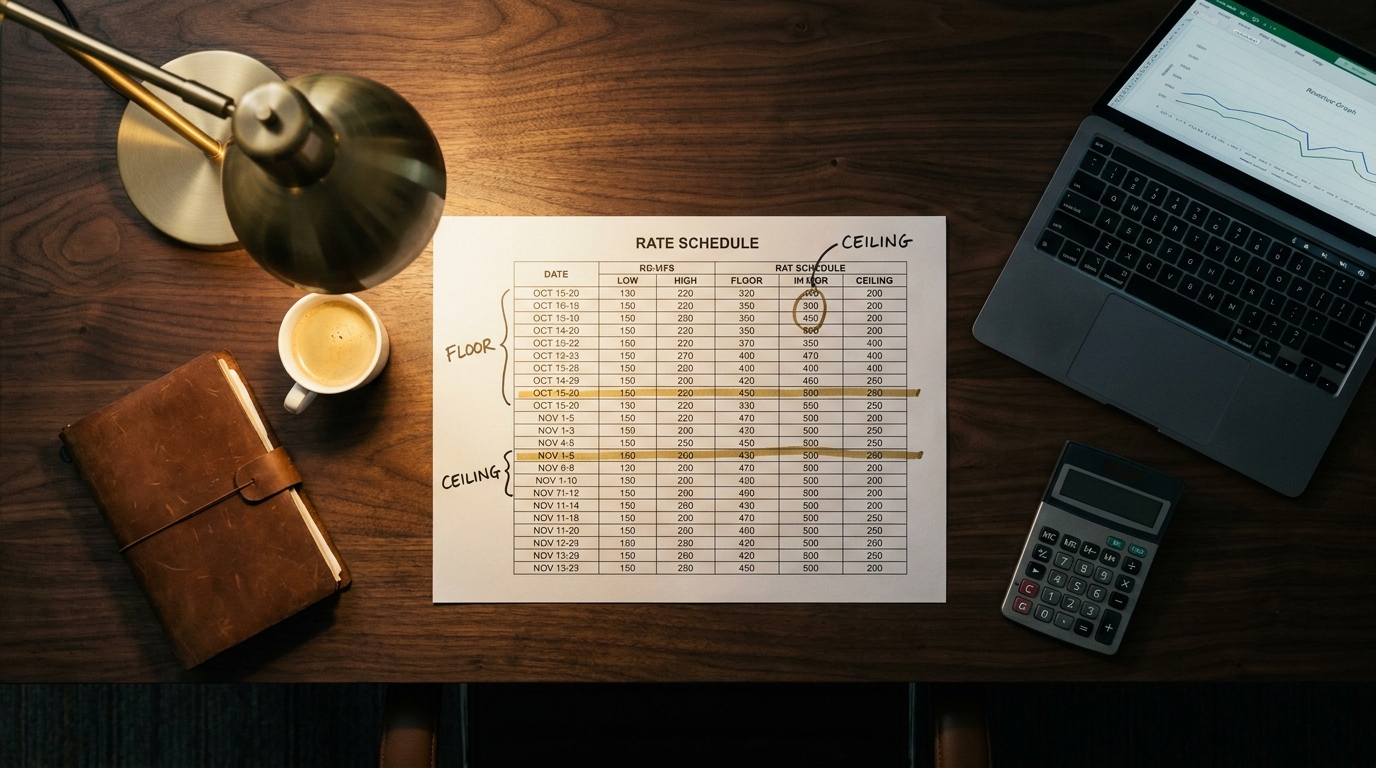
Cinematic overhead shot of a hotel revenue manager's desk with a printed rate schedule showing floor and ceiling markers, gold highlighter, dark wood desk, warm lamp, sharp editorial focusBefore any dynamic pricing system can work effectively, two numbers must be established: the minimum rate the property will ever sell at, and the maximum rate the market will absorb. Every dynamic pricing decision — seasonal tiers, day-of-week adjustments, occupancy triggers — operates within these two boundaries. Getting them wrong means the entire pricing structure is miscalibrated from the start.

These are the floor and the ceiling. They are not suggestions or soft limits — they are the hard constraints that define what is commercially viable for the property and what the market will bear at its peak.

Floor vs Ceiling — What Each Represents

The Floor
The minimum rate the hotel will sell at. Set by the cost per occupied room (CPOR) plus a brand floor that prevents rate devaluation. Selling below CPOR means paying to host a guest. Selling below brand floor undermines perceived value and future rate recovery.
The Ceiling
The maximum rate the market will absorb. Usually the highest rate ever successfully sold at the property, or the rate equivalent to the most expensive comparable property in the market at peak demand. Beyond this point, demand falls away faster than rate increases justify.

How to Calculate Your Floor: CPOR

The Cost Per Occupied Room (CPOR) is the total of all variable costs incurred when a room is occupied — housekeeping labour, guest amenities, laundry, utilities attributable to the room, and any reservation commission costs. CPOR does not include fixed costs like rent, property management fees, or staff salaries that exist regardless of occupancy. It represents the true variable cost of selling one room on one night.

The floor rate must be above CPOR. How far above depends on brand positioning. A budget property might set its floor at CPOR plus 10%. A mid-market property might set its floor at CPOR plus 25–30% to maintain a rate level consistent with its market position. The floor is also the rate at which the property should never sell — it is a no-go line, not a target.

The 2x Rule

A standard industry rule of thumb: the ceiling should be at least 2x the floor. If your floor is A$100 and your ceiling is A$120, you have A$20 of pricing range across all four seasons, all seven days of the week, and all occupancy levels. That is not enough to price dynamically. Either the floor is too high (costs need to be reduced) or the ceiling has never been tested (the property has historically underpriced at peak).

Why Many Independent Hotels Have the Wrong Ceiling

The most common ceiling error is setting it based on what the hotel has historically charged rather than what the market would absorb at peak demand. An independent hotel that has never pushed past A$180 during peak season may assume its ceiling is A$180 — when the actual market ceiling, evidenced by competitor OTA pricing during compression events, may be A$280 or higher. The ceiling is a market reference point, not a historical cap.

The way to test the ceiling is to look at what the highest-priced comparable competitor charges during its most compressed nights of the year. That figure represents the upper bound of what guests in that market have demonstrated willingness to pay for equivalent accommodation. It does not mean the property must charge that — but it establishes that the ceiling is at least that high.

RevParGenius Take

Floor and ceiling are not administrative details. They are the foundation of every pricing decision the property makes, and getting either of them wrong cascades through the entire rate structure.

Before implementing any dynamic pricing system, calculate CPOR accurately, set the floor above it with a brand buffer, and test the ceiling against live competitor OTA data during your market's most compressed periods. Then check that the range between the two is at least 2x. If it is not, you have a cost or a pricing confidence problem to solve before automation can help.

Free Market Analysis — See What Your Market Is Charging

Know Your Ceiling Before You Set Your Rates.

RevParGenius provides live OTA competitor pricing data for APAC hotel markets so you can see what the market ceiling actually is in your competitive set. Request a free analysis.

Request Your Free Market Analysis
Try Automated Dynamic Pricing Free for 14 Days

RevParGenius is an independent hotel market intelligence platform. Dynamic pricing automation referenced in this article is provided by RoomPriceGenie — not affiliated with any OTA or hotel chain.



Research methodology and disclosures: Market figures on RevPARGenius are calculated from room rates publicly advertised on online travel agency (OTA) channels, on one search basis (1 night, 2 adults, 1 room, cheapest offer shown). We publish a market figure only where at least 15 properties were priced. Figures are advertised asking prices. They do not show occupancy, bookings, negotiated corporate rates or revenue achieved. This article is general information, not pricing advice: each hotel sets its own rates independently. RevPARGenius and CloseMode are commercially affiliated platforms. Spotted an error in a market figure? Send a correction request.

Hotel Market Intelligence

Ready to see your market?

Request a market brief for your property: how your advertised rates compare with your market, night by night.

Request Market Analysis Explore Demand Analysis
Run Demand Analysis Free
RevEyeQ Market Intelligence Assistant • Online

See the market before it moves.

Get practical hotel revenue guidance and connect with our team for a tailored market analysis.

Your session has ended.

Ready to go deeper? Our team can run a full market intelligence report for your destination.

Contact Our Team

hello@revpargenius.com

We typically respond within one business day.

20 of 20 questions remaining

Disclaimer: RevEyeQ provides directional hotel revenue intelligence based on available live data and market signals. It may occasionally miss context, contain data gaps, or produce imperfect interpretations. Please use this analysis as a decision-support tool, not as the sole basis for pricing action. For a more accurate review, tailored recommendations, or commercial support, please email hello@revpargenius.com.

Looking to improve pricing performance automatically? Hotels using automated dynamic pricing typically benefit from forward-looking market monitoring, multiple daily rate updates, 365-day pricing coverage, user-controlled rate guardrails, and real-time response to demand shifts, events, and competitor movement. Many properties also see meaningful revenue uplift, time savings, and better consistency than manual pricing alone. If you'd like recommendations on whether this approach fits your property, email hello@revpargenius.com.