 AI Search · Hotel Marketing · 2026
RevParGenius Market Intelligence · April 2026 · Research across 15+ sources
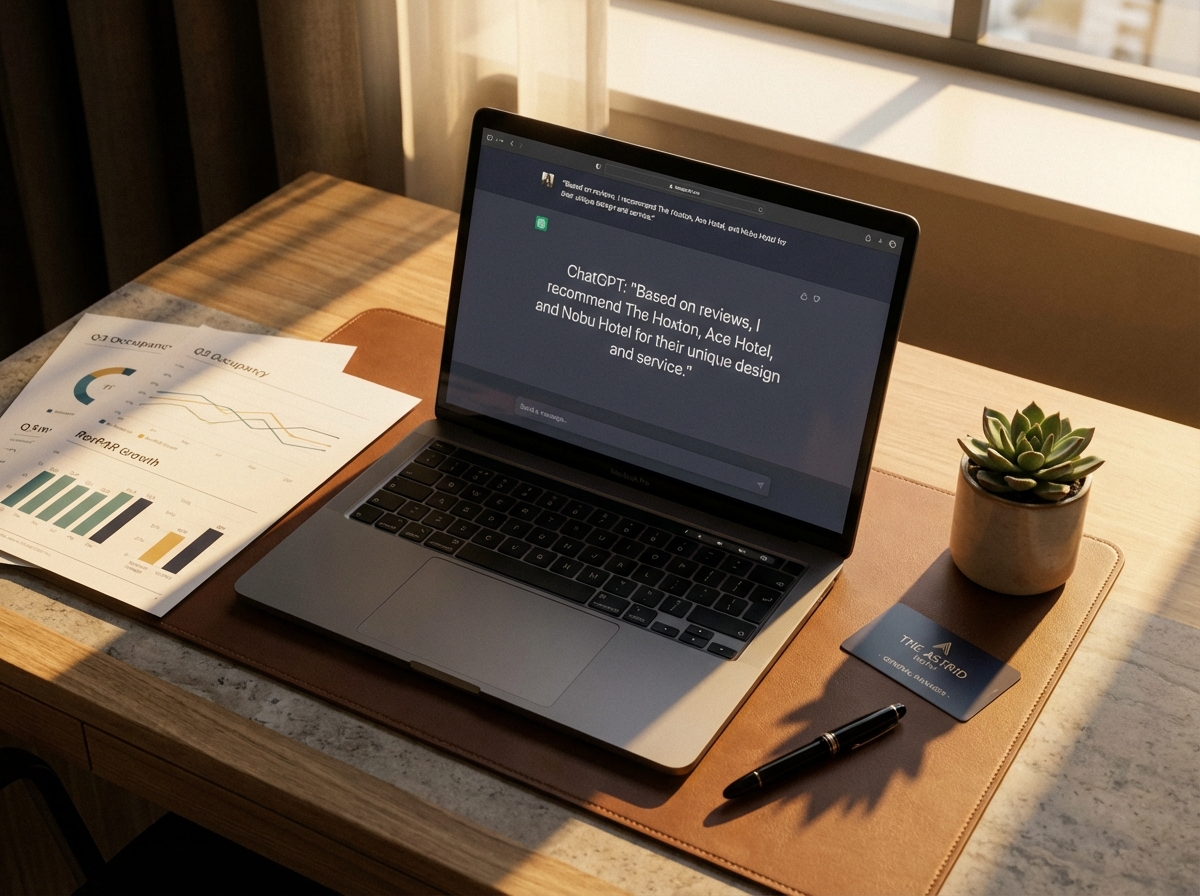
A traveller opens ChatGPT and types: "Find me a quiet boutique hotel in Bali with a rice paddy view, an infinity pool, and vegan breakfast options." ChatGPT responds with five specific hotel names. There is no page two. No comparison table. No OTA listing. Either your hotel is one of those five — or it does not exist to that traveller. This is the new reality of hotel discovery in 2026, and 94 percent of hotels are currently invisible in it.
The Search Shift That Is Already Happening
For twenty years the path to hotel discovery was predictable. A traveller typed a destination into Google, scrolled through OTA listings, spent 45 days comparing options across 141 pages of content, and eventually booked. Hotels optimised for Google rankings, paid OTA commissions, and accepted the distribution structure as fixed.
That structure is shifting — faster than most hotel GMs realise. ChatGPT reached 900 million weekly active users by February 2026, up from 100 million two years earlier. Booking.com surveyed 37,000 travellers across 33 markets and found 67 percent had already used AI in some aspect of travel planning, with 98 percent of those using it specifically for planning and booking. Phocuswright's 2025 study found nearly 4 in 10 US travellers used generative AI for trip research in the past 12 months — an 11-point increase in a single year.
Traditional search is declining in parallel. Google's global market share dipped below 90 percent for the first time since 2015. Desktop searches per user fell nearly 20 percent year-over-year. Gartner predicted traditional search volume would drop 25 percent by 2026 due to AI chatbots. AI search platforms collectively saw traffic increase by over 721 percent in one year.
AI search is binary — not ranked. There is no page two in ChatGPT. Each hotel query produces 3 to 5 specific recommendations. Your property is either in the consideration set or it does not exist. This makes early AI search optimisation disproportionately valuable compared to traditional SEO.
For hotel GMs and owners the implication is direct and urgent. The channel where your future guests are beginning their search is one where most hotels have zero presence — not a low ranking, but complete absence.
APAC Is Leading AI Search Adoption
Asia-Pacific dominates global ChatGPT usage, accounting for an estimated 28.6 percent of all ChatGPT traffic — the largest regional share worldwide. Southeast Asian users are 2.5 times more likely to access ChatGPT daily compared to Western Europe, and 51 percent of users in Asia report using it weekly. This is not a future trend in the region. It is the current reality.
APAC traveller sentiment underscores the urgency. Booking.com's 2025 report found that 95 percent of APAC travellers are excited about AI's role in travel, 93 percent plan to use AI in trip planning, and 82 percent are already familiar with AI tools. Expedia's Q4 2024 data showed APAC recording a 25 percent quarter-over-quarter increase and 35 percent year-over-year uptick in AI-influenced search volumes — the strongest growth of any region globally.
ChatGPT Adoption Across Your Target Markets
What Is GEO — And Why Traditional SEO Is Not Enough
Generative Engine Optimisation (GEO) is the practice of optimising your hotel's content and online presence to appear as a recommendation in AI-generated responses. The term was established by a landmark academic paper from Princeton University, Georgia Tech, the Allen Institute for AI, and IIT Delhi, presented at KDD 2024.
The distinction from traditional SEO matters enormously. A hotel can rank number one on Google and never appear in a single ChatGPT recommendation. Traditional SEO optimises for keyword matching, backlinks, and click-through rates. GEO optimises for semantic clarity, factual density, structured data, and citation-worthiness. Traditional SEO competes for ten spots on page one. GEO competes for three to five mentions in a single AI response — it is binary. You are either cited or invisible.
Traditional SEO vs Generative Engine Optimisation
| Factor | Traditional SEO (Google) | GEO (ChatGPT / AI Search) |
|---|---|---|
| Competition | 10 spots on page one | 3–5 recommendations per response |
| Ranking signal | Keywords, backlinks, page authority | Reviews, structured data, factual content |
| Search engine used | Google index | Bing index — not Google |
| Result format | Ranked list with links | Synthesised narrative with hotel names |
| Content that works | Keyword-optimised pages | Specific, factual, answer-shaped content |
| Reviews impact | Moderate — signals trust | Critical — drive 71% of AI recommendations |
The most counterintuitive finding from research into hotel AI visibility: Bing — not Google — is the gateway to ChatGPT recommendations. A landmark study found that 87 percent of ChatGPT citations match Bing's top results, compared to only a 56 percent match rate with Google. Hotels that have spent years optimising exclusively for Google are building on the wrong foundation for AI search visibility.
The Five Factors That Determine Your Hotel's AI Visibility
Research across hundreds of AI hotel recommendation queries reveals five clear factors that determine whether your property appears in ChatGPT responses — and how high up.
Guest Reviews
TrustYou research found that 71 percent of AI-generated hotel recommendations are driven by guest reviews. AI models trust social media posts and guest reviews more than hotel websites — only 25 percent of AI answers come from hotel website content. The rest comes from reviews, travel blogs, and publicly available third-party sources. AI systems also cross-check marketing claims against review sentiment — properties with inconsistent scores or no recent feedback are frequently excluded entirely.
Structured Data and Schema Markup
Sites with schema markup showed a 30 percent improvement in accuracy and quality of ChatGPT data about those businesses. For hotels, critical schema types include Hotel, FAQPage, Review, LocalBusiness, Offer, and Event markup in JSON-LD format. Research found that 71 percent of pages cited by ChatGPT include structured data — yet 77 percent of hotel websites currently lack adequate structured data. This is one of the largest and most actionable gaps in the dataset.
Third-Party Mentions and Editorial Coverage
AI models cross-reference multiple independent sources. Hotels mentioned in editorial roundups, "best of" lists, travel blogs, and media coverage receive stronger visibility signals. Wikipedia accounts for 47.9 percent of ChatGPT's top cited sources for factual queries. TripAdvisor, Reddit travel communities, and curated publications like Condé Nast Traveler are also heavily referenced. Being mentioned once in a credible source matters more than updating your own website a dozen times.
Answer-Shaped Content — Not Brochure Language
Hotels need to replace vague marketing language with specific, extractable facts. "Luxury amenities and a great location" is useless to an AI. "25-metre heated rooftop infinity pool with panoramic views of the city skyline, open daily 6am to 10pm, accessible to all guests including day-use bookings" gives the AI citable information it can include in a response. FAQ pages addressing natural-language questions — "Is the hotel pet-friendly?" "What restaurants are within walking distance?" — are particularly effective for AI citation. The Princeton GEO study found that adding statistics to content improved AI visibility by up to 41 percent.
Bing Visibility and OTA Presence
ChatGPT searches Bing — not Google — when generating hotel recommendations. Claiming and verifying your Bing Places for Business listing is now a strategic priority, not an afterthought. Simultaneously, research found that Booking.com appeared in 95.3 percent of all AI hotel queries. OTAs receive 22.9 percent of all AI-cited hotel URLs while independent hotel websites receive only 11.8 percent. Hotels must maintain strong OTA listings while building their own direct content presence — the two are complementary strategies, not alternatives.
The Direct Booking Opportunity — And the OTA Threat
AI search is creating a new direct booking opportunity for independent hotels — but OTAs are moving faster to capture it.
Booking.com and Expedia launched as ChatGPT Apps immediately upon OpenAI's marketplace launch in October 2025. They were the first travel businesses embedded directly inside ChatGPT. No individual hotel brand had obtained a direct integration at that point. When a traveller now asks ChatGPT "find me a hotel in Queenstown" and clicks Book, the OTA collects its 15 to 25 percent commission — from a booking that started in an AI interface most hotel GMs are not yet thinking about.
But the counter-infrastructure is emerging. On March 4, 2026, Lighthouse launched The Hotels Network app — the first direct booking app for hotels inside ChatGPT. When a traveller asks ChatGPT for hotel recommendations, the app pulls hotel-provided content, displays brand-verified descriptions with live rates, and provides a one-click link to the hotel's own website for booking — with zero OTA commissions. It supports 20,000-plus hotels in 100-plus countries and is available to properties of every size.
AI-referred website visitors convert 23 times better than traditional organic traffic and deliver 4.4 times higher economic value per visit. AI-referred sessions surged 527 percent year-over-year between January and May 2025. The traffic is small but the conversion quality is extraordinary — and growing fast.
The revenue maths are straightforward. A 30-room independent hotel converting even one additional direct booking per week that would otherwise have gone through an OTA saves between $45 and $150 in commissions per booking — $2,340 to $7,800 per year from a single weekly conversion shift. At meaningful AI search volume, the numbers become material very quickly.
What Your Hotel Should Do Right Now
AI search optimisation for hotels is not technically complex. It is structurally different from traditional SEO — but the foundational steps are accessible to any property regardless of size or technical resources. Here is the priority order.
Step 1 — Allow AI Crawlers Access to Your Website
Check your robots.txt file and ensure it does not block GPTBot (ChatGPT), ClaudeBot (Claude), PerplexityBot, and GoogleExtended (Google's AI). Without this step, AI systems cannot learn about your property from your website regardless of what content you have. This is the most fundamental requirement and the most commonly overlooked one.
Step 2 — Claim and Optimise Bing Places for Business
Go to bingplaces.com and claim your property's listing if you have not already. Verify your Bing Webmaster Tools account and submit your sitemap. Ensure your name, address, phone number, and website are perfectly consistent across every platform. Since 87 percent of ChatGPT citations match Bing's top results, Bing indexing is now a direct revenue priority for every hotel.
Step 3 — Build a Comprehensive FAQ Page
Create a dedicated FAQ page on your hotel website that answers real traveller questions in natural language. Include your check-in and check-out times, parking details, pet policy, pool hours, restaurant hours, distance to key attractions, transfer options from the airport, accessibility features, and cancellation policy. Write the questions exactly as a traveller would ask them. This is the content format AI systems are most likely to cite in response to specific queries.
Step 4 — Replace Marketing Language With Specific Facts
Audit your hotel website and OTA listings for vague marketing phrases. Replace every instance of "luxurious amenities" with a specific list of what those amenities actually are. Replace "great location" with the actual walking time to the beach, the train station, or the city centre. AI systems cannot cite vague claims — they can only cite specific, verifiable information. The more specific your content, the more citable it becomes.
Step 5 — Actively Manage Your Review Presence
Since reviews drive 71 percent of AI hotel recommendations, your review management strategy is now directly linked to your AI search visibility. Respond to every Google and TripAdvisor review — positive and negative. Implement a systematic process for requesting reviews from every checked-out guest. Aim for a minimum of 50 recent reviews on each major platform. Properties with consistent, frequent, recent reviews receive meaningfully stronger AI visibility signals.
Step 6 — Pursue Editorial Coverage
Reach out to travel bloggers, local destination guides, and regional publications for coverage of your property. A single feature in a credible travel publication can do more for your AI search visibility than months of website updates. AI systems trust editorial third-party sources far more than self-promotional hotel content. Even a mention in a "best boutique hotels in [your city]" roundup on a well-trafficked travel blog creates a citation signal that compounds over time.
The Princeton GEO study found that lower-ranked websites benefit significantly more from AI search optimisation than already top-ranked sites. With 94.3% of hotel websites currently invisible to AI and major chains still focused on operational tools rather than search visibility, independent properties with compelling stories and well-structured content can establish AI search presence in their markets before the landscape becomes competitive. The window is open now — but it is closing.
The Bottom Line
AI search is not a future consideration for hotel marketing. It is the present reality for 900 million weekly users — including the travellers who will book your property this quarter, if they can find it.
Three things are simultaneously true about where the industry stands in April 2026. AI search adoption is accelerating faster than most hotel owners realise. The competitive landscape for AI search visibility in hospitality is still largely uncontested — especially for independent and boutique hotels in APAC markets. And the structural advantage of acting early in AI search is significantly higher than in traditional SEO, because the ranking mechanism rewards quality and specificity over budget and domain age.
Hotels that optimise for AI search visibility now — by allowing AI crawlers, claiming Bing presence, building specific FAQ content, managing reviews actively, and pursuing editorial coverage — are establishing a distribution advantage that will compound as AI search adoption grows. Hotels that wait until AI search is competitive are building on someone else's head start.
The traveller asking ChatGPT to recommend a hotel in your market is there right now. The question is whether your property is part of the answer.
Is Your Hotel Visible in ChatGPT?
RevParGenius provides AI visibility analysis for APAC hotel markets — checking whether your property appears in ChatGPT responses, identifying the gaps, and mapping the specific steps to improve your AI search presence. Request a free market analysis and find out where your hotel stands before your competitors do.
Live data. No guesswork. Just signal.
Sources & References
- OpenAI / DemandSage — ChatGPT Statistics 2026: Users, Revenue & Growth · demandsage.com/chatgpt-statistics
- Booking.com — Global AI Sentiment Report 2025 · news.booking.com/bookingcom-releases-the-global-ai-sentiment-report
- Phocuswright — Search Slips, AI Surges · phocuswright.com/Travel-Research/Research-Updates/2025/search-slips-ai-surges
- Gartner — Search Engine Volume to Drop 25% by 2026 Due to AI Chatbots · gartner.com/en/newsroom/press-releases/2024-02-19
- Siana Marketing — ChatGPT Usage by Country Statistics February 2026 · sianamarketing.com/resources/chatgpt-usage-by-country-2026
- MARKETECH APAC — OpenAI Expands ChatGPT Go to 16 Asian Countries · marketech-apac.com
- PhocusWire / WiT — Inside Asia Pacific's Travel Powerhouse: 10 Trends Redefining The Next 20 · phocuswire.com
- Princeton / arXiv — GEO: Generative Engine Optimization (KDD 2024) · arxiv.org/abs/2311.09735
- Search Engine Land — Bing, Not Google, Shapes Which Brands ChatGPT Recommends · searchengineland.com/bing-ranking-chatgpt-visibility-study-473680
- Nokumo Research — How Does AI Recommend Hotels? 450 Queries, 4 Models, 5 Countries · nokumo.net/en/blog
- TrustYou — AI Response Generator and Guest Reviews · trustyou.com
- Lighthouse / Hotels Network — First Direct Booking App for Hotels Launches in ChatGPT · mylighthouse.com/resources/blog
- PhocusWire — Hotels Push Live ChatGPT Integrations as AI Search Goes Bookable · phocuswire.com
- PhocusWire — From SEO to GEO, Hotels Confront the Future of Digital Discovery · phocuswire.com/hotels-AI-seo-geo-strategy
- Hospitality Net — The AI Search Shift Is Here and the Window to Act Is Now · hospitalitynet.org/news/4131516
RevParGenius Market Intelligence · AI Search & Hotel Marketing · April 2026
Live data. No guesswork. Just signal.