
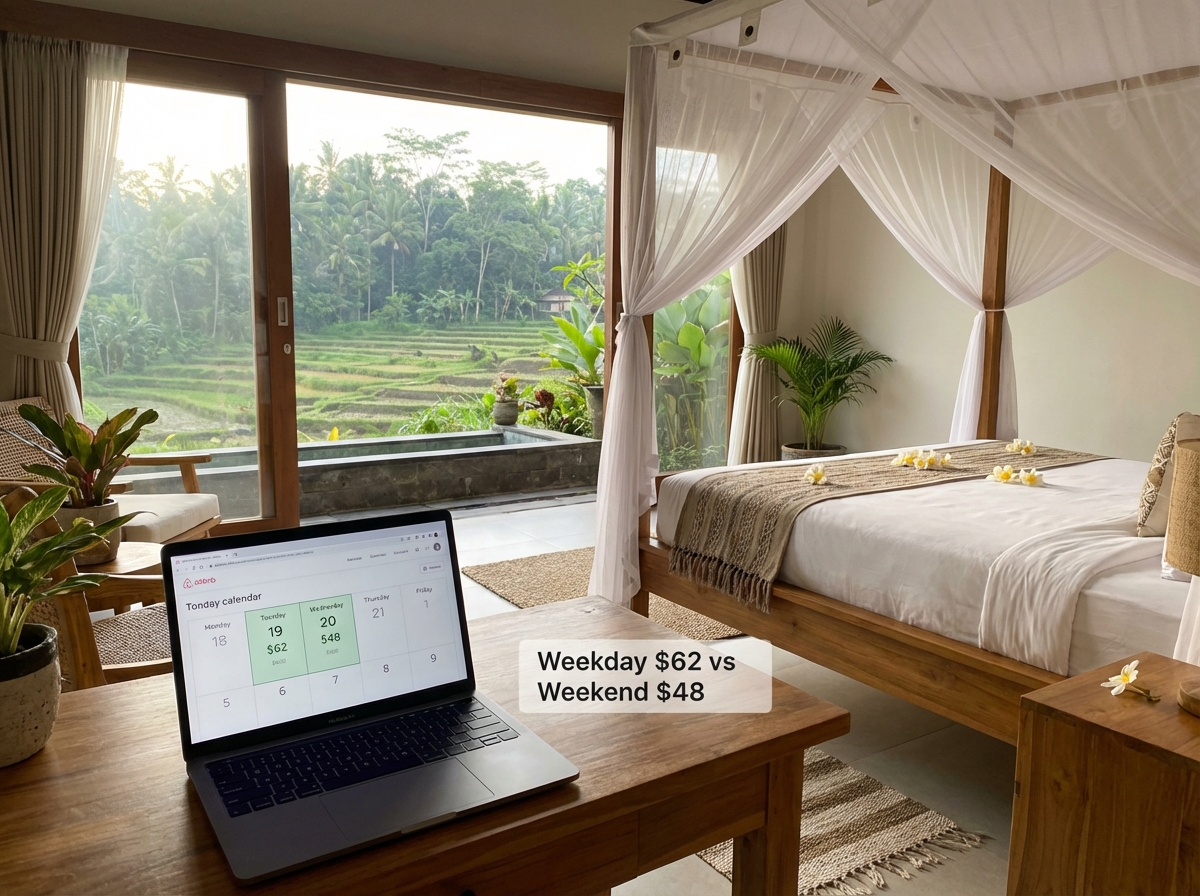
The Ubud Pricing Inversion: Weekdays Are Premium
Ubud is Bali's retreat and wellness capital. Guests arrive Sunday or Monday for 4-7 night stays, typically booking through retreat centers, wellness platforms, or direct channels — not OTA impulse. By the time Saturday arrives, these guests are mid-stay. New arrivals on weekends are rare.
This creates a counterintuitive pricing dynamic: Ubud's weekday rates are significantly higher than weekend rates. Yet most Airbnb hosts in Ubud apply the standard hospitality playbook: raise rates on weekends. This is systematically wrong for the Ubud market.
The data is clear: $62 weekday average vs. $48 weekend average. That's a -23% weekend compression. Hosts who understand this dynamic are outperforming peers by 15-20% annually on RevPAR. Hosts applying weekend premiums are directly harming their revenue.
Live Ubud Airbnb Data (May 2026)
This data comes from live May 2026 Airbnb and Booking.com listings across Ubud. We've sampled rates from 60+ properties ranging from budget homestays to luxury villas, capturing the full market range.
| Property / Tier | Weekday Rate | Weekend Rate | Guest Type |
|---|---|---|---|
| Budget Tier ($15-38) | |||
| Ubud Guesthouse Economy | $18 | $15 | Backpackers, budget travelers |
| Tegallalang Homestay | $28 | $22 | Moderate budget, rice field proximity |
| Penestanan Rooms | $35 | $28 | Budget conscious, location seekers |
| Mid-Tier ($40-65) | |||
| Kahayana Suites | $42 | $38 | Professional travelers, retreat participants |
| Puri Kantor Legacy | $58 | $102 | Luxury niche, weekend exception (rare) |
| Ubud Accommodation Co. | $52 | $45 | Balanced retreat market |
| Premium Tier ($65-120) | |||
| Inara Alas Harum (5★) | $118 | $105 | Luxury, yoga retreat groups |
| Private Villa Ubud | $75 | $62 | Family retreats, wellness packages |
| Market Average | $62 | $48 | -23% weekend compression |
Data source: Live Airbnb and Booking.com listings, May 2026, Ubud core area. Weekday = Mon-Thu averages; Weekend = Fri-Sun averages.
Why Ubud Has Negative Weekend Uplift
Understanding Ubud's pricing structure requires understanding the guest type and arrival pattern.
Retreat Market Structure
Ubud is built on 4-7 day wellness retreats, yoga courses, and meditation programs. These are scheduled with fixed start dates (Monday, Wednesday, or Sunday). Guests arrive to begin the retreat; weekends are mid-program.
Fixed Arrival Schedules
Retreat centers and wellness platforms schedule programs on specific days. Most retreats start Sun/Mon or Wed/Thu. Guests book these bundles at fixed prices. Weekends capture no new arrivals; they're occupied by mid-stay guests from earlier in the week.
Blended Pricing
Retreat packages are sold as 4-7 day bundles at blended rates. A $280 4-day retreat is $70/night regardless of whether it spans Mon-Thu or Wed-Sat. Weekend rate increases don't capture new demand; they cannibalize package economics.
This is fundamentally different from Canggu (where weekends are incremental leisure arrivals) or Uluwatu (where weekends are experience-premium payers). In Ubud, weekends are occupied by guests who've already paid. Raising weekend rates simply lowers the effective per-night price for those occupied days.
Guest Arrival Pattern: The Data Behind the Pricing
Ubud's average guest length-of-stay (LOS) is 4-7 nights. If we track when these guests actually arrive, we see a concentrated pattern:
Typical Ubud Arrival Distribution
Notice: 70% of arrivals happen Sun-Tue. By the time Saturday rolls around, 70% of the property is occupied by guests who arrived earlier in the week.
Now imagine this scenario: You set a $62 weekday rate and a $75 weekend premium. A Monday arrival checking out Friday (4 nights) might have paid $248 at the weekday rate, or $270 if you applied a weekend premium. But the guest booked a single rate through an intermediary; your pricing doesn't matter. What does matter is Saturday: that's a new potential arrival, and your $75 weekend rate prices away the guests who would have booked.
The Exact Ubud Pricing Strategy
Fundamental Principle: Weekdays Are Premium; Don't Discount Them
Your base rate is set on weekday occupancy. Weekdays are when the retreat market is most active. Monday-Thursday should carry your highest nightly rates. Weekends should be flat or slightly lower (to attract overflow).
Step 1: Position by Tier and Guest Type
Ubud has three clear positioning tiers. Choose which tier you compete in — and price accordingly.
Budget Tier ($30-45/night weekday)
Mid-Tier ($50-70/night weekday)
Premium Tier ($100-130/night weekday)
Step 2: Build Your Weekly Calendar (Inverted Model)
This is the critical difference from standard hospitality: your premium days are Mon-Wed, not Fri-Sat.
Sample Mid-Tier Calendar ($50-58)
Why this structure works: Your peak days align with retreat schedules, not with generic "weekend leisure." Your lowest rate (Saturday) captures late arrivals and walk-ins, but doesn't cannibalize Mon-Wed bookings. A guest booking a 5-night retreat starting Monday will pay $68+65+62+58+52 = $305 (blended $61/night), which is competitive and captures the mid-tier market.
Step 3: Package Pricing for Retreats
Ubud's revenue comes from length-of-stay bookings. Create explicit retreat packages that anchor to your weekday premium and discount strategically.
Example: 5-Night Retreat Package (Mid-Tier)
By offering explicit retreat packages (yoga + 5 nights, cooking class + 4 nights), you're meeting guest behavior exactly. Retreat centers and intermediaries book packages, not individual nights. Give them a clear, good deal and lock the occupancy.
Step 4: Occupancy Floor Protection
Your lowest rate (Saturday) should still generate decent volume. Don't go so low that you destroy weekday rates in the market's perception.
Rate Floor Rule
Step 5: Seasonal Adjustments
Ubud's retreat schedule has seasonal patterns. Adjust rates accordingly.
Seasonal Calendar Adjustments
The Revenue Impact: Correct vs. Incorrect Pricing
Scenario 1: Common Mistake — Weekend Premium at $68/night
Scenario 2: Correct Strategy — Inverted Premium (Mid-Tier Example)
Why the improvement: You're not just changing prices — you're aligning pricing with actual demand. Mid-week occupancy stays strong (locked in by retreat bookings); weekend becomes a profit center for overflow rather than a rate collapse. Annual impact: +$1,860 on a single property.
Common Ubud Host Mistakes
Mistake 1: Applying Standard Weekend Premiums
Ubud hosts sometimes set Friday-Saturday at +20-30% above weekday rates. This is backwards. It prices away the only arrivals that matter (late-week walk-ins) and doesn't capture retreat demand (which is mid-week). Fix: Invert the pricing — premium on Mon-Tue, discount on Fri-Sat.
Mistake 2: Setting Flat Rates Across All Days
Some hosts charge $55/night every single day, thinking it avoids complexity. This leaves 15-20% on the table by not capturing weekday retreat demand. Fix: Implement a simple 7-day calendar with clear Mon-Tue peaks and Sat floors.
Mistake 3: Not Offering Explicit Retreat Packages
The retreat market (yoga centers, wellness platforms) books packages, not individual nights. If you don't offer a visible 5-night or 7-night package, you're invisible to your target market. Fix: Create and promote retreat packages on Airbnb, direct site, and wellness platforms.
Mistake 4: Setting Aggressive LOS Discounts
Some hosts offer 30-40% discounts for 7+ nights. This collapses weekday revenue. A 10-15% discount is sufficient to lock the retreat market without destroying your rate. Fix: Cap LOS discounts at 15% maximum.
Mistake 5: Ignoring Channel Mix
Ubud's retreat market uses a mix of channels: direct bookings (40%), Airbnb (30%), wellness platforms like Udaya, Yoga Alliance (20%), Booking.com (10%). Hosts who only focus on Airbnb miss huge distribution. Fix: List on multiple channels and manage inventory across them carefully.
Implementation Checklist for Ubud Hosts
Week 1: Audit Current Pricing
Check if you're applying a weekend premium. If so, reverse it. Calculate your current blended rate. Research 5 comparable properties in your tier.
Week 1: Position Your Tier
Determine if you're budget ($35-45), mid ($50-70), or premium ($100-130). Set your weekday peak rate accordingly.
Week 2: Build Inverted Calendar
Create a 7-day calendar with Mon-Tue peaks, weekend floors. Implement in Airbnb and Booking.com host settings.
Week 2: Create Retreat Packages
Build explicit 5-night and 7-night retreat packages on your Airbnb calendar and direct booking site. Price at 10% discount to nightly rates.
Week 3: Expand Distribution
List on yoga platforms (Udaya, Yoga Alliance), wellness sites, and local retreat directories. Direct bookings often avoid Airbnb fees.
Week 4: Monitor & Optimize
Track occupancy by day and booking channel. If Mon-Tue occupancy drops, your weekday rate may be too high. If weekend is empty, reduce Saturday floor slightly.
The Bottom Line for Ubud Hosts
Ubud is not Canggu. It's not Uluwatu. It's a retreat market with fundamentally different guest arrival patterns. Applying standard "weekend premium" hospitality playbook is economically harmful.
The data is unambiguous: weekdays earn 23% more than weekends. This is not seasonal variation or temporary market shift. It's structural — baked into the retreat calendar and booking behavior.
Hosts who invert their pricing (premium weekdays, discount weekends) and build retreat packages are currently outperforming flat-rate peers by 15-20% annually. That's the difference between a sustainable villa operation and a struggling one.
The fix is simple, takes 2-3 hours to implement, and delivers immediate results. Your competitors have already figured this out. The question is: how long before you do?
Get Your Ubud Retreat Package Strategy
We'll analyze your current pricing, benchmark against comparable properties, and build a custom calendar for your villa with retreat package pricing.
Get Ubud Pricing StrategyIncludes 3-month performance monitoring and calendar optimization. Free consultation for villa owners.