Reviewed by Michael Andrews, Hotel Market Intelligence Researcher · 4 June 2026 · 8 min read
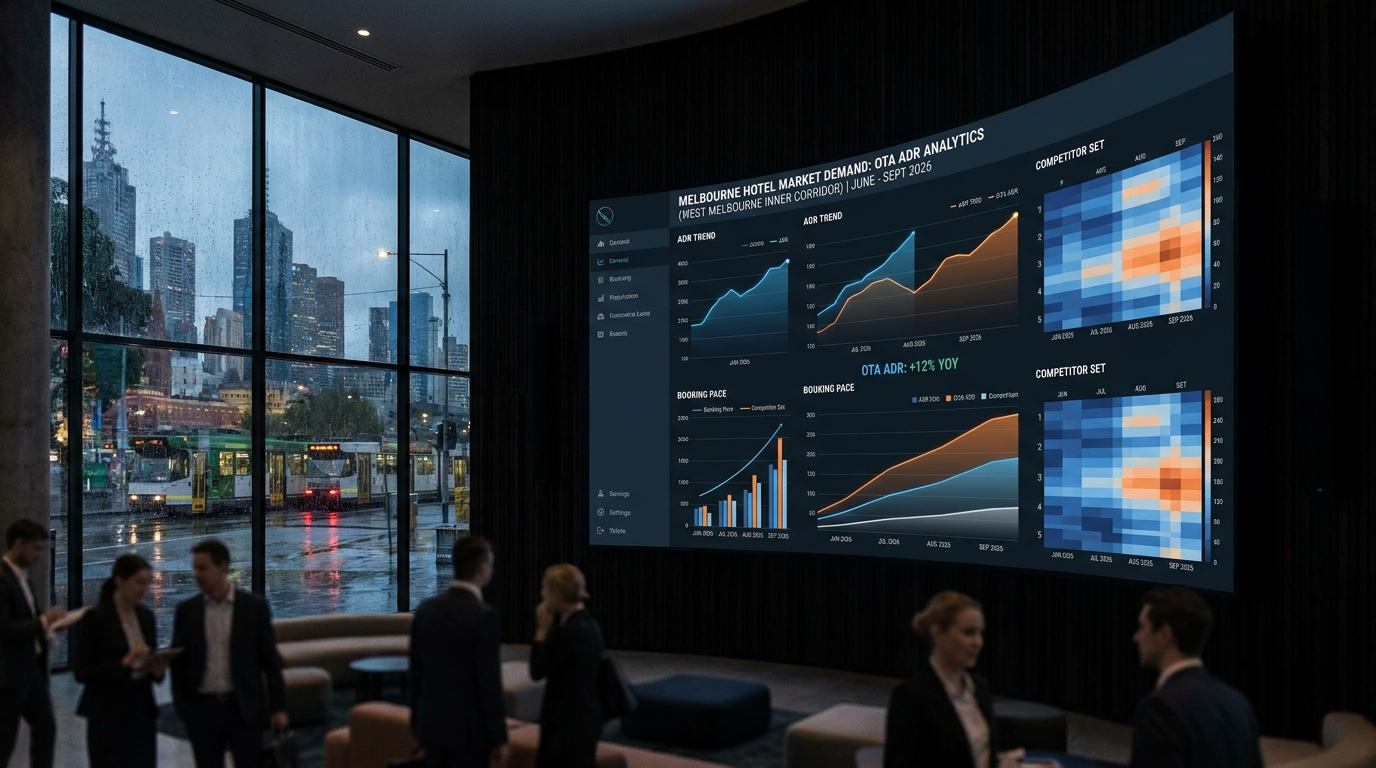
Live OTA data across 24 matched Melbourne hotel comps for the June–September 2026 window shows a weekday ADR of A$176 and weekend ADR of A$231 — a +31% weekend premium that tracks above Melbourne's typical winter shoulder norms of +15–25%. The market score is 80.66/100 and rising, with STR RevPAR at A$134 (+6.85% year-on-year). Three compression weeks stand out: 11–13 July, 18–20 July, and 15–17 August — each delivering +30% weekend uplift and warranting active rate management.
The West Melbourne / inner-city hotel corridor is entering its 2026 winter window in better shape than typical shoulder-season benchmarks would suggest. A RevPARGenius live OTA scan tracking 20 properties across 13 weeks — with 16 to 20 clean matched comps per week — shows a market delivering consistent weekend compression, a rising demand trend, and three distinct peak weeks where ADR uplift exceeds 30%.
This report covers the June–September 2026 demand window for the West Melbourne hotel market, using live Booking.com OTA data and short-term rental benchmarks. It is intended as a market-level reference for hotel operators, revenue managers, and accommodation investors researching demand conditions in Melbourne's inner-city precinct.
What does the live OTA data show about West Melbourne hotel rates for June–September 2026?
The RevPARGenius scan tracked 20 raw hotels across 13 consecutive weeks, producing 223 aggregate clean comp observations — an average of 17.2 matched comps per week, with a low of 16 and a high of 19. Confidence level is rated MEDIUM — OTA data is Verified, but STR occupancy data is partially available and event attendance figures are missing for the three small events in the window.
The headline findings:
Weekday ADR (Mon): A$176 | Weekend ADR (Sat): A$231 | Weekend Uplift: +31% (raw) / +27% (outlier-adj.) | ADR Range: A$122 – A$636 | Volatility: 36.6% CV (High)
The +27% average weekend uplift is tracking above Melbourne's typical mid-winter shoulder-season norms, which historically show +15–25% weekend premiums. The high combined volatility (36.6%) signals that individual week compressions swing between 15% and 33%, making static pricing a significant revenue risk — the market is moving, and properties that don't move with it are giving up A$20–40 per room per night on peak Saturdays.
The STR layer adds context: with 32,455 active STR listings across Melbourne, inventory remains plentiful at the macro level, but this figure is a directional signal only. The OTA matched-comp data provides a cleaner read of the actual competitive hotel market and is the more reliable input for revenue management decisions in this window. For a full explainer on how to combine OTA and STR signals, see our hotel market demand intelligence guide.
Which weeks show the strongest compression in Melbourne's inner-west hotel market?
The 13-week weekly breakdown identifies three distinct peak compression windows where weekend uplift exceeds +30% — and several soft-premium weeks where static pricing at weekday rates would be adequate. Here is the full week-by-week picture:
| Week | Mon ADR | Sat ADR | Uplift | Signal |
|---|---|---|---|---|
| Sat 6 – Mon 8 Jun | A$163 | A$273 | +67.9% | Outlier-driven |
| Sat 13 – Mon 15 Jun | A$163 | A$191 | +16.8% | Soft Premium |
| Sat 20 – Mon 22 Jun | A$167 | A$212 | +27% | Healthy Premium |
| Sat 27 – Mon 29 Jun | A$158 | A$191 | +20.5% | Healthy Premium |
| Sat 4 – Mon 6 Jul | A$173 | A$206 | +18.9% | Soft Premium |
| Sat 11 – Mon 13 Jul ⚡ | A$174 | A$227 | +30.5% | Peak ↑ |
| Sat 18 – Mon 20 Jul ⚡ | A$185 | A$242 | +30.8% | Peak ↑ |
| Sat 25 – Mon 27 Jul | A$180 | A$214 | +18.7% | Soft Premium |
| Sat 1 – Mon 3 Aug | A$186 | A$226 | +21.4% | Healthy Premium |
| Sat 8 – Mon 10 Aug | A$189 | A$230 | +21.5% | Healthy Premium |
| Sat 15 – Mon 17 Aug ⚡ | A$184 | A$244 | +32.7% | Peak ↑ |
| Sat 22 – Mon 24 Aug | A$186 | A$226 | +21.6% | Healthy Premium |
| Sat 29 – Mon 31 Aug | A$167 | A$192 | +15.2% | Soft Premium |
⚡ = Peak compression weeks. Purple highlighted rows indicate +30%+ weekend uplift. Source: RevPARGenius live OTA scan, West Melbourne comp set, 13 weeks to 31 August 2026. Data: Booking.com matched comps + STR benchmarks.
The three peak weeks — July 11–13, July 18–20, and August 15–17 — are the critical rate management windows. The July double-peak (back-to-back +30% uplift weeks) aligns with mid-winter school holidays and AFL minor round fixtures at the MCG, which is approximately 4km from the West Melbourne precinct. The August 15–17 peak is the highest Saturday ADR in the window at A$244 and warrants specific investigation: this date range falls within the Victorian school spring holiday build-up and typically coincides with a cluster of AFL finals lead-up fixture dates.
How do current events affect Melbourne hotel demand in the June–September window?
The RevPARGenius events scan identified three live events in the immediate 90-day window, all classified as low-impact / noise given missing attendance data:
None of the three detected events are expected to drive meaningful hotel compression — they are single-venue arts and music events with limited overnight demand pull. The more significant demand drivers for this 90-day window are structural rather than event-driven: Melbourne's winter AFL minor rounds (running through August), the Queen's Birthday long weekend (June 9), and the school holiday windows that bracket the July peak.
Melbourne is structurally an events-driven hospitality market — the AFL season (March–September), Melbourne Cup (November), Australian Open (January), and Formula 1 Grand Prix (March) anchor its four major compression calendars. The June–September window falls in the AFL active season, which generates consistent stadium-adjacent demand, particularly for Friday and Saturday nights when games are scheduled at Marvel Stadium (Docklands, approximately 1.5km from West Melbourne) or the MCG. Properties in West Melbourne and the inner-city corridor benefit from spill demand from both venues when key match-ups drive above-average crowd attendance.
For the specific peak weeks identified above, the July 11–13 and 18–20 windows should be cross-referenced against the AFL fixture for those weekends — if marquee games (Melbourne Derby, traditional rivals, interstate visits) are scheduled at Marvel Stadium or MCG during those dates, the +30% uplift has a structural event anchor and rate floors can be set with higher confidence. See our analysis of how AFL compression windows affect Australian hotel revenue strategy in 2026 for the full framework.
Hotel Website
Does your Melbourne hotel website convert peak-week demand before guests reach Booking.com?
The July compression weeks are now visible in live OTA data. Hotels that capture those guests directly — rather than through Booking.com at 15–18% commission — retain significantly more revenue per occupied room. See the direct booking gaps most Melbourne independent hotels miss.
Read: Why Your Hotel Website Isn't Getting Direct Bookings →Who are the matched comp set hotels operating in Melbourne's inner-city corridor?
The RevPARGenius precision match algorithm identified 24 properties as the active competitive comp set for the West Melbourne / inner-city corridor in this window. These are the hotels whose Booking.com pricing most directly sets the market floor and ceiling for mid-tier and upper-midscale accommodation in the precinct:
One data quality note: Week 1 (June 6–8) showed an outlier-driven uplift of +37.9% which is flagged as non-representative. RevPARGenius data shows Imagine Marco was priced 3.8x above the weekend average in that week — a single-property outlier that inflates the raw uplift figure. After outlier adjustment, Week 1 likely represents a +20–24% market-level uplift. Properties using raw unfiltered comp data for that week may overestimate their realistic rate ceiling.
What do Melbourne inner-city hotel operators need to act on from this data?
The data picture for the West Melbourne / inner-city hotel corridor in winter 2026 is more nuanced than a flat "shoulder season" read. Three actionable conclusions:
1. Protect the three peak Saturdays with active rate management
July 11–13, July 18–20, and August 15–17 are the compression windows where weekend ADR should be set at a minimum of +30% above Monday baseline. For a 34-room property at A$185 Monday baseline, that's a Saturday floor of A$241 — in line with what the best-performing comps are already charging. Static pricing at A$200 Saturdays in those weeks leaves A$15–25 per room per night on the table, or A$1,530–2,550 across three peak Saturdays. The market is signalling these windows clearly in OTA data now; hotels that act ahead of the booking surge capture the full premium.
2. Don't over-correct on the soft-premium weeks
Weeks showing +15–21% uplift (Jun 13–15, Jun 27–29, Jul 4–6, Aug 29–31) reflect genuine shoulder-week demand that does not support aggressive rate increases. The market's +27% outlier-adjusted average masks a wide range; setting a flat +30% rule for the entire window would likely cost occupancy on the softer weeks. A tiered approach — +15–20% floor on soft weeks, +30%+ on peak weeks — captures maximum revenue across the full 13-week window.
3. Monitor comp set rate movements at least twice a week
The 36.6% combined volatility means the market is not setting rates once and holding them — matched comps are moving 5–31.6% week-to-week. A property reviewing comp rates once a week will miss a meaningful percentage of actual rate shift windows. The optimal cadence for this market in this window is Monday and Thursday morning reviews, giving enough lead time to adjust weekend rates before the Friday-to-Sunday booking surge. For a framework on structuring a weekly revenue review that doesn't burn out your team, see our hotel revenue planning 2026 guide.
See exactly where your Melbourne hotel appears — and doesn't appear — in AI search right now.
The RevPARGenius Hotel AI Visibility feature runs live prompts across ChatGPT, Perplexity, Gemini, and Google AI Overviews for your market and measures your hotel's mention rate, citation rate, and AI share of voice against your comp set. 56% of US travellers now use AI tools to plan trips (Skift Research, 2024) — Australian adoption is tracking closely behind.
If your Melbourne property isn't appearing for queries like "best hotel near West Melbourne", "inner-city Melbourne accommodation", or "hotel near Marvel Stadium", you're invisible to early-stage high-intent guests before they even reach Booking.com. The July compression windows are building now — check your score before the demand peaks.
Run my Hotel AI Visibility scan →See live market demand data for your Melbourne hotel
RevPARGenius delivers live OTA comp set pricing, matched weekly ADR, uplift classification, and event-demand context for your specific Melbourne precinct — updated daily.
Run a live Melbourne market scan →Frequently Asked Questions
What is the average hotel ADR in West Melbourne for June–September 2026?
Based on a live RevPARGenius OTA scan of 20 matched Melbourne hotel comps across 13 weeks, the clean weekday ADR is A$174 and the clean weekend (Saturday) ADR is A$221 — a +27% weekend premium. The STR market ADR reference is A$219/night with RevPAR at A$134 (+6.85% year-on-year). These figures represent the competitive mid-tier hotel market in Melbourne's inner-city and West Melbourne corridor.
When are the peak demand weeks for Melbourne inner-city hotels in winter 2026?
Three weeks show +30%+ weekend uplift in the June–September 2026 window: July 11–13 (+30.5%, Sat ADR A$227), July 18–20 (+30.8%, Sat ADR A$242), and August 15–17 (+32.7%, highest Sat ADR in the window at A$244). These are the three priority rate management windows for Melbourne inner-city hotels in Q3 2026. The back-to-back July peak aligns with mid-winter school holidays and AFL mid-season fixtures.
What is the weekend uplift premium for Melbourne West hotels in this window?
The 13-week average clean weekend uplift is +27.0% (Saturday ADR A$221 vs Monday ADR A$174). This is tracking slightly above Melbourne's typical winter shoulder-season norms of +15–25%. However, the range across individual weeks is wide — from +15.2% (soft, Week 13) to +37.9% (outlier-driven, Week 1) — meaning static pricing fails to capture value on peak weeks while potentially over-pricing on soft weeks.
Which hotels are in the West Melbourne / inner-city hotel competitive comp set?
The RevPARGenius precision match identified 24 properties including Crown Promenade Melbourne, Dorsett Melbourne, 1 Hotel Melbourne, Hotel Indigo Melbourne on Flinders (IHG), Novotel Melbourne South Wharf, Sheraton Melbourne, Oakwood Premier Melbourne, Rydges Melbourne, Holiday Inn Melbourne Bourke Street Mall, Hyde Melbourne Place, and Quest NewQuay, among others. These are the properties whose Booking.com rates most directly set the competitive rate band for mid-tier and upper-midscale accommodation in the inner Melbourne precinct.
How does AFL season affect hotel demand in Melbourne's West Melbourne precinct?
Melbourne's AFL minor rounds (March–September) generate consistent stadium-adjacent demand, particularly on Fridays and Saturdays when games are scheduled at Marvel Stadium (Docklands, ~1.5km from West Melbourne) and the MCG (~4km). The June–September window covers the AFL second half of the home-and-away season and the start of the finals series (September). Peak compression weeks in July and August typically correlate with marquee fixtures at these venues, and West Melbourne hotels benefit from spill demand when the immediate precinct hotels fill first.
Sources: RevPARGenius live OTA market data scan, West Melbourne / Rosslyn precinct, 20 matched hotel comps, 13 weeks June–August 2026 (scan date: 4 June 2026). STR benchmark data: RevPARGenius STR integration, Melbourne metropolitan market. Confidence: MEDIUM — OTA Verified (223 aggregate clean comps), STR Partial (RevPAR and ADR loaded; occupancy unavailable), Events Live (3 events, low-impact classification). Skift Research, 2024 AI Travel Planning Adoption Survey. Last reviewed June 2026.