link href="https://fonts.googleapis.com/css2?family=DM+Serif+Display:ital@0;1&family=Inter:wght@300;400;500;600;700&display=swap" rel="stylesheet">
Reviewed by Michael Andrews, Hotel Market Intelligence Researcher · June 2026 · 8 min read · Last reviewed June 2026
AEO (Answer Engine Optimization) for hotels means becoming the property an AI assistant names when a traveller asks where to stay. You win it by being fully indexable in both Google and Bing, marking up your pages with LodgingBusiness, FAQPage and Speakable schema, and writing self-contained 60–90 word answers backed by specific, dated facts. A 2024 Princeton/KDD study found named expert quotes lift AI citation rates by 41% and dated statistics by 31%. Each assistant retrieves differently — ChatGPT via Bing, Google AI Overviews via Google's index, Perplexity in real time — but one well-built, well-marked-up site satisfies all four.
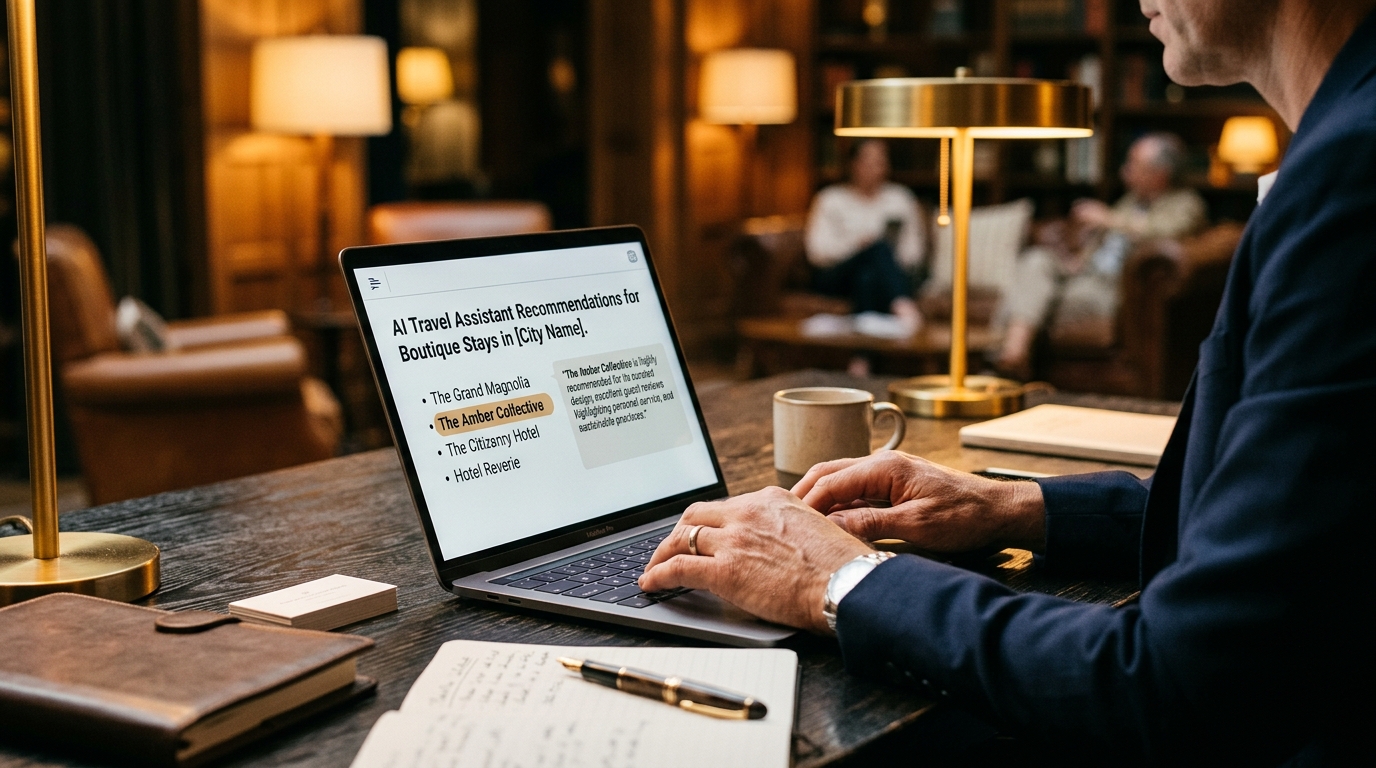
Travellers increasingly ask an AI assistant "where should I stay in [city]?" before they ever open a booking site — 56% of US travellers now plan trips with AI tools (Skift Research, 2024). Answer Engine Optimization is how your hotel becomes the answer — not a blue link buried on page two, but the property the assistant actually names.
AEO and GEO (Generative Engine Optimization) describe the same shift: optimising to be quoted in an AI answer rather than ranked in a list of links. For a hotel, the work is concrete and largely technical — and almost no independent property is doing it yet, which is exactly why the window is open.
What moves AI citation
What is the difference between SEO, GEO and AEO for hotels?
SEO gets your hotel ranked in a list of Google results. GEO (Generative Engine Optimization) gets you named and cited inside an AI-generated answer. AEO (Answer Engine Optimization) wins the single direct answer shown above all results — the AI Overview, the voice answer, the ChatGPT recommendation. In practice the three overlap, and SEO is the floor: if a page can't be crawled and indexed, it can never appear in any AI answer.
The strategic shift is that ranking position is no longer the finish line. A hotel sitting at position eight can be the property a Google AI Overview cites while the position-one result earns zero AI mentions. You optimise for being the clearest, most quotable answer — not just the highest link. Google's own 2026 Search Central documentation confirms this: appearing in AI Overviews and AI Mode requires nothing beyond standard SEO plus genuinely helpful, well-structured content. The advantage goes to whoever writes the clearest answer, regardless of domain authority.
Which AI engine is reading your hotel's website right now?
"AI visibility" is really four separate problems, because each assistant retrieves from a different source. ChatGPT Search reads Bing's index and the OAI-SearchBot crawler in web-connected mode. Google's AI Overviews and AI Mode draw from Google's own index — the same one traditional SEO targets. Perplexity crawls in real time and weights freshness heavily — one analysis of 680 million citations found it draws 46.7% of top citations from Reddit and community platforms (Profound, 2025). Claude retrieves through Brave Search, with roughly 86.7% citation overlap with Brave's top results. We compare the tools that track all four surfaces in our hotel AI visibility tools comparison.
Get indexed in Bing — not just Google — to appear in ChatGPT answers. Submit your sitemap to Bing Webmaster Tools if you haven't. Keep content fresh and dated for Perplexity. Earn genuine third-party mentions and reviews, because assistants lean on sources they already trust. There is no single switch — but one well-built, well-marked-up site satisfies all four. You can see exactly where you stand across all four engines using RevPARGenius Hotel AI Visibility, which runs live checks 3× per week.
What schema markup does a hotel website need for AI search?
A hotel website needs three schema types working together for AI search: LodgingBusiness, FAQPage, and Speakable. LodgingBusiness (or the more specific Hotel type) declares your property name, address, geo-coordinates, star rating, and price range — the signals AI assistants use to include you in location-based recommendations. FAQPage schema on your guest-question pages maps visible Q&A content to structured extraction points that Google AI Overviews and ChatGPT can lift directly. Speakable flags the specific passages on your page that are built for voice and AI answer extraction — typically your Quick Answer block and your FAQ answers. Our hotel schema markup guide includes paste-ready JSON-LD for all three.
Google's 2026 documentation is explicit: no special schema is required to appear in AI Overviews or AI Mode beyond standard indexability. But schema removes ambiguity — it lets an assistant state your location, price band, and property type with confidence instead of guessing from unstructured text. For ChatGPT and Perplexity, which use different indices, schema provides meaningful signal that Google doesn't need to infer.
Keep your name, address and phone number identical across your site, Google Business Profile, TripAdvisor, Booking.com, and every directory you're listed on. Inconsistent NAP data is one of the fastest ways to reduce an AI's confidence in your property — and it does not show up as an error anywhere in your analytics. For a deeper look at the technical schema stack, the RevPARGenius methodology page covers how each engine uses structured data to decide which hotels to cite.
How do you write hotel content that AI assistants quote verbatim?
AI assistants quote self-contained answers, not whole pages. A 2024 Princeton and IIT Delhi study (Aggarwal et al., KDD 2024) tested 10,000 AI queries and found named expert quotes lifted citation rates by 41%, dated statistics by 31%, self-contained 60–90 word answer blocks by 28%, and inline cited sources by 27%. Keyword stuffing produced a negative result. The pattern is consistent: AI engines reward clarity and penalise noise.
For a hotel, this translates directly. Open each key page — your homepage, your rooms page, your location page — with a short, direct answer that contains your hotel name, location, and a specific differentiator: "The Harbour View is a 4-star boutique hotel two minutes from Salamanca, with winter rates from A$220 and free parking for all guests." Write your FAQ answers in plain language under question-shaped headings. Back every claim with a specific, dated fact where possible. How ChatGPT decides which hotel to recommend comes down to exactly this kind of extractable, verifiable copy.
“The content an AI can quote is content that would make sense read aloud, out of context, in response to a direct question. If your copy needs the three paragraphs before it to make sense, an assistant will never extract it. Rewrite until every key claim stands alone.”
— Michael Andrews, Hotel Market Intelligence Researcher, RevPARGenius
This approach is exactly what drives results in the sample report from a real Brisbane property we've published — the hotels winning the queries are the ones whose content AI can extract without guesswork.
What should every hotel do in the next 30 days to improve AI visibility?
Five steps improve a hotel's AI visibility within 30 days: confirm indexation in Google and Bing, add LodgingBusiness/FAQPage/Speakable schema, lead key pages with 60–90 word answers, publish a visible FAQ with matching JSON-LD, and measure your baseline across the four engines. Most independent hotels haven't done any of this yet — which means the competitive window is real.
Confirm indexation in both Google and Bing. Submit your sitemap to Bing Webmaster Tools — most hotels never do this, which means ChatGPT's web-connected mode has never reliably crawled their site. This takes ten minutes and unblocks the highest-traffic AI assistant for hotel queries.
Add LodgingBusiness, FAQPage and Speakable schema. If your website CMS doesn't have a schema field, add the JSON-LD blocks directly to your page's HTML head. Keep NAP identical across every platform your hotel appears on — site, GBP, TripAdvisor, Booking.com, Expedia.
Lead every key page with a 60–90 word self-contained answer. Write it as if you're answering a traveller who just asked ChatGPT where to stay. Include your property name, location, a specific differentiator, and a dated fact. This is the block AI assistants extract — marketing copy without it is invisible to AI.
Add a visible FAQ section with 5 real guest questions, answered in 2–4 sentences each, with FAQPage JSON-LD that exactly matches the visible text. These are the answer blocks Google AI Overviews and ChatGPT extract directly for hotel recommendation queries.
Measure your current AI visibility before you change anything. You cannot fix what you cannot see. Run a live check across ChatGPT, Perplexity, Gemini and Grok with the prompts travellers actually use — "best boutique hotel in [city]", "where to stay for couples in [city]" — and record your mention rate and your competitors'. That baseline is your benchmark. RevPARGenius Hotel AI Visibility does this automatically, 3× per week.
RevPARGenius Take
AEO is not a new marketing channel to buy — it is SEO discipline plus answer-shaped writing. Be indexable, be specific, be the clearest answer to a real guest question.
The properties winning AI recommendations in 2026 are not gaming schema or stuffing keywords. They are crawlable, well-structured and genuinely useful — and they get named because there is something real for the machine to quote.
Frequently asked questions
What is AEO for hotels?
Answer Engine Optimization (AEO) is the practice of structuring a hotel's website so AI answer engines — Google AI Overviews, ChatGPT, Perplexity, Claude — name and cite the property when travellers ask for a recommendation. It combines technical indexability (in both Google and Bing), schema markup (LodgingBusiness, FAQPage, Speakable), and self-contained answer-formatted content that AI systems can extract and quote directly.
Is AEO different from SEO for hotels?
AEO builds on SEO but targets a different outcome. SEO ranks your hotel in a list of links; AEO optimises to be the quoted answer in an AI response. SEO is the prerequisite — an unindexable page can never be cited by an answer engine — but AEO adds answer-formatted content and structured data on top. A hotel can rank on page one of Google and still score zero in ChatGPT if its content isn't answer-shaped.
Does a hotel need special schema to appear in Google AI Overviews?
No — Google's own 2026 documentation states that no special schema, markup files, or AI-specific structured data is required for Google AI Overviews or AI Mode. Standard SEO fundamentals are sufficient for Google's own features. Schema markup (LodgingBusiness, FAQPage, Speakable) is valuable for ChatGPT, Perplexity, and Bing-grounded AI systems, which use their own retrieval logic where structured data provides meaningful signal beyond what Google needs.
How long does it take to see results from hotel AEO?
Technical fixes — Bing indexation, schema markup, answer-formatted content — can be crawled within days, but AI citation depends on indexation cycles, freshness signals, and domain trust. Meaningful visibility typically builds over 4–8 weeks for low-competition local queries, longer for terms dominated by OTAs and large travel media. Perplexity tends to reflect content changes fastest; Google AI Overviews typically take the longest to update after a content change.
How do I know if AI assistants are currently recommending my hotel?
You can't tell from Google Analytics, Search Console, or your booking data — AI-driven traffic doesn't come with a source tag that identifies the recommending assistant. The only way to measure it is to run the actual prompts travellers use across ChatGPT, Perplexity, Gemini and Grok and record whether your hotel is named, at what position, and which competitors are winning. RevPARGenius Hotel AI Visibility does this automatically, 3× per week, with a full competitor breakdown and recommended actions for each gap.
Free AI Visibility Check
Is AI naming your hotel — or your competitor?
RevPARGenius tracks your hotel across ChatGPT, Perplexity, Gemini and Grok — 3× per week, with real competitor data and the exact fixes to close the gap.
Check My Hotel's AI Visibility — Free →See a Sample Report First
No credit card. First check is free.
Sources: Princeton/IIT Delhi GEO study (Aggarwal et al., KDD 2024); Profound AI citation analysis (2025, 680M citations); Google Search Central AI-features guidance (2026); Skift Research US AI travel-planning adoption survey (2024). Last reviewed June 2026. RevPARGenius is an independent hotel market intelligence platform — not affiliated with any OTA, revenue management system, or hotel chain.