RevParGenius Market Intelligence · April 2026 · Data from 10+ independent sources
Not replacing. Disrupting. There is an important difference — and for hotel owners, it changes everything about how you should think about your marketing budget, your website, and your OTA strategy for the next three years.
Google Is Not Dead — But the Journey Has Changed
Google still processes an estimated 8.5 billion searches per day. It is not going anywhere. But the way individual travellers interact with it is changing in a way that has profound consequences for hotels — because the searches that lead to hotel bookings are exactly the kind of complex, conversational, multi-criteria queries that AI handles better than a list of blue links.
Consider the difference between how a traveller found a hotel five years ago versus how they find one today. Five years ago: search "hotels Queenstown", scroll through Booking.com, compare 30 options, read reviews, filter by price, book. The process took an average of 45 days and involved 141 pages of content. Today: open ChatGPT, type "I need a hotel in Queenstown for a romantic anniversary weekend in July, we want mountain views, a spa, and somewhere that does a good breakfast, budget around $400 a night." ChatGPT responds with four specific hotel names and a sentence about why each one fits. The search is over in two minutes.
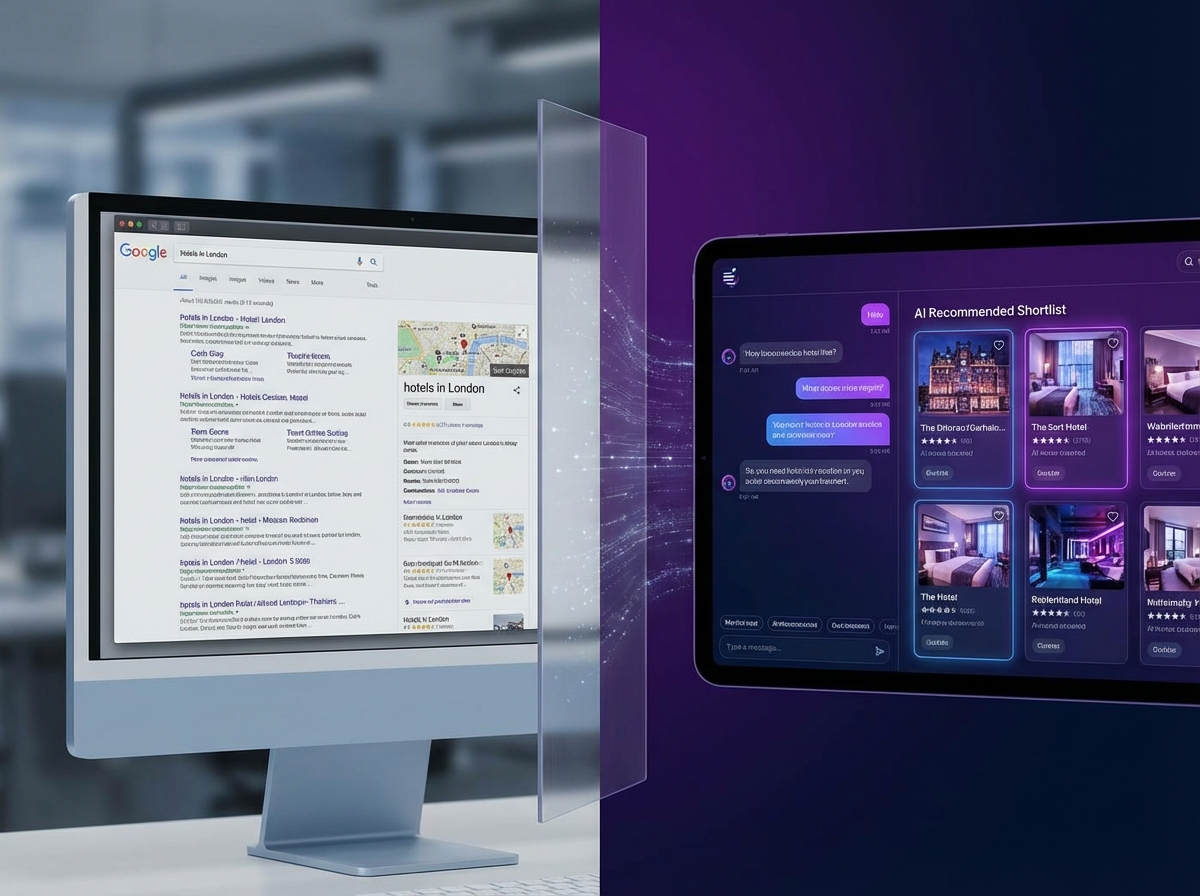
That is not Google being replaced. That is the discovery phase — the part where a traveller moves from "I need a hotel somewhere" to "I want to stay at this specific property" — shifting to a completely different channel. And it is the discovery phase that hotels have historically influenced through SEO, content marketing, and OTA listings. All of that leverage is now being rebuilt in AI search from scratch.
Phocuswright's 2025 study found that nearly 4 in 10 US travellers used generative AI for trip research in the past 12 months — an 11-point increase in a single year. Among Gen Z and Millennials, roughly two-thirds have already used AI for travel planning.
The Numbers Behind the Shift
The data on how search behaviour is changing is more dramatic than most hotel owners realise — because it does not show up in their own analytics until they specifically look for it.
Google's share is falling for the first time in a decade
Google's global search market share dipped below 90 percent in 2025 — the first time since 2015 that any meaningful erosion has occurred. Desktop searches per user in the US fell nearly 20 percent year-over-year. Gartner, one of the most conservative technology research firms in the world, predicted that traditional search volume would drop 25 percent by 2026 due to AI chatbots. These are not fringe predictions — they reflect measured behavioural change already underway.
AI search is growing at an extraordinary rate
AI search platforms collectively saw traffic increase by over 721 percent in one year, capturing nearly 8 percent of the combined search market by mid-2025. The ratio of Google users to AI search users halved in 12 months, moving from 10:1 to 4.7:1. ChatGPT alone reached 900 million weekly active users by February 2026 — up from 100 million two years earlier. The ChatGPT mobile app recorded 73.4 million downloads in December 2025 alone.
AI-referred visitors convert dramatically better
The most commercially important statistic in the entire dataset: visitors arriving at hotel websites via AI search convert 23 times better than traditional organic search traffic, with 4.4 times higher economic value per visit. Expedia's VP of Strategic Partnerships confirmed publicly that traffic from generative AI search is "small but growing quickly and converting to bookings at higher rates than other traffic." This is not a volume story yet — it is a quality story. And the quality advantage is extraordinary.
How the Hotel Discovery Journey Has Actually Changed
The shift is not just about which platform travellers use. It is about how they search, what they trust, and when the booking decision gets made.
Broad Search → OTA Comparison → Decision
Traveller searches "hotels in Bali." Gets 10 blue links — mostly OTAs. Clicks through to Booking.com. Sees 847 properties. Applies filters. Reads reviews. Compares prices across multiple tabs. Visits the hotel's own website at some point — maybe. Spends 45 days in research mode. Books through the OTA or eventually direct. Hotel's job: rank well enough that OTAs pick you up, keep your reviews positive, and hope the traveller finds your direct site.
Specific Query → AI Response → Direct Comparison
Traveller asks ChatGPT: "Best boutique hotel in Ubud for a yoga retreat, adults only, with a rice paddy view, under $300 per night." Gets five specific property names with brief explanations. Clicks directly to one or two. Books. Entire process: under ten minutes. Hotel's job: be one of the five names ChatGPT mentions — which requires completely different optimisation than Google SEO.
The critical difference is specificity and shortlisting. Google gives a traveller a list of places to look. ChatGPT gives them a shortlist of places to book. Hotels that appear in the ChatGPT shortlist skip the OTA comparison phase entirely — which means they have a direct path to the traveller that bypasses the commission layer.
Why Your Current SEO Strategy Is Not Enough
The most common mistake hotel owners make when they first learn about AI search is assuming that ranking well on Google will naturally translate to appearing in ChatGPT. It does not — and the reason why is structural.
ChatGPT does not use Google's index when generating hotel recommendations. It uses Bing's index. A landmark Search Engine Land study found that 87 percent of ChatGPT Search citations match Bing's top results — compared to only a 56 percent match rate with Google. A hotel that ranks number one on Google but is not in Bing's top results for relevant queries will not appear in ChatGPT recommendations regardless of how good its Google SEO is.
Beyond the indexing difference, the signals that drive Google rankings are materially different from the signals that drive ChatGPT recommendations. Google weights keywords, backlinks, page authority, and click-through rates. ChatGPT weights review sentiment, structured data, factual content density, and third-party editorial mentions. A hotel with weak Google SEO but excellent reviews, comprehensive structured data, and coverage in travel publications can outperform a Google-optimised competitor in ChatGPT results.
87% of ChatGPT hotel recommendations match Bing's top results. If you have never optimised for Bing — never claimed your Bing Places listing, never submitted your sitemap to Bing Webmaster Tools — you are invisible to ChatGPT regardless of your Google ranking.
What Smart Hotels Are Doing Differently
The hotels gaining traction in AI search right now are not the ones with the biggest marketing budgets. They are the ones that understood early that AI search requires a different kind of presence — and built it while their competitors were still focused exclusively on Google.
They optimised for Bing first
Claiming Bing Places for Business, submitting sitemaps to Bing Webmaster Tools, and implementing IndexNow for real-time content updates. Simple, free steps that most hotels have never taken because Bing seemed irrelevant when Google dominated. In the ChatGPT era Bing is the gateway — and most of your competitors have ignored it.
They made their content AI-readable
Replacing marketing language with specific, factual, citable descriptions. A 25-metre heated infinity pool with mountain views, open 6am to 10pm, is AI-citable. "Stunning pool and amazing amenities" is not. FAQ pages written in natural language that answer exactly the questions travellers ask ChatGPT — these are the content formats AI systems extract and cite most reliably.
They treated reviews as an AI ranking signal
TrustYou research found that 71 percent of AI-generated hotel recommendations are driven by guest reviews. Hotels that implemented systematic review request processes — asking every checked-out guest across Google, TripAdvisor, and Booking.com — saw their AI search visibility improve measurably. Because AI systems trust third-party reviews far more than self-promotional hotel content.
They built editorial coverage deliberately
Wikipedia accounts for 47.9 percent of ChatGPT's top cited sources for factual queries. TripAdvisor, Reddit travel communities, and curated travel publications are heavily referenced. Hotels that actively pursued features in travel blogs, destination guides, and media roundups built citation signals that AI systems trust far more than anything on the hotel's own website.
The Bottom Line
ChatGPT is not replacing Google for hotel search. It is replacing the discovery phase — the part where a traveller decides which hotel to seriously consider. That phase is where hotels have historically competed through SEO and content, and it is now operating under completely different rules.
Hotels that continue investing exclusively in Google SEO while ignoring AI search optimisation are not making a bad decision about an emerging technology. They are making a bad decision about the channel where their next guests are already forming their shortlists.
The shift is not theoretical. 900 million weekly ChatGPT users. 67 percent of global travellers already using AI in trip planning. 721 percent growth in AI search traffic in one year. The travellers are there. The question is whether your hotel is.
Get Your Hotel's AI Visibility Analysis
RevParGenius analyses AI search visibility for independent hotels across APAC — checking whether your property appears in ChatGPT, identifying exactly what is blocking visibility, and providing a market-specific action plan. Request a free analysis today.
Live data. No guesswork. Just signal.
RevParGenius Market Intelligence · AI Search & Hotel Discovery · April 2026