
Push too early and you spook the market. Wait too long and you leave money on the table. The answer lives in the booking curve — and for Christchurch May weekends, that curve has a very specific shape every revenue manager needs to understand.
What Is a Hotel Booking Curve and Why Does It Matter?
A booking curve maps how hotel occupancy builds over time before a specific arrival date. It tells you when guests are committing, how fast demand is accelerating, and whether the market has enough heat to support a rate move.
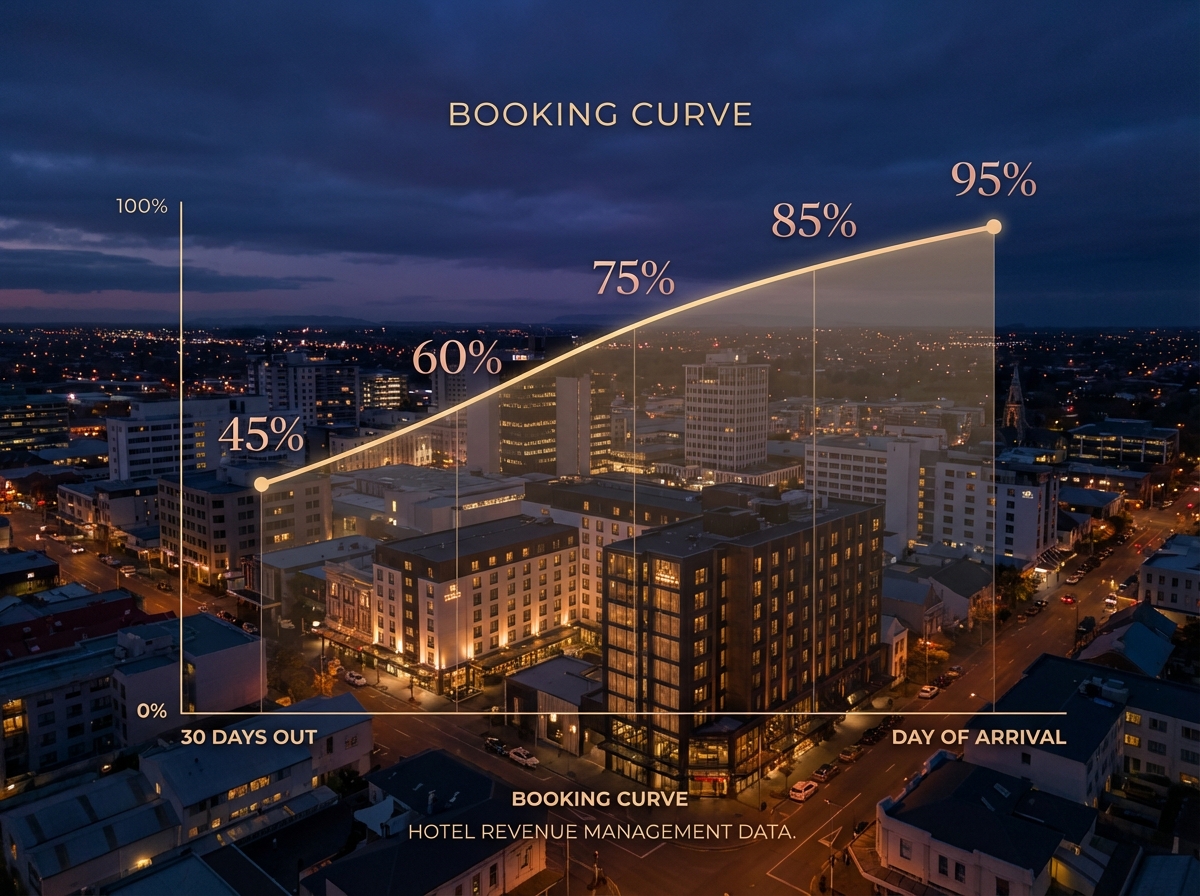
For Christchurch May weekends, the curve has a distinctive shape — back-weighted, with the majority of pickup concentrated in the final seven days before arrival.
Christchurch May weekend booking curve — typical patterns based on OTA availability and market booking pace signals
| Window Before Arrival | Typical Occupancy | What's Happening |
|---|---|---|
| 21–30 days out | 40–60% | Early market — mostly planned travel, low urgency |
| 10–14 days out | 60–75% | Main pickup window begins, market warming |
| 3–7 days out | 75–88% | Late shoppers enter — highest rate-push potential |
| 1–2 days out | 85–95% | Final fill — discount risk if rooms remain unsold |
| Day of arrival | 90–100% | Weather, events, and last-room dynamic |
Understanding the Wait-and-See Curve
A wait-and-see curve means guests are not committing early. They're browsing, comparing, and holding off on booking until they're certain they're travelling — typically inside the seven-day window.
You can read the shape of this curve in real-time by watching three market signals:
Budget Inventory Still Visible
Low-rate rooms remain showing across OTAs well into the booking window — no urgency, no compression. The market is not tightening from the bottom up yet.
No Weekend Premium Forming Early
No strong weekend rate premium is appearing 2–3 weeks out. Hotels are not yet closing lower rate categories aggressively — a clear signal that demand hasn't built to a forcing point.
Pace Pickup Is Back-Weighted
The majority of booking volume is landing inside seven days. This is not a low-demand market — it is a late-converting one. The distinction matters entirely for how you price it.
⚠️ The Reactive Pricing Trap
GMs who misread a wait-and-see curve as low demand and start discounting early will cap their upside when the late-window pickup arrives. The move in this market is patience and precision — not panic pricing. You are not behind. You are in a late-pickup market.
How to Price Christchurch May Weekends — Window by Window
Each booking window requires a different posture. What works at 21 days out will cost you ADR at five days out — and vice versa. Here's the framework, window by window.
Hold Your Line
At this point in the booking window, your job is not to chase bookings — it's to hold position. Maintain your base BAR rate. Resist the urge to add a strong weekend premium until you see the market move. Watch whether low-end OTA inventory is disappearing from your comp set.
The temptation is to offer an early-bird discount to stimulate pickup. In a wait-and-see market, that typically just pulls forward bookings you would have gotten anyway — at a lower rate.
Add Value Before Cutting Price
If pickup has been slower than your pace targets, the answer at this window is value — not discounting. Keep your weekend rate flat to weekday, or only slightly above if pace has been tracking well. You're protecting ADR while remaining competitive.
Your Key Rate Decision
This is the moment that defines your May weekend revenue performance. At five to seven days out, you have enough visibility to make the call that matters.
If Comp Set Still Has Broad Availability
Stay competitive. The market hasn't compressed and pushing rate now will cost you occupancy without the ADR gain to compensate. Hold position and monitor daily.
If Low-Priced Rooms Are Disappearing
Start pushing rate in small incremental steps — NZD $10–20 at a time. Don't jump. Small moves let you test resistance before committing to a higher rate floor.
⚑ This window is where the real revenue management skill lives. The GMs who win this market are watching their comp set's OTA availability daily — not just their own occupancy number.
Yield Up or Protect Occupancy
At this point, your decision depends on one thing: has the market tightened? If comp set availability has narrowed and your remaining inventory is premium-facing, yield upward. If availability is still broad, your priority is conversion and occupancy protection — don't hold out for rate you won't get.
Last-room pricing requires a live read of the market, not a formula. This is judgment territory.
The Five Compression Triggers to Watch Right Now
The booking curve steepens — and rate push becomes justified — when you see these five signals appearing in the Christchurch market. Monitor them daily for all dates within the next 30 days.
Low-End Rooms Disappear First
When budget OTA inventory vanishes from your comp set but mid-range rooms are still showing, demand is price-sensitive and tightening. That's your cue to nudge rate upward.
Hotels Drop Off OTA Search Results
If hotels that showed availability last week have disappeared from OTA search entirely, they've closed out. Less supply in the channel means your remaining rooms carry more rate value.
Midscale Hotels Move Up Together
When multiple mid-tier competitors raise rate simultaneously, the market is signalling compression. Follow — and consider leading if your product supports the premium.
Weekend Spread Narrows Upward
If the gap between weekday and weekend rates starts compressing because weekday rates are rising to meet weekend rates, it signals a market-wide tightening — not just weekend demand.
A Visible Event Lands In-Market
A conference, touring show, or major sporting fixture can reshape the curve fast. Stay connected to the Christchurch events calendar through May — and set rate within 24 hours of any major announcement.
What This Means for Your Strategy This Week
The headline takeaway for Christchurch May weekends: most of your pickup will land inside seven days, not thirty. That shapes every decision you make right now.
Protect Weekday ADR
That's where your stable revenue base lives in May. Don't sacrifice weekday rate in pursuit of weekend volume — the curve rewards patience on both.
Keep Weekends Competitive Early
Don't inflate rate before the market signals it can hold. A modest NZD $15–25 test premium is fine. A significant early weekend hike will slow the pickup you need.
Build a Daily Monitoring Habit
For the 5–7 day window, check competitor availability on Booking.com and Expedia every day. That's where your best revenue decisions live — not at 30 days out.
Pre-Set Your Trigger Responses
Know your compression triggers and have a pre-set rate move ready when they appear. GMs who win this market aren't the fastest to react — they're the ones who already know what to do.
The One Question to Ask Yourself Today
If most of your May weekend bookings arrive in the final seven days, what are you doing in the first three weeks to engineer early commitment?
Even in a late-pickup market, a small early-bird offer — a value-add, not a rate cut — can pull forward enough volume to give you pace confidence. And pace confidence is what lets you push rate when the window finally opens. That's the difference between a reactive revenue strategy and an intentional one.
Frequently Asked Questions
What is a hotel booking curve?
A hotel booking curve is a map of how occupancy builds over time before a specific arrival date. It shows when guests are committing to reservations, how quickly demand is accumulating, and whether the market has enough momentum to support a rate increase. Reading the curve correctly tells you when to hold, when to push rate, and when to yield down.
When should I raise hotel rates in Christchurch in May?
For May weekends, the primary rate-push window is 5–7 days before arrival, when late shoppers enter the market and comp set availability begins to tighten. A modest test premium of NZD $15–25 can be applied from 21 days out to gauge market sensitivity. Significant rate increases are only justified once you see competitor inventory restricting on OTAs — that's the compression signal that confirms demand can absorb a higher rate.
What is demand compression in hotels?
Demand compression occurs when market-wide accommodation demand exceeds available supply, causing rates to rise sharply and inventory to absorb rapidly across the competitive set. In Christchurch, compression is most common around confirmed major events, public holiday weekends, and periods when multiple large group bookings coincide. Identifying the compression signals early — particularly low-rate inventory disappearing from OTA search results — allows you to raise rates ahead of the market rather than chasing it.
Should I discount to fill May weekends early?
In a wait-and-see market like Christchurch May, early discounting typically pulls forward bookings you would have received anyway — at a lower rate. It caps your ADR without meaningfully improving total occupancy. A better approach is to add value (breakfast, parking, upgrade) at a stable rate rather than cutting BAR. Reserve discounting for the very late window (0–2 days out) if pickup genuinely hasn't materialised and broad comp set availability remains.
See How Your Christchurch May Weekends Are Tracking Right Now
RevPARGenius gives independent hotel operators live booking curve visibility, daily comp set monitoring, and automated rate alerts — so you're making the 5–7 day window decision with data, not intuition.
Start Your Free Trial → No Credit Card RequiredFull market analysis included. Set up in under 10 minutes.