Reviewed by Michael Andrews, Hotel Market Intelligence Researcher · June 2026 · 9 min read · Last reviewed June 2026
The Cloudbeds website builder is a fast, AI-assisted template site that works well for one job: getting an existing Cloudbeds PMS customer a presentable website wired to the Cloudbeds booking engine. Its limits are structural — exclusive templates with layout changes routed through support, meta-tag-level SEO rather than search architecture, no answer-formatted content for AI engines, and a site that lives inside the Cloudbeds ecosystem. For hotels whose priority is direct bookings, Google rankings and AI-search citation, a custom build like RevPARGenius (from AUD $9,000, owned outright) is the stronger long-term asset.
Cloudbeds is one of the most-reviewed platforms in hospitality software — 6,000+ verified reviews averaging 4.5/5 across Hotel Tech Report and Capterra, against a more sobering 3.6/5 "Average" rating from 540 reviews on Trustpilot (June 2026). But almost all of that feedback is about the PMS, channel manager and booking engine. The website builder bundled on top gets far less scrutiny — and for an independent hotel, the website is the asset that decides whether Google ranks you and whether ChatGPT recommends you. This review looks at the builder specifically.
The honest frame up front: this is not a hit piece. The Cloudbeds booking engine is genuinely good, and the builder is a rational choice for some properties. The question is what you give up — and whether your property is one of the ones that shouldn't.
Cloudbeds by the numbers (June 2026)
What is the Cloudbeds website builder and what do you actually get?
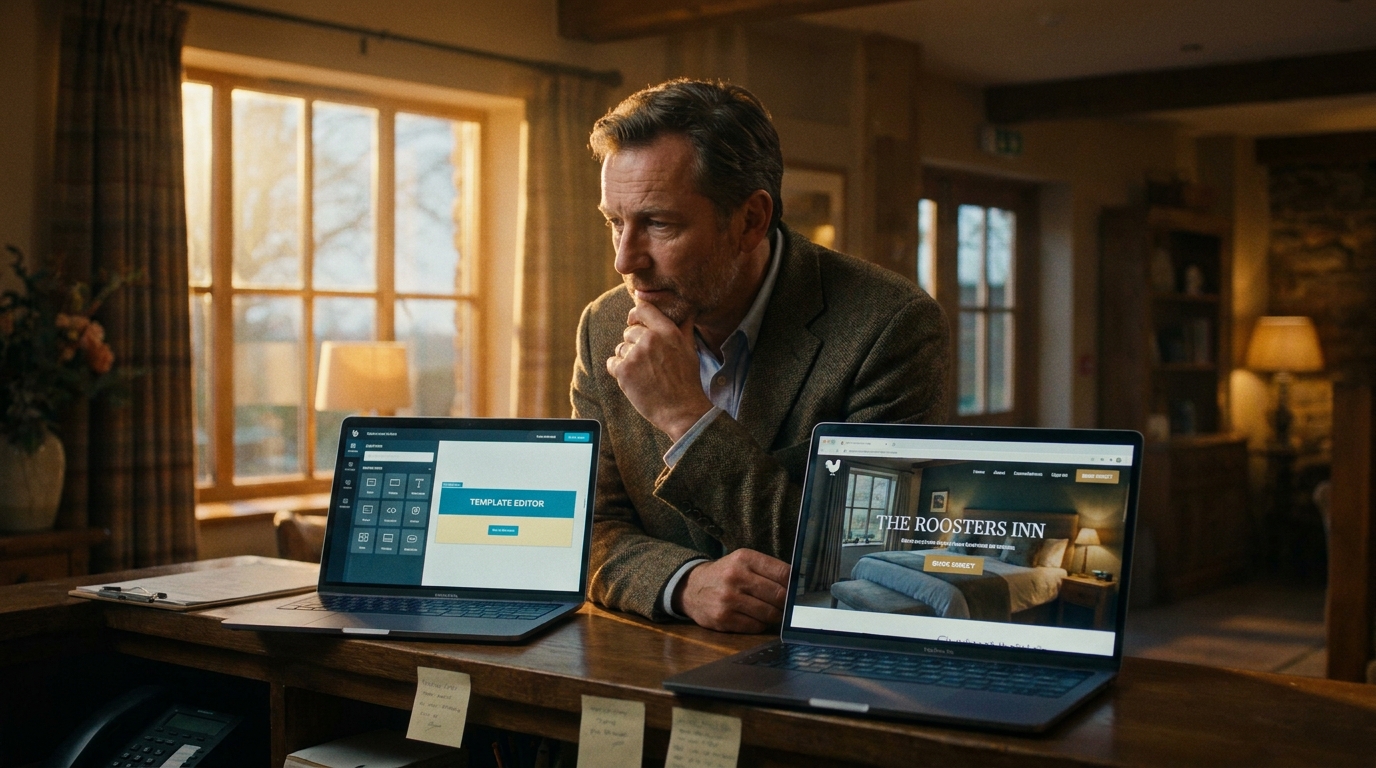
The Cloudbeds website builder is an AI-powered, template-based site builder bundled with the Cloudbeds PMS. It generates a website from the property data already in your PMS — name, description, amenities, room details — pre-integrated with the Cloudbeds booking engine, and includes an AI assistant that writes copy, generates SEO metadata, and updates pages. Sites are built from exclusive Cloudbeds templates: you can change colours, fonts and add sections, but per Cloudbeds' own documentation, layout changes and style switches are routed through their support team rather than edited directly.
That design is deliberate. Cloudbeds is a PMS company; the website exists to feed the booking engine, and the builder is engineered to get a functional site live in minutes with minimal operator effort. Judged on that goal, it succeeds. The problems start when the website needs to do more than exist — when it needs to win search.
What do real Cloudbeds reviews actually say?
Across Trustpilot, Hotel Tech Report, Capterra and hospitality community forums, Cloudbeds feedback in 2026 splits cleanly. The consistent praise: ease of use, centralised reservation management, a polished multilingual booking engine, and a channel manager covering 300+ OTAs with near-zero double bookings. The consistent criticism: pricing opacity (no public pricing, and some users report unexpected fees and upselling), support that has shifted to slow ticket-and-chat queues, and periodic availability glitches that block bookable inventory.
Two themes from the lower-rated reviews matter specifically for the website decision. First, support speed: when your public website's layout can only be changed through a support request, slow support stops being an inconvenience and becomes a marketing bottleneck. Second, ecosystem dependency: reviewers who migrated away from Cloudbeds describe the switching process as painful across the board — and a website that lives inside the Cloudbeds platform is one more thing you don't take with you. Check the Cloudbeds Websites terms before committing if portability matters to you.
Weigh both sides honestly: a 4.5/5 aggregate across 6,000+ reviews is a genuinely strong PMS signal, and most operators reviewing it are happy with the core platform. The 3.6/5 Trustpilot tail is where the operational friction lives — and websites are operational.
Where does the Cloudbeds website builder fall short on SEO, GEO and AEO?
The Cloudbeds website builder handles SEO at the metadata level — titles, descriptions, heading tags, alt text — but not at the architecture level where Google rankings and AI citations are actually decided. Per Cloudbeds' own documentation, keyword research and alt-text setup are not part of the standard build, SEO fields are left blank if content isn't provided, and the AI assistant generates tags rather than strategy. There is no provision for destination content hubs, no answer-formatted content framework, and no hospitality schema depth beyond the basics the template ships with.
For AI search, that gap is decisive. A 2024 Princeton/IIT Delhi study (Aggarwal et al., KDD 2024) found AI citation rates are lifted 28–41% by exactly the structures templates don't provide: self-contained 60–90 word answer capsules, named expert quotes, and dated sourced statistics. AEO for hotels is an architecture decision made at build time — a template that routes layout changes through a support queue cannot iterate toward it.
“The Cloudbeds builder answers ‘do we have a website?’ It does not answer ‘does our website win the searches our next guest is making?’ Those are different products, and the second one is where the direct-booking revenue actually is.”
— Michael Andrews, Hotel Market Intelligence Researcher, RevPARGenius
How does the Cloudbeds website builder compare to a custom RevPARGenius build?
The comparison is template-plus-ecosystem versus custom-plus-ownership. Cloudbeds gives you speed and booking-engine integration; a RevPARGenius build gives you the search architecture — server-side rendering, full hospitality schema, answer capsules, destination hubs — plus outright ownership of code, content and domain. Both can drive direct bookings; only one is built to be found and cited.
| Criteria | Cloudbeds Websites | RevPARGenius Custom Build |
|---|---|---|
| Design | Exclusive templates; layout changes via support | Fully custom, no templates |
| SEO depth | Meta tags, AI-generated tags; keyword research not standard | Full technical floor: SSR, canonicals, Core Web Vitals, keyword-led architecture |
| AI-search (GEO/AEO) | Not addressed | Answer capsules, full schema stack, 4-engine AI-visibility tracking |
| Content strategy | AI copy assistant | Destination hubs + 1–4 content pages monthly |
| Booking engine | Cloudbeds, pre-integrated (excellent) | Your choice — integrates with your existing engine, including Cloudbeds |
| Ownership | Lives in the Cloudbeds ecosystem — check terms on leaving | You own code, content and domain outright |
| Cost | Not published — DIY builder: no setup fee; designer-built: unpublished setup + monthly fee, non-refundable per ToS | From AUD $9,000 build + growth retainer; $1,000 audit to start |
Note the booking-engine row: this is not either/or. A custom RevPARGenius build integrates with the booking engine you already use — including Cloudbeds'. Plenty of properties should keep the Cloudbeds PMS and booking engine, which reviewers consistently rate as the platform's strongest assets, and replace only the template website in front of them. The full options landscape is in our best hotel website builders 2026 comparison.
What Cloudbeds actually costs. Cloudbeds publishes no pricing for Websites or the platform — every quote requires a sales call. What the public record shows: the DIY AI builder has no setup fee and a 14-day trial; the designer-built option carries a one-time setup fee plus a monthly fee, neither amount published, with content development extra, a US$20/year fee for a Cloudbeds-managed domain, and all payments non-refundable under the Cloudbeds Websites terms. Third-party estimates (ITQlick, CostBench) put overall Cloudbeds platform plans at roughly US$200–$1,000 per month depending on property size and tier, with onboarding estimated at US$200–$5,000, and one directory (HotelMinder) lists a Cloudbeds website-and-booking-engine bundle priced at 3.5% of revenue generated. These figures are third-party estimates, not Cloudbeds-published prices — verify directly with Cloudbeds before budgeting. The contrast with a fixed, published AUD $9,000–$24,000 build you own outright is the point: you can put one of these numbers in a budget today.
Who should use the Cloudbeds builder — and who should build custom?
Use the Cloudbeds website builder if you are already a Cloudbeds PMS customer, need a presentable site live this week, have minimal OTA commission exposure, and aren't competing for search visibility in your market. It is the lowest-effort path to a functional hotel website that books rooms.
Build custom if OTA commissions are a meaningful annual cost, if your market has competitors worth beating in Google, or if you want to be the property ChatGPT and Perplexity name when travellers ask where to stay. RevPARGenius hotel website design builds exactly this — server-side rendered, schema-rich, answer-formatted, with live AI-visibility tracking — from AUD $9,000, live in 4–6 weeks, owned by you outright. Not sure which side you're on? The AUD $1,000 SEO · GEO · AEO audit benchmarks your current site — Cloudbeds-built or otherwise — across Google and four AI engines, with no build commitment.
RevPARGenius Take
Keep the Cloudbeds booking engine if you love it — it's the best part of the platform. But don't let a PMS template be your property's front door in the AI-search era.
The website is the one distribution asset you can own outright, and the one place where search architecture compounds in your favour every month. A bundled template optimises for Cloudbeds' ecosystem; a custom build optimises for your bookings.
Frequently asked questions
Is the Cloudbeds website builder good?
For its intended job, yes: it gets a Cloudbeds PMS customer a clean, AI-assisted template website pre-wired to the Cloudbeds booking engine in minutes. Its limits are structural — exclusive templates with layout changes routed through support, metadata-level SEO, and no AI-search content architecture — so it suits properties that need a website to exist more than they need it to win search.
Does the Cloudbeds website builder include SEO?
Partially. It lets you manage meta titles, descriptions, heading tags and alt text, and includes an AI assistant that generates SEO metadata. Per Cloudbeds' own documentation, keyword research and alt-text setup are not part of the standard build, and there is no provision for destination content, answer-formatted capsules, or the deeper hospitality schema stack that drives AI-search citation.
Do you own your website if you build it with Cloudbeds?
Cloudbeds websites are built and hosted within the Cloudbeds platform, so review the Cloudbeds Websites terms of service for what happens to your site if you leave the PMS. By contrast, a RevPARGenius custom build transfers full ownership on completion — code, content and domain are yours, and the site stays live regardless of which PMS or booking engine you use.
Can I keep the Cloudbeds booking engine with a custom website?
Yes. A custom build integrates with the booking engine you already use, including Cloudbeds'. Many properties keep the Cloudbeds PMS and booking engine — consistently the platform's best-reviewed components — and replace only the template website in front of them with a search-engineered custom site.
What does a custom hotel website cost compared to Cloudbeds?
Cloudbeds does not publish website pricing: the DIY AI builder has no setup fee, while the designer-built option carries an unpublished one-time setup fee plus monthly fee, non-refundable under the Cloudbeds Websites terms. Third-party estimates — not Cloudbeds-published prices — put overall platform plans at roughly US$200–$1,000 per month depending on property size and tier. RevPARGenius custom builds have fixed, published pricing: AUD $9,000 (Essentials) to AUD $24,000 (Authority) plus a monthly growth retainer, currently 25% off, with a standalone AUD $1,000 SEO/GEO/AEO audit available first.
Hotel Website Design · SEO · GEO · AEO
Keep your booking engine. Upgrade your front door.
A custom hotel website built to rank in Google, get cited by AI assistants, and convert direct — integrated with the booking engine you already use. Live in 4–6 weeks, owned by you outright.
Build My Hotel Website →Audit My Current Site First
All build plans currently 25% off. AUD, excl. GST.
This review reflects publicly available information and verified user reviews as of June 2026; features, ratings and pricing are subject to change. Cloudbeds is a trademark of its owner; RevPARGenius is not affiliated with Cloudbeds. Sources: Trustpilot (cloudbeds.com, 3.6/5, 540 reviews, June 2026); Hotel Tech Report and Capterra aggregate (6,000+ reviews, 4.5/5); Cloudbeds Websites documentation and Terms of Service (myfrontdesk.cloudbeds.com, cloudbeds.com/terms/websites, 2026); Aggarwal et al., "GEO: Generative Engine Optimization," Princeton/IIT Delhi, KDD 2024. Cloudbeds does not publish official pricing; platform-cost estimates are from third-party sources (ITQlick, CostBench, HotelMinder) as of June 2026 and may differ from actual quotes. Last reviewed June 2026.