Reviewed by Michael Andrews, Hotel Market Intelligence Researcher · June 2026 · 12 min read
Hotel AI visibility for boutique properties is critically low because independent hotels lack the structured data, consistent review signals, and named property attributes that AI engines require to identify and cite the best answer. Phocuswright’s February 2026 research found 56% of US leisure travellers used AI for at least one trip in the past year — meaning boutique operators who fix their schema markup, review content, on-page specificity, and cross-platform entity consistency can own the high-intent, conversion-ready queries that chains and OTAs simply cannot answer as precisely.
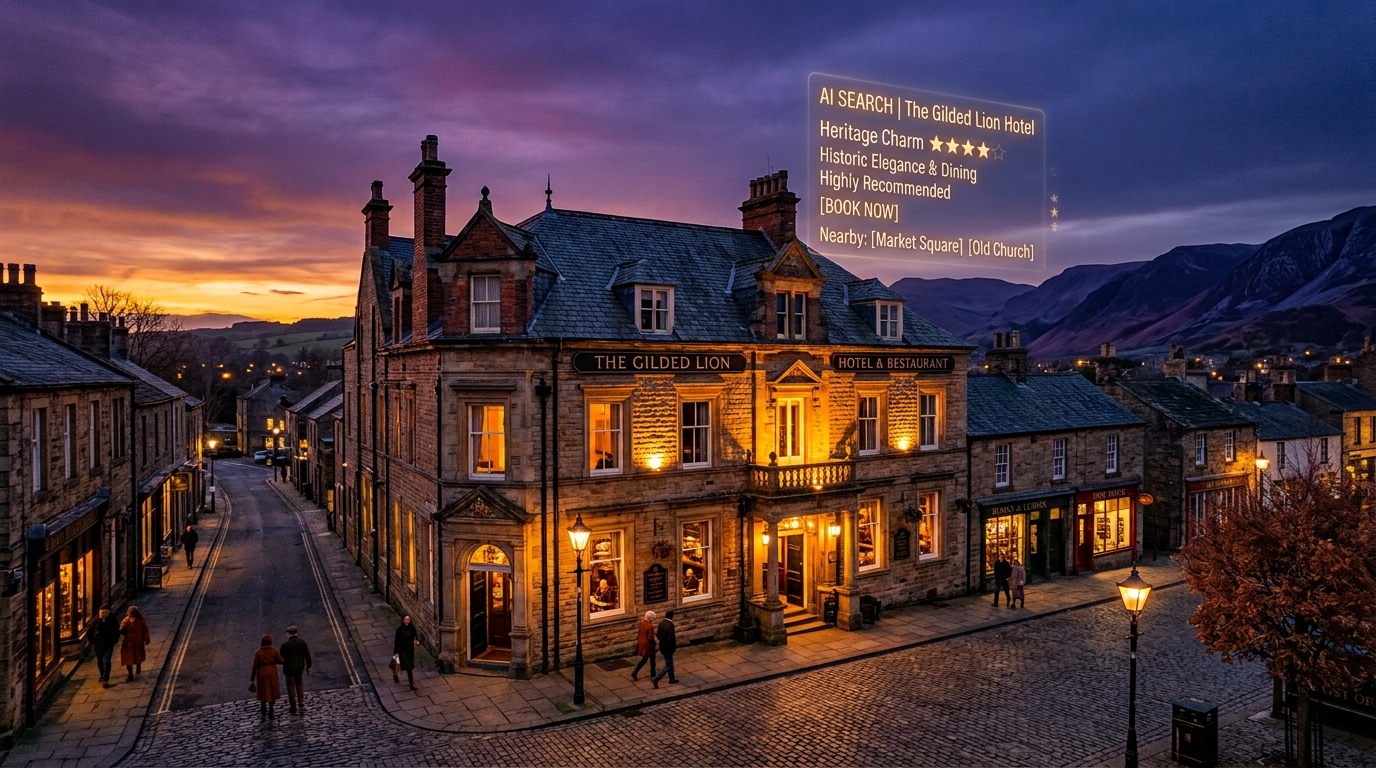
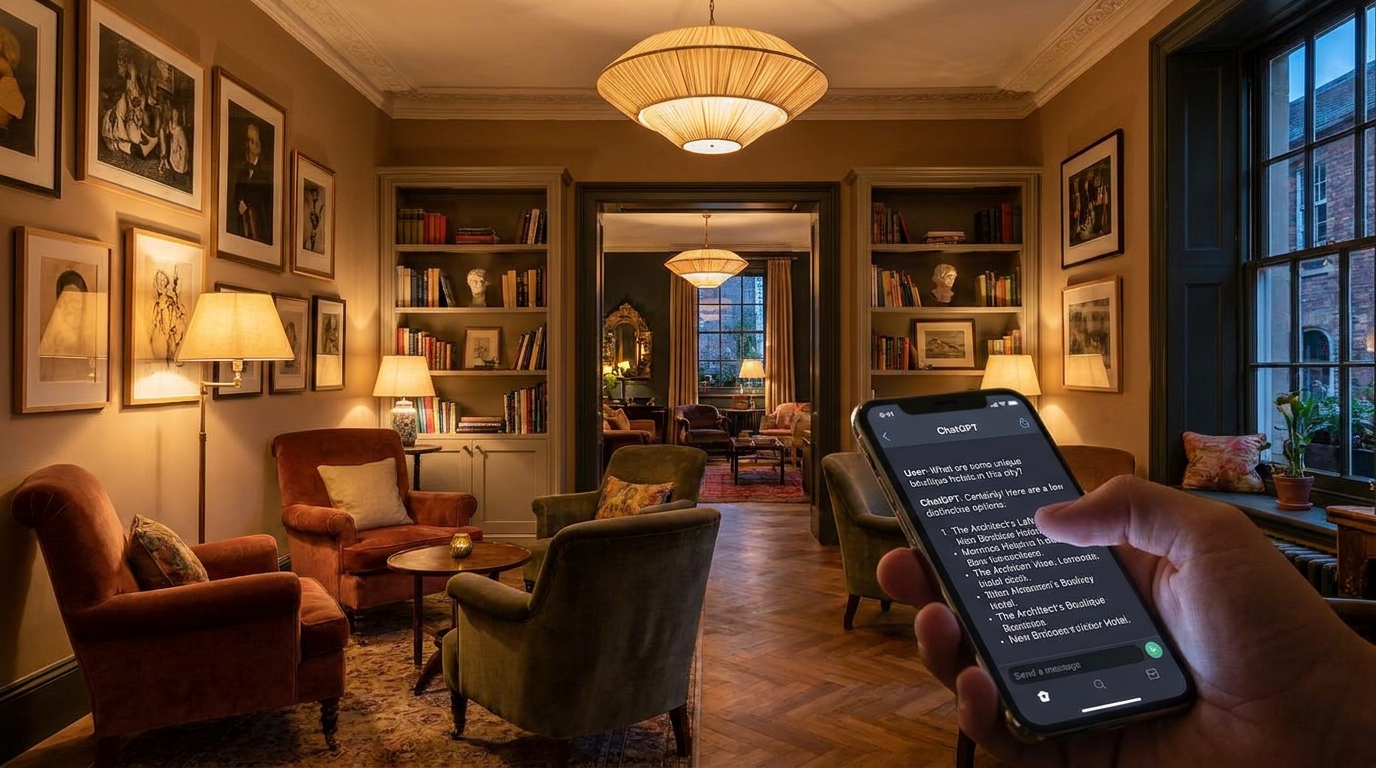
Boutique hotels occupy a strange paradox in the age of AI-powered search: they are the most distinctive, most story-rich, most recommendation-worthy properties in any destination — and yet they are systematically the least likely to appear when a traveller asks an AI engine for exactly the type of stay they offer. The reason is structural. Chains and OTAs have spent years building the data infrastructure that AI engines rely on. Independent boutique operators, running lean teams without dedicated SEO or tech staff, have not — and the gap is now showing up directly in booking pipelines.
A 2025 structured study of 25 luxury boutique hotels across six AI platforms found that just four properties captured nearly two-thirds of all AI mentions, while twelve registered under one percent share of voice — and two were entirely invisible. This is not a quality problem. Several of the invisible hotels had stronger guest reviews and more distinctive positioning than the ones that appeared. It is a structural data problem, and it is entirely fixable.
This guide explains why boutique hotels lose the AI visibility competition, how each of the six major AI engines behaves differently for boutique hotel queries, and the specific fixes that close the gap — most within 30 days.
Boutique hotel AI visibility — the numbers
Why are boutique hotels especially invisible to AI engines?
AI engines — ChatGPT, Perplexity, Google AI Overviews, Gemini, Claude, and Grok — do not discover hotels the way Google’s crawler used to. They synthesise answers from structured data signals, review content, cited web sources, and entity databases. For a property to appear in those answers, the AI engine needs to confidently resolve three questions: What exactly is this property? What kind of guest would it suit? How authoritative are the sources talking about it?
Chain hotels have spent years feeding clean, consistent, structured answers to all three of those questions — through OTA listings with standardised category tags, brand microsites with validated schema markup, and high-volume review profiles. Boutique hotels, by contrast, typically have a beautifully written website that tells a compelling story in prose — but very little of it is machine-readable. There is no LodgingBusiness schema block telling an AI engine that this is a 14-room property with a rooftop terrace in the Arts District. There are no structured amenity tags. There is no declared price range. From an AI engine’s perspective, the property barely exists as a confirmed entity — and so it defaults to whoever does have clean structured signals.
There is a second compounding risk that most boutique operators have not yet fully absorbed. Since ChatGPT integrated Booking.com and Expedia data in October 2025 (OpenAI announcement), AI engines surfacing OTA results cite the OTA entity, not the independent hotel’s own website. A boutique property that relies on OTA distribution for its digital presence is building brand equity for Booking.com, not for itself. When AI routes a traveller to that booking, it attributes the recommendation to the OTA. The property is invisible in the journey even when it is technically findable. Understanding your hotel AI visibility score and how it is calculated is the starting point — because the score reveals exactly which structural gaps your property is carrying.
What do AI engines actually need to know about a boutique hotel?
When an AI engine evaluates whether to include a boutique hotel in its answer, it is trying to resolve four things simultaneously. Understanding these four requirements is the clearest lens for diagnosing where a property is losing AI citations.
1. Entity confirmation. Is this a verifiable lodging business? The AI needs a confirmed property entity: a name, address, phone number, and URL that appear consistently across the hotel’s own site, Google Business Profile, OTA listings, and any third-party mentions. Inconsistency across sources causes AI engines to hedge — and hedging means fewer citations and lower confidence in the descriptions they do give. A LodgingBusiness JSON-LD schema block on the homepage is the single most efficient way to confirm entity status to every major AI engine simultaneously.
2. Named specificity. What makes this property distinctive? Generic marketing copy (“a boutique hotel offering a unique stay”) gives AI engines nothing to anchor to. Named, specific attributes — the rooftop terrace overlooking the Arts District, the 1920s mosaic tiles in the lobby, Room 4’s king bed with harbour views, the in-house sommelier on Friday evenings — are what generate matches against the specific queries boutique hotel guests actually use. Specificity is not just good writing. It is the technical signal AI engines weight most heavily when deciding which property to cite.
3. Occasion fit. What type of guest would choose this property and why? AI engines are increasingly answering occasion-driven queries (“best boutique hotel for a romantic anniversary weekend in [city]”, “quiet boutique hotel near [landmark] with excellent breakfast”). On-page content and review text need to name these occasions explicitly — not assume they are self-evident from the hotel’s positioning. Properties that answer the occasion question in their own content are more likely to be matched to it by AI.
4. Third-party authority. How trusted are the sources talking about this property? A named editorial citation in a respected travel publication generates AI engine citations across multiple platforms for years. Travel press, local neighbourhood guides, and editorial “best of” lists are the external sources AI engines use to validate a property’s reputation. A Princeton/IIT Delhi study (Aggarwal et al., KDD 2024) found that named expert quotes produce a +41% lift in AI citation rates — editorial coverage is the named-expert signal for hospitality properties.
Which AI visibility gaps hurt boutique properties most?
Not all visibility gaps carry the same weight. Based on RevPARGenius AI visibility scans of independent properties, the highest-impact gaps cluster into five categories — listed here in order of citation damage:
1. Missing or incomplete LodgingBusiness schema
The foundational gap. Without a validated LodgingBusiness JSON-LD block, an AI engine cannot resolve the property as a confirmed entity. All context — room count, amenities, price band, check-in policy, neighbourhood — must be inferred from prose. AI engines infer poorly when structured signals are absent. The hotel schema markup implementation guide covers every required field with annotated examples.
2. No llms.txt or llms-full.txt file
This is the most overlooked gap in 2026, and the one with the highest short-term return because almost no boutique hotels have done it. An llms.txt file is the AI-native equivalent of robots.txt — it tells AI engines which pages are safe to read and provides a clean, structured plain-text description of the property in a format optimised for machine consumption. An llms-full.txt file goes further: it contains the full property positioning, room types, amenity list, distinctive attributes, and occasion fit in plain text the AI can use directly without parsing marketing prose. Implementation is a single text file. Industry adoption remains under 5% across independent hotels, meaning the competitive return is outsized right now.
3. Thin or generic review content
AI engines use review text to understand what makes a property distinctive. A boutique hotel with 40 reviews saying “great location, clean rooms, friendly staff” gives an AI engine almost nothing to work with — those phrases apply to thousands of properties. A boutique hotel with 40 reviews specifically mentioning “the fireplace in Room 4,” “the owner’s handwritten breakfast recommendation card,” and “the 1920s mosaic tiles in the lobby” gives an AI engine highly specific, citable attributes that can match against very specific traveller queries. Since Perplexity integrated Tripadvisor booking data in 2025, Tripadvisor review tags — “Best for Solo Travellers,” “Great Rooftop,” “Quiet Location” — are being ingested as hard attributes by AI recommendation systems. Tripadvisor is no longer a reputation channel. It is booking infrastructure.
4. OTA-only digital presence
Since the ChatGPT-Booking.com/Expedia integration of October 2025, boutique hotels relying solely on OTA distribution receive indirect AI citations — but under the OTA’s entity, not their own. The property needs its own authoritative web entity — its own domain, its own schema, its own review strategy — to build direct AI visibility that routes guests to a direct booking rather than a commission-generating OTA page. The seven structural gaps that explain why independent hotels disappear from AI answers are covered in detail in our hotel AI invisibility diagnostic.
5. Inconsistent NAP and positioning across the web
AI engines penalise contradictory facts across sources. If your website says 32 rooms but an OTA listing says 35, or your homepage copy says “boutique luxury” while your Google Business Profile says “budget-friendly”, the AI engine hedges. That hedging shows up as fewer mentions, less specific descriptions, and lower-confidence framing. Every social profile, third-party listing, historical press release, and OTA description needs to match the canonical positioning on the main site.
How do the six AI engines handle boutique hotel queries differently?
Monitoring only one AI platform — the most common mistake in 2026 — misses where a guest probably asked. Each of the six major engines has a distinct retrieval mechanism and favours different signal types. Understanding the differences tells you where to prioritise effort.
ChatGPT. Combines training data with live web retrieval. Since the October 2025 OTA integration, booking queries frequently surface Booking.com or Expedia links rather than the hotel’s own site. A boutique hotel without its own strong web entity — validated schema, editorial citations, structured content — will be cited under the OTA’s entity name rather than its own. FAQ content and specific named attributes on the hotel’s website are highly extractable by ChatGPT’s synthesis layer.
Perplexity. The most heavily source-citation-focused engine. Every answer cites its sources by URL. Properties with specific editorial mentions on high-authority travel publications surface disproportionately. Since the 2025 Tripadvisor integration, Perplexity uses Tripadvisor review tags as hard structured attributes for filtering. A boutique hotel with strong, specific Tripadvisor tags gets matched to occasion-driven queries (“boutique hotel best for couples”) that Perplexity fields at high volume.
Google AI Overviews and AI Mode. Deeply integrated with Google Hotels and Google Business Profile. Properties without Google Hotels connectivity face structurally higher OTA routing in this ecosystem. Google AI Mode draws heavily on Google Hotels data for booking pathways — if your property is not connected, the booking button defaults to an OTA. Google AI Overviews rewards content that directly answers specific questions with structured, factual sentences. FAQPage schema is the most direct signal for extraction.
Gemini. Google’s model benefits substantially from Google Business Profile completeness. Location accuracy, amenity tags, up-to-date images, and Q&A content on the GBP all influence Gemini’s property descriptions. Gemini is particularly strong at location-driven queries (“boutique hotel near [landmark]”) — the GBP geocoordinates and category tags are weighted heavily in these results.
Claude. Weights structured, factual content over marketing prose. Well-formed FAQ sections, specific named attributes, and clearly structured room and amenity pages perform well. Claude also benefits from llms.txt implementation more visibly than other engines — it actively uses machine-readable property description files when present, reducing its reliance on parsing marketing copy.
Grok. Integrated with X (Twitter) and trending content signals. Less comprehensive for hotel discovery currently but rewards boutique properties with active social content and PR mentions that generate X discussion. Useful for properties in destinations with strong travel-blogging communities. Its overall hotel coverage remains thinner than the other five platforms at this stage, but its audience skews toward the traveller demographic most likely to use boutique properties.
How do boutique hotels out-rank chains in AI answers?
The common assumption is that chains win AI visibility because they have bigger marketing budgets. The actual mechanism is that they have more consistent structured data, higher review volume, and more web entities pointing to the same property entity. Boutique hotels cannot match chains on review volume or brand site scale. They do not need to.
The boutique advantage is specificity. A chain hotel is optimised to appear for “4-star hotel in [city]” — a broad query where it competes with every other chain and every major OTA. A boutique hotel with clean structured data and specific named attributes can own a cluster of narrow, high-intent queries that chains cannot answer as well:
- “Romantic boutique hotel with rooftop bar near the waterfront in [city]”
- “Boutique hotel in a historic building with a fireplace, central, good for a weekend anniversary trip”
- “Where to stay in [city] that feels like a local recommendation, not a tourist trap”
- “Small hotel with excellent breakfast and character in [neighbourhood]”
These are high-intent, conversion-ready queries. The guest has already decided they want a boutique experience — they are in buying mode. A well-positioned boutique hotel is the correct answer to every one of those questions. The problem is not relevance. It is machine-readability. Without structured data, specific named attributes, and review content that uses the guest’s own language, the AI engine cannot confirm the match — and so it hedges with a generic list or cites the chain that does have clean signals.
The same research on citation mechanics is encouraging: a Princeton/IIT Delhi study (Aggarwal et al., KDD 2024) found that pages anchored to dated statistics with named sources produce a +31% lift in AI citation rate. Named expert quotes and editorial citations produce a +41% lift. For boutique hotels, this means specificity is not just good marketing — it is the technical signal AI engines weight most heavily when deciding who to recommend. See our deep dive on understanding hotel AI visibility scores to see how these signals are measured in practice.
What does a practical boutique hotel AI visibility fix actually look like?
A practical AI visibility fix for a boutique hotel is not a six-month agency project. It is a focused set of changes targeting specific signal gaps, most executable in days. Here is what the four-week sequence looks like:
Week 1: Schema and llms.txt foundation
Implement a LodgingBusiness JSON-LD block on the homepage and key room pages. Include: property name, address, telephone, URL, priceRange, numberOfRooms, and amenityFeature with named, specific attributes (“Rooftop Terrace,” “Historic 1920s Building,” “In-room Fireplace” as individual LocationFeatureSpecification items). Simultaneously, create an llms.txt in the root directory listing key pages and a structured plain-text description of the property, and an llms-full.txt with full property positioning, room types, amenities, occasion fit, and policies. Validate schema at schema.org/validator. These two actions give every AI engine a clean canonical source to cite rather than stitching together fragments from marketing copy.
Week 2: On-page specificity audit
Audit every page of the website for generic copy and replace with named, specific attributes. The homepage hero should name the property’s most distinctive characteristic in the first sentence. Room pages should describe specific features and named details — not “a comfortable bed” but “a king-size bed facing the harbour, with handmade linen from a local artisan.” Simultaneously: audit the Google Business Profile and all OTA listings for factual consistency with the website. Correct any inconsistency in room count, neighbourhood, star rating, or property category.
Week 3: Review content and Tripadvisor activation
Launch a post-stay email sequence with two specific prompts: “What was the one thing about your stay you did not expect?” and “Is there a specific detail you would tell a friend about?” These generate the specific, named-attribute review content AI engines can extract. On Tripadvisor, verify that your review tags reflect your actual primary occasions (“Best for Couples,” “Great Breakfast,” “Historic Property”) and that your property description and amenity list are current. Respond to existing reviews in ways that reinforce the property’s distinctive characteristics — review responses are crawlable content.
Week 4: Third-party citation building
Identify five to ten editorial sources that regularly publish “best boutique hotels in [city]” content: travel press, neighbourhood guides, food publications with hotel coverage, local “weekend guide” sites. A single named editorial mention in a respected publication can generate AI engine citations across multiple platforms for years. This is the named-expert-quote signal that drives the +41% citation lift in the KDD 2024 research — and it is a channel that chains rarely compete on at the neighbourhood level.
To see what a real AI visibility audit surfaces for an independent property — and make the gap concrete before investing in fixes — this walkthrough of a live boutique hotel AI visibility report shows exactly what the scan reveals and how to prioritise the output.
RevParGenius Take
Boutique hotels have a structural AI visibility advantage that chains cannot replicate — if they do the technical work to activate it. Specificity wins. The queries boutique hotel guests ask AI engines are exactly the queries generic chain profiles cannot answer well.
The fix is not a six-month project. Schema, llms.txt, on-page specificity, and Tripadvisor activation can be done in four weeks. The boutique properties doing this now are building an AI citation moat that will compound as the 56% of AI-using travellers becomes 70%, then 85%. The window to move first is still open — but not indefinitely.
The fastest way to see exactly where your boutique property sits across all six AI engines — and which specific gaps are keeping you out of the answers your guests are already getting — is a RevPARGenius AI Visibility audit.
Run My Free AI Visibility Audit →Frequently asked questions
Do boutique hotels appear in ChatGPT hotel recommendations?
Some do, but most do not — and the determining factor is not the quality of the property. It is the quality of the structured data and web entity behind it. ChatGPT now draws on Booking.com and Expedia data following the October 2025 integration, meaning boutique hotels relying solely on OTA listings may receive an indirect citation — but under the OTA’s entity, not their own. Properties with their own validated schema markup, an llms.txt file, consistent NAP data, and specific on-page attributes are far more likely to be cited directly by name.
What makes a boutique hotel more likely to be cited by AI engines?
Specificity is the single most important driver. AI engines are more likely to cite a boutique hotel when they can confirm specific, named attributes that match a traveller’s query — features like a named rooftop terrace, a historic building date, a distinctive breakfast offering, or room-level details mentioned consistently across reviews and on-page content. Properties with validated LodgingBusiness schema, an llms.txt file, a strong review profile with specific attribute mentions, and at least one third-party editorial citation consistently outperform generic boutique listings across all six major AI engines.
How is AI visibility different for boutique hotels versus chain properties?
Chain hotels carry pre-built entity authority: years of consistent structured data across brand sites, loyalty program pages, OTA listings, and press coverage have already trained AI engines to recognise them. Boutique hotels start with a lower baseline but can outperform chains on narrow, high-intent queries (“best boutique hotel for a romantic weekend with a rooftop in [city]”) that chain profiles cannot answer as specifically. The gap is real but closeable with schema, specificity, and citation strategy.
Can a boutique hotel with few reviews still appear in AI answers?
Yes, if the structured data foundation is solid and on-page content is specific enough. Review volume matters, but review specificity matters more for boutique properties. Twenty reviews that each mention a distinctive named characteristic give an AI engine more usable signal than 200 generic reviews saying “great stay.” Schema markup and on-page specificity fixes should come first — so when new reviews arrive, the AI engine has a complete entity picture to attach them to.
How long does it take for a boutique hotel to improve its AI visibility?
Schema and llms.txt changes can be picked up by AI engines within days to a few weeks of validation and indexing. On-page content changes typically take two to six weeks to be re-crawled. Review content improvements take two to four months to build meaningful specificity. Third-party editorial citations can begin influencing AI responses within weeks of publication. Most boutique hotels see measurable AI visibility improvement within 60 days of fixing schema, llms.txt, and on-page specificity.
Sources: Phocuswright, US Traveler Technology Survey, February 2026; Skift Research, 2024 AI Travel Planning Adoption Survey; Aggarwal et al., “GEO: Generative Engine Optimization,” Princeton University / IIT Delhi, KDD 2024; OpenAI, ChatGPT + Booking.com / Expedia integration announcement, October 2025; LuxDirect CS10 London structured AI query study, 2025 (9,380 responses across 25 properties). Last reviewed June 2026.