
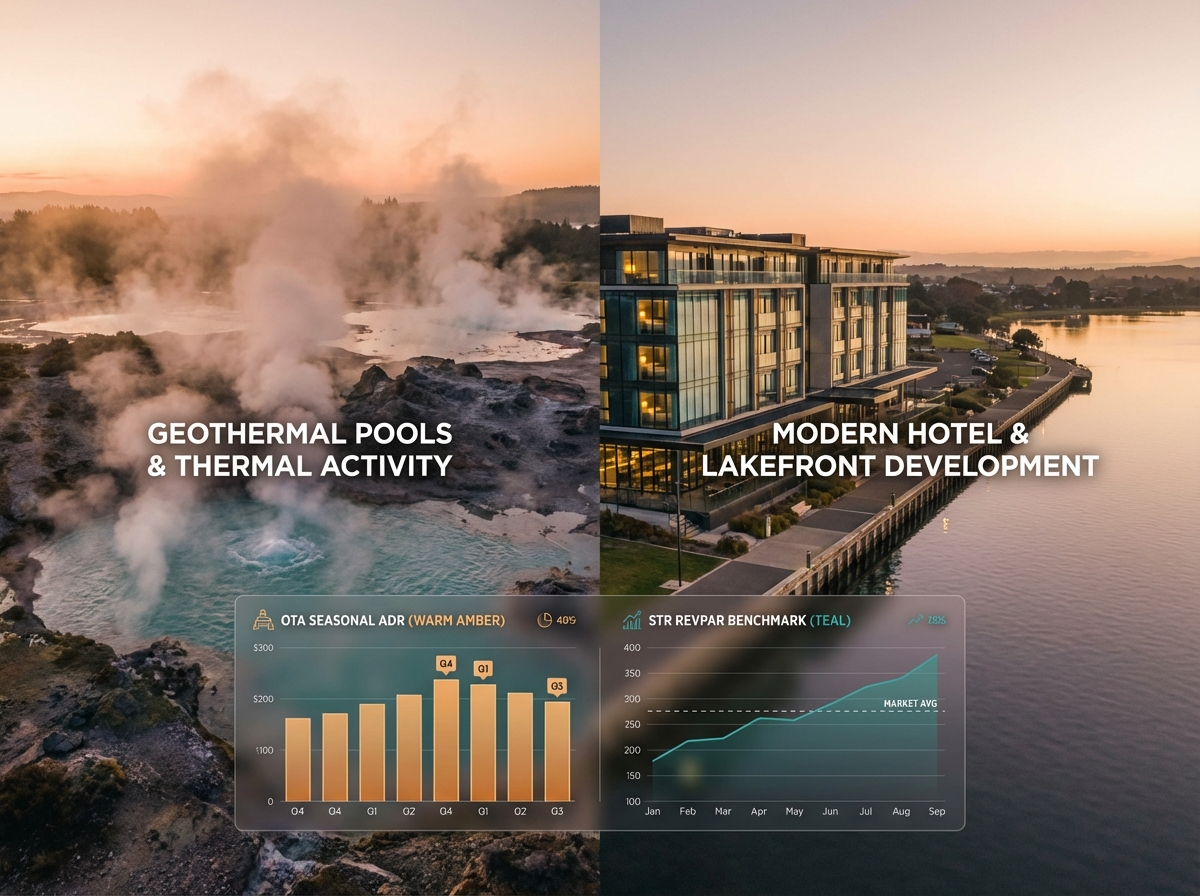
Most hotel revenue analysis in New Zealand relies on one data source. When you layer OTA pricing signals on top of STR RevPAR benchmarks — and correct for the methodological trap most GMs fall into — the Rotorua market looks quite different from what either source tells you alone.
The Two Data Sources and What They Actually Measure
Before drawing any conclusions, it's worth being precise about what each dataset captures — because they are measuring fundamentally different things, and conflating them is the most common analytical error in hotel market analysis.
What it measures: Advertised rate on major online travel agencies at a specific point in time.
What it tells you: Competitive positioning, market floor and ceiling dynamics, rate pressure direction.
⚠ Blind spot: No occupancy, no achieved revenue, no fill rate signal.
What it measures: Achieved RevPAR across the short-term rental accommodation market including Airbnb and similar platforms.
What it tells you: Yield-adjusted performance — occupancy is already factored in.
⚠ Blind spot: Not directly comparable to hotel ADR without occupancy adjustment.
What the Rotorua OTA Data Shows
Pulling OTA pricing across four seasonal sample dates, the Rotorua hotel competitive set shows a clear seasonal hierarchy — one that surprises most GMs who assume summer is the dominant pricing window.
Source: Booking.com OTA availability data — 8–10 priced hotels per seasonal sample date. Prices in NZD.
| Season | Sample Date | OTA ADR (NZD) | Price Range | Demand Signal |
|---|---|---|---|---|
| 🍂 Autumn | Apr 11, 2026 | ~$86 | $13 – $153 | Weak · Price-sensitive |
| ❄️ Winter | Jul 11, 2026 | ~$104 | $21 – $145 | Moderate · Stable |
| 🌸 Spring | Oct 10, 2026 | ~$137 | $21 – $286 | Building · Some compression |
| ☀️ Summer | Jan 9, 2027 | ~$109 | $24 – $183 | Stable leisure |
What the STR Data Adds
The Rotorua District short-term rental market (AirDNA Market ID: 85512) returns a single confirmed data point from the available API: an average daily RevPAR of USD $83.87, with a year-on-year change of −1.95%.
Converting to NZD at approximately 0.58: NZD ~$144 RevPAR for the STR market, softening slightly year over year.
⚠️ The Comparison Error Most GMs Make
RevPAR is not ADR. RevPAR = ADR × Occupancy. It is always lower than ADR unless the property is at 100% occupancy. Comparing STR RevPAR directly to hotel ADR — without adjusting for occupancy on both sides — produces a misleading picture of relative performance. That comparison is analytically invalid.
The correct approach: derive implied ADR from RevPAR on both sides using an estimated occupancy rate, then compare like with like.
The Corrected Comparison
Deriving implied STR ADR requires an occupancy estimate. For a leisure destination like Rotorua, typical STR occupancy runs 60–70%. Applying that range to the NZD $144 RevPAR figure gives an implied STR ADR of approximately NZD $205–$240.
On the hotel side, applying a reasonable hotel occupancy of 65–75% to the blended seasonal OTA ADR of roughly NZD $109 gives an implied hotel RevPAR of approximately NZD $71–$82.
Source: OTA pricing data via Booking.com; STR RevPAR via AirDNA (Market ID 85512). Occupancy estimates based on typical leisure market ranges. All figures NZD unless stated.
| Metric | STR Market | Hotel (OTA) | Gap |
|---|---|---|---|
| RevPAR (NZD) | ~$144 | ~$71–$82 est. | STR leads by ~$62–73 |
| Implied ADR (NZD) | ~$205–$240 est. | $86–$137 seasonal | STR premium ~$100+ |
| YoY RevPAR trend | −1.95% | Not confirmed | Both markets softening |
Why the STR Premium Exists — and What It Means for Hotels
The gap between STR and hotel performance in Rotorua is primarily a product premium, not a pricing discipline gap. Lakefront houses, geothermal-area cabins, and multi-room properties for families are not the same product as a hotel corridor room — and the guests booking them are not cross-shopping on Booking.com. Attempting to close the STR yield gap by simply raising hotel rates misreads the problem entirely.
STR operators hold three structural advantages that hotels typically lack:
No Rate Parity Constraints
STR operators price on their own terms. Hotels operating under OTA rate parity clauses are constrained in how aggressively they can yield their ceiling — STR operators face no such limit.
Product Differentiation
Unique lakefront or geothermal-area properties face less direct price comparison than standardised hotel rooms. When there is no obvious substitute, price sensitivity drops and ADR rises.
High-Value Segment Alignment
STRs naturally capture the family, group, and experiential traveller segments that Rotorua's leisure positioning attracts — guests with higher per-trip spend and lower price sensitivity than solo or couple transient travellers.
💡 The More Productive Response for Hotels
Rather than trying to match STR rates on OTA, the strategic move is to focus on the segments where the hotel product genuinely competes — corporate, loyalty, and midweek transient — and price those with more discipline. Then build ancillary revenue through spa packages, cultural experience inclusions, and geothermal wellness offerings that STR properties cannot easily replicate. Close the yield gap through product and segment strategy, not rate inflation.
The Signal Most GMs Are Missing
The −1.95% year-on-year STR RevPAR decline is the number that changes the strategic framing.
STR operators in Rotorua hold structural advantages — better product differentiation, pricing freedom, and segment alignment — and their RevPAR is still softening. That tells you the constraint is on the demand side, not the pricing side. Total accommodation demand in Rotorua is flat to slightly declining across both hotel and STR supply.
This has a direct implication for hotel pricing strategy: the market is not positioned to absorb broad rate increases. The GMs who outperform this year are not the ones pushing rate across all seasons — they are the ones who protect rate floors in autumn, extract the available spring compression premium with precision, and build occupancy in winter through segment-specific strategies.
What the Combined Data Tells You to Do — Season by Season
Each season in Rotorua demands a different strategic posture. Here is what the OTA + STR data prescribes for each window.
🍂 Autumn · Apr–May
Focus: Rate floor, not volume at any price.
The $13–$19 rooms in the OTA sample are someone else's problem. Set a minimum rate you will not go below. Use value-adds — breakfast, experience packages — to stimulate pickup. Do not follow distressed competitors down.
❄️ Winter · Jun–Aug
Focus: Domestic segments + geothermal packaging.
Rotorua's spa and thermal product genuinely performs in colder months. Price accordingly and package it — a thermal experience inclusion with a standard room night is incremental revenue that a plain room booking leaves on the table. Watch school holiday periods for selective yield opportunities.
🌸 Spring · Sep–Nov 🔥
Focus: Yield aggressively — this is your revenue season.
The $286 OTA ceiling confirms event-driven compression is present. Watch comp set availability daily from 5–7 days out. Push rate in incremental steps as inventory tightens. Consider minimum length-of-stay controls on peak weekends. Most of your annual ADR improvement happens here.
☀️ Summer · Dec–Jan
Focus: Rate discipline, not rate aggression.
Summer is stable leisure demand, not peak demand. Resist the temptation to price it as your primary season. Maintain rate discipline, watch your booking window closely, and avoid early discounting — that caps your spring upside if patterns shift late in the season.
Frequently Asked Questions
Is Rotorua a summer or winter peak hotel market?
Neither. OTA pricing data across four seasonal sample dates shows spring (September–November) as the strongest pricing season, with an ADR of approximately NZD $137 and a ceiling of $286 on OTA channels. Summer ADR of $109 and winter ADR of $104 both trail spring significantly. Rotorua behaves as an event-influenced leisure market, not a pure summer or ski-driven winter market.
How does Rotorua hotel pricing compare to Airbnb?
After correcting for the RevPAR vs ADR comparison error, the STR market in Rotorua shows an implied ADR of approximately NZD $205–$240 versus a hotel seasonal ADR range of $86–$137. The gap is real — roughly $100+ on ADR — but it is primarily a product premium reflecting unique STR properties (lakefront houses, geothermal-area cabins) rather than superior pricing discipline. Hotels and STRs are not serving the same guest segments in most cases.
What does the −1.95% STR RevPAR decline mean for hotels?
It signals that total accommodation demand in Rotorua is flat to softening year-on-year — the constraint is on the demand side, not the pricing side. For hotels, this means the market is not positioned to absorb broad rate increases. The outperformance strategy is focused rather than broad: protect autumn rate floors, capture spring compression precisely, and use packaging and segment strategy in winter rather than blunt rate moves.
Why is there such a wide price range in the Rotorua OTA market?
The extreme low-end prices visible in the OTA data — particularly the $13–$19 autumn floor — represent distress discounting by individual properties, not rational competitive positioning. This behaviour drags the seasonal ADR average down and creates a falsely compressed picture of the market's actual rate potential. Hotels that anchor their pricing strategy to these floor prices are competing for a guest segment that produces poor ancillary revenue and marginal profitability. The better benchmark is the mid-market cluster: $77–$111 in winter, $74–$177 in spring.
See Your Rotorua Property's Corrected Market Position
RevPARGenius combines live OTA competitive data with STR benchmark intelligence to give Rotorua hotel operators a complete, seasonally-adjusted view of their market — so you price from the right picture, not a misleading one.
Start Your Free Trial → No Credit Card RequiredFull market analysis included. Set up in under 10 minutes.