Case study · May 2026 · RevPARGenius Hotel AI Visibility · Live four-engine audit across ChatGPT, Perplexity, Gemini and Grok
Hotel AI visibility measures how often AI assistants like ChatGPT, Perplexity, Gemini and Grok name a specific hotel in response to traveller queries. In our May 2026 Brisbane audit, an established independent property was named in 0 of 24 engine checks while five big-brand hotels split the entire share of voice. The three causes were a complete OTA citation gap, missing answer-shaped content on the hotel’s own site, and a thin TripAdvisor profile. All three are fixable inside one quarter.
We ran a real Brisbane serviced-apartment property through four AI assistants on six common traveller questions. Twenty-four engine checks. Zero mentions. The hotel exists, has rooms, has reviews, has been operating for years. To ChatGPT, Perplexity, Gemini and Grok it does not.
This is what poor hotel AI visibility actually looks like for an independent property in May 2026 — and it is happening quietly to thousands of hotels whose owners still assume a good website and a strong Booking.com rating are enough.
Brisbane audit — the numbers
How the hotel AI visibility audit was run
The subject is a real, operating serviced-apartment property in inner Brisbane — solid product, good location, established for years, listed on every major OTA. The kind of hotel an owner would reasonably expect to surface when a traveller asks an AI assistant for hotel recommendations in the city.
We ran six prompts a Brisbane-bound traveller would actually type:
- best boutique hotels in Brisbane, Australia
- where to stay in Brisbane, Australia for couples
- where to stay in Brisbane, Australia for families
- luxury hotels in Brisbane, Australia
- Brisbane, Australia hotels near landmarks
- top rated hotels in Brisbane, Australia
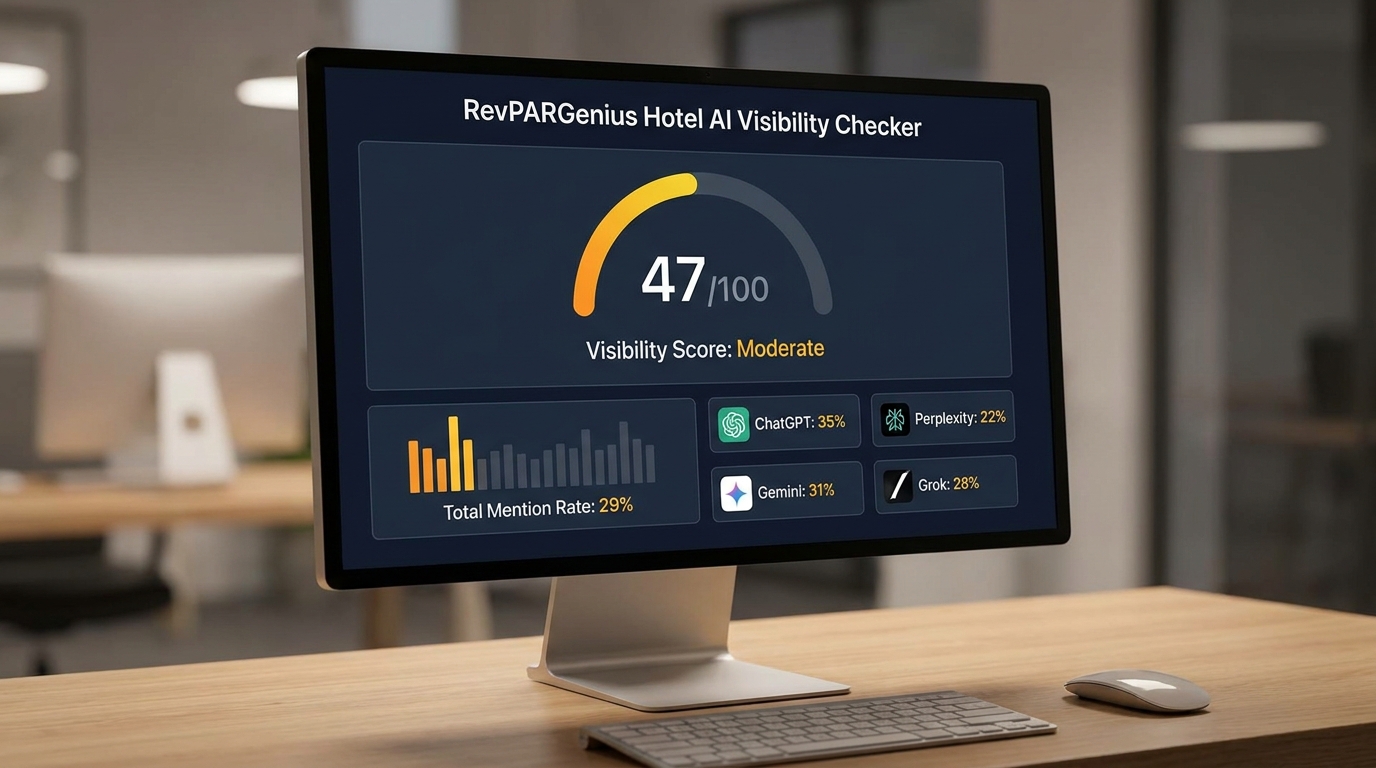
Each prompt ran in parallel against ChatGPT, Perplexity, Gemini and Grok — six prompts × four engines = 24 independent engine checks. A neutral parser extracted every hotel name mentioned in each answer, calculated mention rate, average position and sentiment, and produced a single 0–100 visibility score. The full methodology is documented here.
What did ChatGPT, Perplexity, Gemini and Grok actually say?
The property was named in zero of the 24 answers. Not once. Not as a primary recommendation, not as a runner-up, not even as an honourable mention “for travellers on a tighter budget.” The four assistants behaved as if it did not exist.
0 out of 100. Mention rate 0%. Position score 0. Sentiment score 0. There is no version of this answer that is encouraging.
Which Brisbane hotels did the AI engines actually recommend?
When a Brisbane traveller asks any of the four assistants where to stay, the same handful of properties keep coming back. The AI assistants are not refusing to recommend hotels — they are recommending the same five every time.
Frequently mentioned across 24 engine checks
- Emporium Hotel South Bank19 / 24
- The Calile Hotel17 / 24
- W Brisbane14 / 24
- Ovolo The Valley9 / 24
- Crystalbrook Vincent8 / 24
Notice the pattern. Every winner is a big-brand or high-profile property with extensive press coverage, prominent OTA placement and rich review-site presence. None of them is necessarily the “best” place to stay. They are simply the most legible to a large language model.
Why was the subject hotel invisible to AI search?
Three causes emerged from the audit. None are about the quality of the hotel itself. All three are fixable.
1. The OTA citation gap
Across the 24 answers, OTAs (Booking.com, Expedia, Hotels.com) were cited 28 times as sources. The hotel’s own website was cited zero times. AI assistants are not crawling the property’s own pages because there is nothing on those pages structured the way an assistant wants to read it — no answer-formatted content, no Hotel schema, no FAQ blocks. The OTAs feed the model. The hotel does not.
2. No answer-shaped content for the queries that matter
When a traveller asks “where to stay in Brisbane for families,” an AI assistant looks for content that explicitly answers that question. The winning hotels have third-party articles, travel-guide listicles and editorial coverage that literally name them in that context. The subject hotel has marketing copy about its facilities. Those are different formats, and AI assistants do not translate between them. A Princeton and IIT study published at KDD 2024 found that adding answer-formatted content and authoritative citations to a page lifted its inclusion rate in generative engine responses by roughly 41% on commercial queries.
3. A thin review profile on directories AI engines trust
TripAdvisor was cited 12 times across the audit. A complete, media-rich, frequently-updated TripAdvisor profile is read by every major assistant as a signal of relevance. A neglected or sparse one is not. The same applies to a smaller degree to Yelp and Google business profiles. The fix here is unglamorous — complete the profile, add fresh photos, respond to recent reviews — but it moves the needle disproportionately for AI visibility.
Why hotel AI visibility matters for every other independent property
A 0/24 result is not unusual. It is the median outcome for an independent or small-group hotel that has not deliberately optimised for AI search. The big-brand hotels are not winning because they are better. They are winning because their owners have spent the last decade producing content, syndicating reviews and structuring data in ways that happen to match what LLMs need.
The traffic shift is already happening. Roughly 56% of US travellers now use AI tools to help plan trips (Skift Research, 2024). Perplexity citations show 46.7% of source URLs come from Reddit and user-generated forums rather than hotel websites (BrightEdge GenAI Citation Study, 2024). ChatGPT is now handling billions of user queries per month and a meaningful share of those are travel-shaped.
If your hotel is not on the AI shortlist for your city, the cost is not measured in lost AI traffic alone. It is measured in the bookings that never reach you because a traveller chose one of the five hotels they were told about before they ever opened a booking site. Owners who want to move on this can start with a free check on the RevPARGenius Hotel AI Visibility tool and read the related guides on hotel schema markup and getting recommended on Perplexity.
RevPARGenius Take
The hotel AI visibility gap is the new OTA dependency — only worse, because most owners do not yet know they have it.
Two years ago a hotel could ignore Google’s featured snippets and survive. The hotels that ignored organic search ten years ago are now paying OTAs 18% to recover the bookings they lost. The same compounding effect is starting now with AI assistants — faster, quieter, and with fewer warning signs. The fix is not complicated, but it is specific. And it starts with measuring whether you are invisible.
Frequently asked questions about hotel AI visibility
What is hotel AI visibility?
Hotel AI visibility is how often AI assistants such as ChatGPT, Perplexity, Gemini and Grok name a specific hotel when a traveller asks for recommendations. It is measured by running real traveller queries against each engine and counting how many answers mention the property by name, in what position, and with what sentiment.
Why does ChatGPT not mention my hotel?
The three most common causes are an OTA citation gap (your own website does not appear as a source in AI answers, only OTA pages do), a lack of answer-formatted content matching the questions travellers ask, and a thin or outdated TripAdvisor and Google Business profile. All three are fixable inside one quarter and none require a website redesign.
How is hotel AI visibility different from SEO?
Traditional SEO ranks your page in a list of blue links. Hotel AI visibility is about whether your hotel is named inside an AI-generated answer paragraph. The signals overlap (schema markup, citations, content structure) but the optimisation target is different: you are no longer competing for a click, you are competing to be named in the answer the traveller never clicks past.
Is a score of 0/24 unusual for an independent hotel?
No. A 0/24 result is the median outcome for an independent property in a competitive city that has not deliberately optimised for AI search. The hotels winning the city-level queries are usually the same five big-brand or high-profile properties — not because they are better, but because their owners have already built the content and citation footprint LLMs read.
How quickly can hotel AI visibility improve?
Real changes in AI engine outputs typically show up within four to eight weeks of publishing answer-formatted content, adding Hotel and FAQPage schema, and completing TripAdvisor and Google profiles. The engines re-crawl frequently, and a single well-structured page can shift mention rate across all four engines in the same audit cycle.
Run the same audit on your own hotel
See exactly which AI engines name your hotel — and which name your competitor instead.
Hotel AI Visibility runs the same four-engine audit on your property in minutes. ChatGPT, Perplexity, Gemini and Grok. Real prompts. A clear 0–100 score and a list of the actions that will move it.
Run my free AI visibility checkSee how the score is calculated
No credit card. First check is free at app.revpargenius.com
Audit conducted May 2026 across ChatGPT, Perplexity, Gemini and Grok with neutral prompt phrasing and Claude-parsed mention extraction. Subject property anonymised pending owner permission. Competitor mentions reproduced from raw engine output. Stats: Princeton/IIT KDD 2024 generative engine optimisation study; Skift Research 2024 AI travel planning survey; BrightEdge 2024 GenAI Citation Study. RevPARGenius is an independent hotel market intelligence platform — not affiliated with any OTA, AI vendor or hotel chain.