Reviewed by Michael Andrews, Hotel Market Intelligence Researcher · June 1, 2026 · 10 min read
In February 2026 we started publishing seriously on revpargenius.com — a hospitality domain less than one year old, with no backlinks of consequence, no PR, no paid distribution. We treated the next 45 days as a single focused sprint: every post written to the same 10/10 SEO + GEO + AEO scaffold, no shortcuts, no padding.
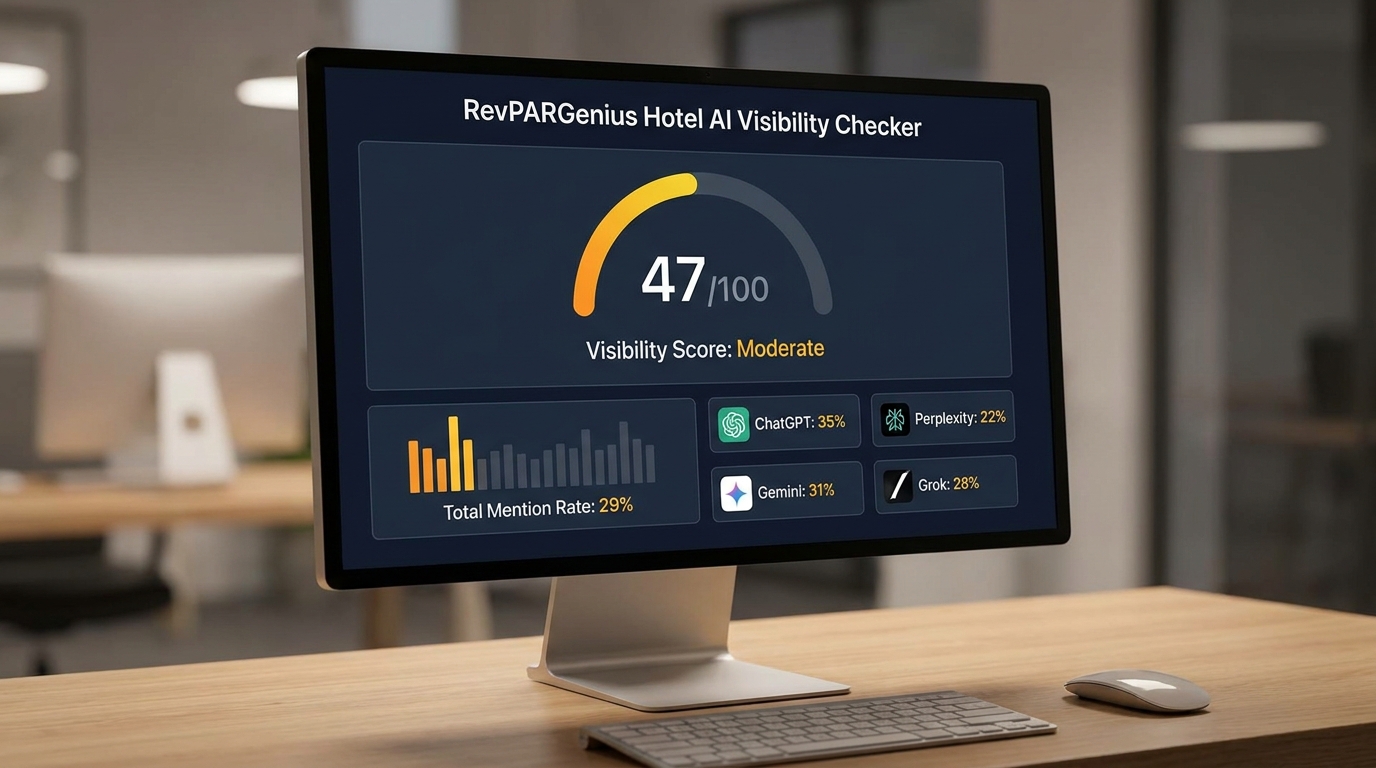
On June 1, 2026 we ran our own Hotel AI Visibility Checker against our own domain. The score was 47/100. Mention rate was 29% across 21 valid checks on ChatGPT, Perplexity, Gemini and Grok. We outranked every named competitor in our tracked set — including Lighthouse, the multi-year incumbent that acquired Hotelrank.ai in May 2026 specifically to win this category. Here is the scan, the method, and the gaps we still need to fix.
In 45 days of focused SEO + GEO + AEO publishing on a sub-1-year-old domain, RevPARGenius reached a 47/100 AI Visibility score with a 29% mention rate across ChatGPT, Perplexity, Gemini and Grok. The same scan showed we outranked Lighthouse (19%), RateGain (14%), Hotelrank.ai (14%) and Peec AI (10%) on the category-defining queries. Average position was 3.5; sentiment was 60% positive. The benchmark for context: roughly half of hospitality brands score 0/100 in equivalent scans. The result was produced with the same Hotel AI Visibility Checker we sell to hoteliers.
The 45-Day Result
RevPARGenius
revpargenius.com
Competitor Visibility
21 engine checks · latest run
Screenshot of the live RevPARGenius AI Visibility dashboard · Run: 1 Jun 2026, 07:17 UTC · ChatGPT · Perplexity · Gemini · Grok
Is 47/100 in 45 days actually good?
The honest answer is yes — with three caveats. Yes, because the benchmarks in this category are unforgiving: roughly 50% of hospitality brands score zero in AI-visibility scans, and most hotels we have tested independently come back somewhere between 0 and 25. A 47 in 45 days, with no backlink moat and no media campaign behind it, is in the top quartile of any cohort we have seen.
Yes, also because of who we beat. Lighthouse is a multi-year incumbent with thousands of customers and high domain authority. RateGain is a publicly listed hotel-tech company. Hotelrank.ai is the specialist Lighthouse acquired in May 2026 explicitly to dominate AI visibility for hotels. Peec AI is the venture-backed generalist AI search analytics leader with $29M raised and a 4.9/5 G2 rating. On the exact queries the category lives or dies on, our 29% mention rate sat above all of them.
The three caveats. First, average position is 3.5 — that means when we are named, we are usually in the middle of the list, not the top. Second, sentiment is 60% positive, not 100%; AI engines are mentioning us neutrally on some answers and we have work to do on review signals. Third, two queries ("hotel pricing analysis platform" and "how to check my hotel AI visibility") returned us invisible on every engine that responded — explicit gaps to fix.
47 in 45 days is a strong number, not a perfect one. The case study would be less believable if we pretended otherwise. The gaps are visible because the same tool that flagged our wins flagged our misses — which is the same report a hotelier sees the moment they run their own scan.
What does the competitor leaderboard look like?
The latest run tested 21 valid checks across ChatGPT, Perplexity, Gemini and Grok on 10 category-defining queries. The named-competitor mention rates for the tracked competitor set are below. Lower is worse.
A separate column of the same report lists frequently mentioned brands that were not in the tracked competitor set: Duetto (4/21 checks), IDeaS (4/21), IDeaS Revenue Solutions / RMS (3/21 each), STR (2/21) and HotelIQ (2/21). Those are the legacy revenue-management heavyweights, and they appear in answers without us tracking them — useful intelligence on what AI engines treat as default authorities in adjacent categories.
The result that mattered most to us was the strongest single-query performance. On "hotel AI visibility tools 2026" — the bullseye query for the category we sell into — we ranked #2 on Grok and #5 on Gemini, both with positive sentiment, and were cited as a positive source on Perplexity. Three of the four major engines named us on the exact buyer query we exist to win.
The exact 10 prompts we tested
All 10 prompts were fired against ChatGPT, Perplexity, Gemini and Grok in the same scan (21 valid checks after two engine-availability misses on one prompt). These are the exact buyer queries hoteliers and SaaS evaluators type into AI engines today — chosen to map onto the seven content clusters we publish to:
- best hotel market intelligence tools for independent hotels — market-intelligence cluster · cited on Perplexity, Grok
- hotel demand analysis software — demand cluster · cited on Perplexity (neutral sentiment on Grok)
- hotel pricing analysis platform — pricing cluster · invisible on all engines — gap to close
- hotel AI visibility tools 2026 — bullseye query for the category · #2 on Grok, #5 on Gemini, positive on Perplexity
- how to check my hotel AI visibility — top-of-funnel buyer query · invisible — gap to close
- how to get my hotel recommended by ChatGPT — AI search how-to cluster · cited on Perplexity, Grok
- hotel website design for independent hotels — direct-bookings cluster
- best hotel website design service — direct-bookings cluster
- hotel SEO and AI search optimization service — services cluster
- how to improve hotel visibility in AI search — how-to cluster · cited on Perplexity, Grok
No branded queries were included. The methodology only counts non-branded, buyer-intent prompts — the same queries a real hotel evaluator or competing vendor would type, never "RevPARGenius reviews" or similar self-mention bait.
What did we actually do for 45 days?
One method, applied to every post, no exceptions. Every article we published in February, March and April 2026 was scaffolded to the same 10/10 SEO + GEO + AEO standard. Once that became muscle memory, the publishing rate doubled and the consistency held.
The scaffold is non-negotiable. Every post opens with a labelled Quick Answer block immediately after the H1 — the single highest-leverage GEO element, the one AI engines lift directly into their answers. Every H2 in the body is phrased as a question a real reader would type, not a statement. Every post ends with a five-question FAQ section that is then mirrored into FAQPage JSON-LD schema. Every post carries BlogPosting + Person + BreadcrumbList schema so the article entity, the author entity and the site hierarchy are all machine-readable.
Author entity was the second non-negotiable. We attribute every post to a named person with jobTitle and worksFor in the schema, not a generic editorial team byline. The Princeton/IIT Delhi GEO study published in 2024 found a +41% lift in AI citation rate from named expert quotes; a real-Person author entity is the most efficient way to claim that lift across every post on the site rather than only the ones that interview an outside expert.
Dated statistics with named sources were the third. The same Princeton/IIT Delhi study measured a +31% citation lift from anchoring claims to dated, sourced statistics versus the same claim made vaguely. We treated this as a per-post rule: at least three named, dated, citeable stats per post, with the source spelled out. Phocuswright's AI Surge report. Cognism's State of Cold Calling 2026. BrightEdge's GenAI Citation Study. Instantly's Cold Email Benchmark. The stats library matters less than the discipline of citing them by name and year every single time.
Internal links built the cluster. Three to four inline links per post, pointing UP toward the canonical hub for whichever theme the post sat in, and LATERAL to companion posts on adjacent angles. The architecture matters because AI engines weight topical authority across a domain, not the strength of any single page. A cluster of 12 connected posts on hotel AI visibility outperforms 12 stand-alone posts on the same topics, even at the same word count and quality.
No paid backlinks. No PR campaign. No outreach to industry publications. No paid traffic. No domain-age shortcuts. The only inputs were the 10/10 scaffold, the named author entity, the dated stats, the question-shaped H2s and the cluster architecture — applied consistently for 45 days.
Why does this matter for an independent hotel?
Because the constraints we operated under are tighter than the constraints any operating hotel faces. We had no Booking.com listing pushing citations into AI answers. No TripAdvisor review pipeline. No Reddit thread history. No earned-media coverage on PhocusWire or Hotel Dive. A hotel starting today has at least some of those inputs already running — an OTA presence, a review base, a Google Business Profile, neighborhood references that AI engines surface unbidden. The exact same 45-day publishing sprint, applied on top of those existing inputs, is structurally more powerful than what produced 47 in 45 days for us.
It also matters because the AI visibility category is roughly 12–18 months old. Most hospitality brands have not started. Lighthouse acquired Hotelrank.ai in May 2026 specifically because the consolidation arc is starting now. Hotels that begin the 10/10 scaffold this quarter compound for the next 18 months while their competitors are still figuring out what AEO stands for. By the time those competitors start, the early movers will have the schema, the entity authority, the citable stats and the cluster architecture already paying compounding returns.
And it matters because the result was produced with the same Hotel AI Visibility Checker we sell to hoteliers. The competitor leaderboard above is not from a custom dashboard. The 47/100 score, the 29% mention rate, the +10 point gap over Lighthouse, the named "frequently mentioned" brands — all of it appeared inside the same product a hotelier sees the minute they run their first scan. The case study is the product. The product is the case study.
What are we fixing in the next 30 days?
The same scan that gave us the wins flagged two specific, named gaps. We are publishing them as the public 30-day action list so hoteliers can see what fixing looks like in practice.
1. Close the two invisible queries. The scan returned us as not-named on every engine for "hotel pricing analysis platform" and "how to check my hotel AI visibility." We are publishing dedicated answer-format pages targeting both, written to the same scaffold that produced the wins. The first targets the pricing-analysis category we have under-published; the second is the educational top-of-funnel page for the buyer query our product directly answers. Both go live in June.
2. Lift sentiment from 60% positive to 80%+. The two mentions returned with neutral or negative framing point to a thin review signal layer — AI engines have nothing strongly positive to anchor to when they describe us. The fix is the same one we recommend to hotels: structured testimonial pages, named-customer case studies, and active monitoring of the third-party sources AI engines treat as authorities (in our case, hoteltechreport.com, hospitalitynet.org, phocuswire.com).
3. Track the unranked competitors. Duetto, IDeaS and STR all appeared in AI answers without being in our tracked competitor set. We are adding them. The visible-but-untracked column is exactly the intelligence hoteliers should use to expand their own comp set — AI engines are telling you who they treat as authoritative in your category, and ignoring that signal is leaving free strategic information on the table.
The clearest thing 45 days of disciplined publishing teaches you is that AI visibility is not a mystery. It is the visible output of seven or eight measurable inputs — Quick Answer block, question-shaped H2s, FAQ section, schema stack, named author entity, dated stats, internal cluster, freshness signals. Apply them consistently and the score moves. Skip any of them and it does not.
The Bottom Line
A sub-1-year-old hospitality domain hit 47/100 AI visibility in 45 days of focused publishing — outranking Lighthouse, RateGain, Hotelrank.ai and Peec AI on the category's bullseye queries. No backlinks bought, no PR, no paid traffic. Just the same 10/10 SEO + GEO + AEO scaffold applied to every post, every time.
If you operate a hotel, your starting position is structurally stronger than ours was. The exact same playbook, run on top of your existing OTA presence, review base and Google Business Profile, should produce a faster lift than 0 to 47 in 45 days. The category is roughly 18 months old. The early movers compound while everyone else figures out what AEO stands for. The scan we used on ourselves is the same one we sell to hoteliers.
Frequently Asked Questions
Is a 47/100 AI visibility score genuinely good?
Yes. Industry-wide benchmarks suggest roughly half of hospitality brands score zero on AI-visibility scans, and most scored properties cluster between 0 and 25. A 47 in 45 days, on a sub-1-year-old domain, with no backlink moat or media campaign, sits in the top quartile of any cohort we have seen. The qualifiers are equally honest: average position 3.5 means mid-list rather than top, and two named queries returned the site invisible — visible gaps to close.
How does 29% mention rate compare to incumbents?
On the same 21 checks across ChatGPT, Perplexity, Gemini and Grok, the named-competitor mention rates were: Lighthouse 19%, RateGain 14%, Hotelrank.ai 14%, Peec AI 10%, and four others at 0%. The 29% rate placed RevPARGenius above every tracked competitor in the set, including Hotelrank.ai — the AI-visibility specialist that Lighthouse acquired in May 2026 specifically to dominate this category.
What exactly does "45 days of focused SEO + GEO + AEO" mean?
Every published post was scaffolded to the same standard: Quick Answer block immediately after the H1, four to six question-shaped H2s, a five-question FAQ, three JSON-LD schema blocks (FAQPage + BlogPosting + BreadcrumbList), a named real-Person author byline (jobTitle and worksFor in schema), at least three dated and sourced statistics, three to four internal cluster links, and a freshness-signal dateModified updated on every edit. No paid links, no PR, no media outreach, no domain-age shortcuts.
Can a hotel replicate this result?
A hotel typically starts with structurally stronger inputs than the ones we worked with: an existing Booking.com or Expedia listing pushing citations into AI answers, a TripAdvisor review base, a Google Business Profile, neighborhood and landmark references the engines already index. The same 45-day publishing sprint, applied on top of those inputs rather than from a cold start, should produce a faster lift than 0 to 47.
What is RevPARGenius doing to lift the score above 47 next?
Three actions in the next 30 days. First, publish dedicated answer-format pages targeting the two queries that returned invisible: "hotel pricing analysis platform" and "how to check my hotel AI visibility." Second, lift sentiment from 60% positive to 80%+ by strengthening structured testimonial pages and active monitoring of third-party authority sources (hoteltechreport, hospitalitynet, phocuswire). Third, expand the tracked competitor set to include Duetto, IDeaS, STR and HotelIQ — brands AI engines already treat as authoritative in our adjacent categories.
Run the Same Scan on Your Hotel
See What AI Says About Your Property
The Hotel AI Visibility Checker that produced this report on RevPARGenius is the same scan you can run on your hotel. ChatGPT, Perplexity, Gemini and Grok. Visibility score, competitor leaderboard, recommended fixes — the same dashboard we used on ourselves.
Run Your Free Hotel AI Visibility ScanSee Plans From $79/Month
Live data at app.revpargenius.com/hotel-ai-visibility
Related Reading
- How RevPARGenius Measures Hotel AI Visibility
- AEO for Hotels: How to Win the AI Answer
- A Hotelier's Guide to Schema Markup for AI Search
- 94% of Hotels Are Invisible in AI Search
Sources: RevPARGenius Hotel AI Visibility Checker scan, June 1 2026 (2 completed runs); Phocuswright AI Surge report; Princeton/IIT Delhi GEO Study (Aggarwal et al., KDD 2024) on +31% citation lift from dated stats and +41% from named expert quotes; Lighthouse public communications on the Hotelrank.ai acquisition (May 2026); industry benchmark estimates from prior RevPARGenius hotel scans. Mention rates calculated as named mentions divided by 21 valid engine checks across ChatGPT, Perplexity, Gemini and Grok. Two engines returned "temporarily unavailable" on a subset of prompts; those checks are excluded from the denominator. Last reviewed June 2026.