RevParGenius Market Intelligence · April 2026 · Based on landmark hotel AI visibility research
Go to ChatGPT right now. Type: "What are the best independent hotels in [your city]?" Read the response carefully. If your property is not named — and statistically there is a 94.3 percent chance it is not — you are not ranking lower than your competitors. You do not exist to that traveller at all.
What 94.3% Invisible Actually Means
The 94.3 percent figure comes from research analysing hotel website compatibility with AI search systems — examining whether the technical and content foundations that allow AI platforms to read, understand, and cite a property are in place. The finding is not that 94.3 percent of hotels have bad websites. It is that 94.3 percent of hotel websites are structured in a way that makes them effectively unreadable by the AI systems that are now shaping traveller decisions.
This is a different problem from Google SEO invisibility. When a hotel ranks poorly on Google it still exists — it just appears on page three. When a hotel is invisible to AI search it does not appear at all. ChatGPT does not say "here are the top five hotels and then there are 500 more you can look at." It says "here are the five hotels that match your criteria" — and if your hotel is not one of those five, the traveller has no reason to ever know you exist.
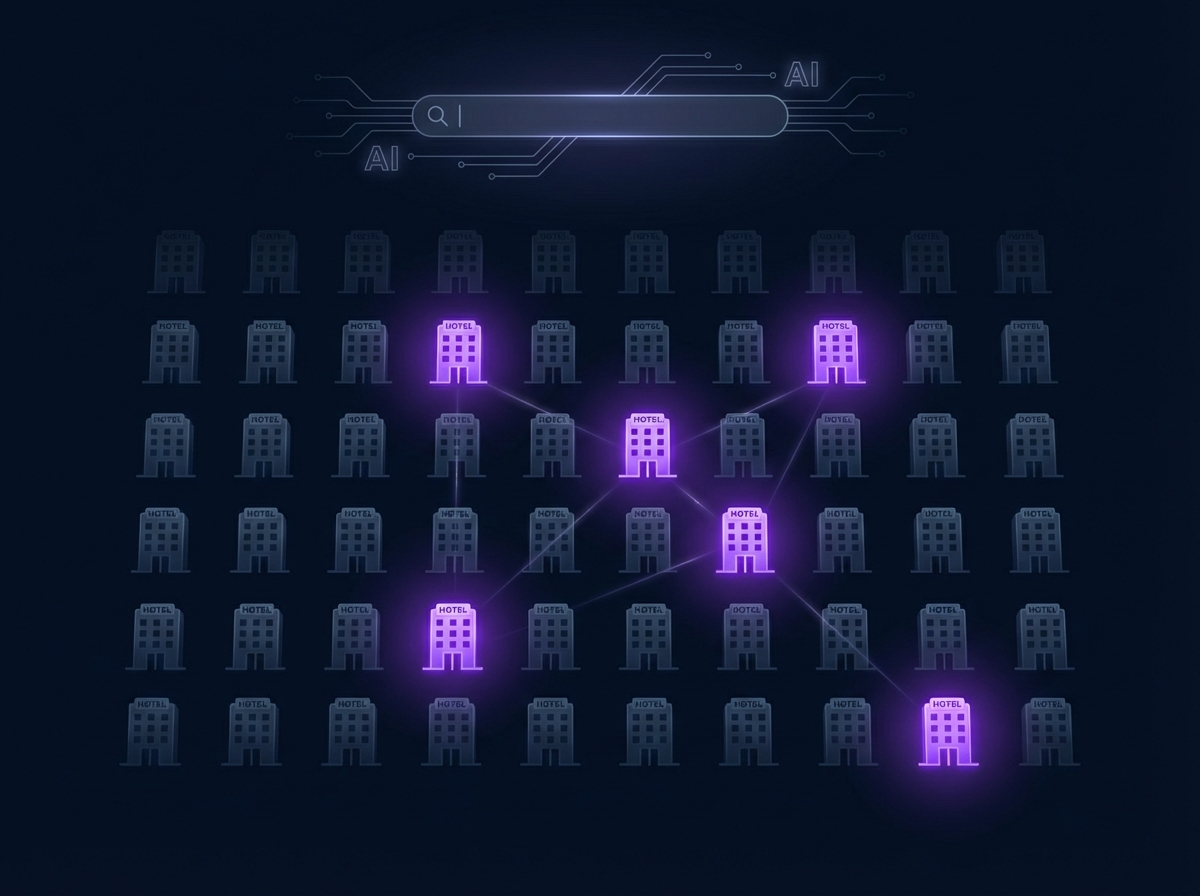
AI search is binary — not ranked. You are either in the 5.7% of hotels that appear in AI recommendations or you are in the 94.3% that do not exist to AI-assisted travellers. There is no middle ground, no page two, no "at least you showed up somewhere."
The Six Reasons Your Hotel Is Invisible
Research across thousands of hotel websites and AI recommendation analyses has identified six specific technical and content failures that make properties invisible to AI systems. Most hotels have at least three of them.
AI Crawlers Are Blocked
If your robots.txt file blocks GPTBot, ClaudeBot, PerplexityBot, or GoogleExtended, AI systems cannot read your website at all. Every other optimisation effort is irrelevant if the AI cannot access your content. This is the single most common and most easily fixed problem — yet the majority of hotel websites have never checked or updated their robots.txt to accommodate AI crawlers. To check: go to yourhosteldomain.com/robots.txt and look for any Disallow rules applied to these bot names.
No Bing Presence
ChatGPT uses Bing's index — not Google's — when searching for hotel recommendations. Research found that 87 percent of ChatGPT citations match Bing's top results. A hotel can rank number one on Google and be completely absent from ChatGPT recommendations if it has no Bing presence. The fix is straightforward: claim your free Bing Places for Business listing, verify it, and submit your sitemap to Bing Webmaster Tools. Most hotel owners have never done this because Bing seemed irrelevant in the Google era. It is not irrelevant anymore.
Missing Structured Data
Sites with schema markup showed a 30 percent improvement in accuracy and quality of ChatGPT data about them. Yet 77 percent of hotel websites lack adequate structured data. Schema markup is code in the background of your website that tells AI systems exactly what type of business you are, where you are located, what amenities you have, and what your reviews say. Without it, AI systems must guess — and they frequently guess wrong or skip your property in favour of one with clearer structured signals. Critical schema types for hotels: Hotel, FAQPage, Review, LocalBusiness, and Offer in JSON-LD format.
Brochure Content Not Answer Content
AI systems can only recommend what they can extract and cite. "A stunning boutique hotel in a prime location with world-class amenities" extracts as nothing. "28-room boutique hotel in Seminyak, 400 metres from the beach, with a 15-metre private pool, daily yoga classes at 7am, and a farm-to-table restaurant" extracts as five separate citable facts. Hotels whose websites consist primarily of marketing language — beautiful, evocative, but vague — give AI systems nothing to work with. The Princeton GEO study found that adding specific statistics to content improved AI visibility by up to 41 percent.
Thin Review Presence
TrustYou research found 71 percent of AI-generated hotel recommendations are driven by guest reviews. AI systems pull only 25 percent of answers from hotel website content — the rest comes from reviews, blogs, and publicly available third-party sources. A hotel with fewer than 50 recent reviews on Google and TripAdvisor gives AI systems insufficient signal to confidently recommend it. AI models also cross-check marketing claims against review sentiment — properties whose self-described features do not align with what guests actually report may be excluded entirely.
No Third-Party Editorial Mentions
Wikipedia accounts for 47.9 percent of ChatGPT's top cited sources for factual queries. TripAdvisor, Reddit, and credible travel publications are heavily referenced. AI systems cross-reference multiple independent sources before recommending a property — a hotel that exists only on its own website and OTA listings has far fewer citation signals than one mentioned in travel blogs, destination guides, and media features. A single feature in a respected travel publication creates more AI visibility signal than dozens of updates to your hotel website.
How to Check If Your Hotel Is Visible Right Now
You can run a basic AI visibility check yourself in ten minutes. Here is exactly how.
Test 1 — The ChatGPT Direct Query
Open ChatGPT (free version is sufficient). Type: "What are the best boutique hotels in [your city or suburb]?" Then try: "Recommend a hotel in [your city] for [your property's primary guest type — families, couples, business travellers]." Run five different variations of how a traveller might ask for a hotel like yours. Note whether your property name appears in any response. If it does not appear in any of five queries, you are in the 94.3 percent.
Test 2 — The Robots.txt Check
Go to your hotel website URL and add /robots.txt at the end. For example: yourhosteldomain.com/robots.txt. Read what you see. If you see "Disallow: /" next to GPTBot, ClaudeBot, or PerplexityBot — or if you see a blanket "Disallow: /" under "User-agent: *" — AI crawlers cannot access your site. This is blocking everything. Ask your developer to fix it immediately.
Test 3 — The Bing Check
Go to bing.com and search your hotel name. If your hotel's own website does not appear in the top three results — or if Bing shows incorrect information about your property — your Bing presence needs immediate attention. Go to bingplaces.com and claim your listing. It is free and takes 15 minutes.
Test 4 — The Review Audit
Count your current reviews on Google and on TripAdvisor. If you have fewer than 50 reviews on either platform, or if your most recent review is more than three months old, your review presence is too thin for AI systems to use as a reliable signal. Note also whether you are responding to reviews — AI systems interpret management responses as a trust signal indicating an actively managed property.
The First-Mover Window Is Real and Closing
The Princeton University GEO study found that lower-ranked websites benefit significantly more from AI search optimisation than already top-ranked sites. In practical terms: a 20-room boutique hotel with no existing AI search presence that implements GEO best practices now can outperform a major chain property in ChatGPT recommendations — if it acts before the chain does.
Major hotel chains are investing in AI — but their focus has been on operational AI (revenue management, guest messaging, back-office automation) rather than AI search visibility. Marriott, Hilton, IHG, Accor, and Hyatt all have AI strategies underway but remain largely focused on internal tools. According to Skift research, not a single hotel brand currently appears among the top 10 citations for travel planners in leading AI search results.
The competitive landscape for AI search visibility in APAC hospitality is still largely open territory. The properties that establish presence now — by fixing the six reasons listed above, building their review profiles, and pursuing editorial coverage — will hold compounding advantages as AI search adoption accelerates. The properties that wait will be building on someone else's head start.
With 94.3% of hotel websites currently invisible to AI, fixing even three of the six problems above puts your property in the top 10% of AI-visible hotels in your market. That is a competitive advantage that did not exist two years ago and will not be this accessible two years from now.
Find Out Exactly Where Your Hotel Stands
RevParGenius runs full AI visibility analyses for independent hotels in APAC — testing your property across multiple AI platforms, identifying each of the six visibility blockers, and providing a prioritised action plan specific to your market and property type. Request your analysis and get our Hotel AI Visibility Guide.
Live data. No guesswork. Just signal.
RevParGenius Market Intelligence · Hotel AI Search Visibility · April 2026