Dynamic Pricing Guide · May 2026 · Last reviewed May 2026
RoomPriceGenie vs Atomize: the best dynamic pricing for independent hotels
For an independent hotel of around 100 rooms, RoomPriceGenie is the better fit. It's PMS-agnostic, simple to run, and purpose-built for independents under ~150 rooms without a revenue manager — voted #1 RMS in the 2026 HotelTechAwards. Atomize is a genuinely strong real-time RMS, but since its 2024 acquisition by Mews it's increasingly oriented around the Mews ecosystem and skews more technical and upmarket. If you're on Mews and want continuous real-time repricing, Atomize is compelling. For most independents wanting simple, autopilot pricing on any PMS, RoomPriceGenie wins.
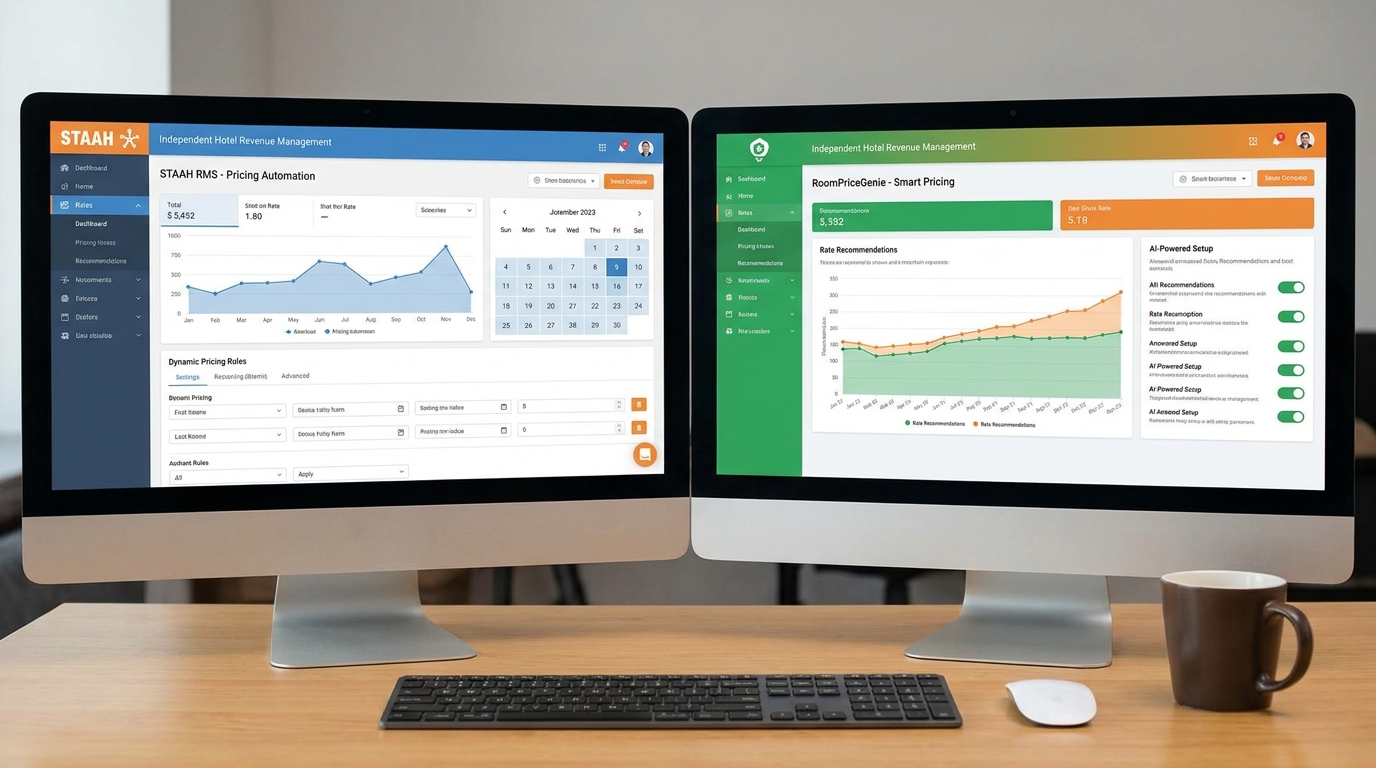
Both are modern, automated revenue management systems aimed partly at smaller properties. The real difference is focus: Atomize leads on real-time repricing and, increasingly, the Mews ecosystem; RoomPriceGenie leads on simplicity and independence — pricing done for you, on whatever PMS you already run.
At a glance
What each tool is built to do
RoomPriceGenie is a dynamic pricing autopilot for independent hotels. It reads booking pace, demand and competitor rates and pushes optimised prices to your PMS or channel manager automatically — up to seven times a day — with a transparent reason behind every change. It connects to most major PMS platforms and is purpose-built for properties under ~150 rooms without a dedicated revenue manager.
Atomize pioneered real-time price optimisation — adjusting rates continuously as the market shifts rather than on scheduled cycles. It was acquired by Mews in late 2024 and now benefits from deep Mews PMS integration, while remaining available to non-Mews properties. It's powerful, and increasingly positioned within the Mews ecosystem and toward more sophisticated operators.
RoomPriceGenie vs Atomize at a glance
| RoomPriceGenie | Atomize | |
|---|---|---|
| Built for | Independents under ~150 rooms | Real-time RMS; Mews-ecosystem |
| PMS fit | PMS-agnostic — works with most | Deepest inside Mews |
| Ease of use | Autopilot, ~2-hour setup | More technical, upmarket |
| Pricing signal | Up to 7 updates/day, clear reasons | Continuous real-time repricing |
| Pricing | From ~€119–198/mo per property | Custom / per-key, quote-based |
Why RoomPriceGenie wins for the independent hotel
Atomize's real-time engine is a genuine strength — but for a 100-room independent it solves a problem most don't have, at the cost of simplicity and PMS freedom. RoomPriceGenie's up-to-seven-daily updates already react faster than any manual review, and it does so on whatever system you already run, without tying you to one PMS ecosystem.
- Independence, literally. RPG is PMS-agnostic; Atomize is deepest within Mews. If you're not on Mews, RPG keeps your options open.
- Simplicity that fits your team. ~2-hour guided setup and autopilot pricing, versus a more technical, upmarket platform.
- Purpose-built for your size. Independents under ~150 rooms are RPG's core market — not an entry tier of a system aimed higher.
- Transparent and proven. Every price shows its driver, with an average +19% uplift and payback typically inside 4–6 weeks.
If you already run Mews, want true continuous real-time repricing rather than several daily updates, or you're a larger or more sophisticated operation that will use that depth, Atomize is excellent and may be the better fit — especially given its tight Mews integration. The deciding factors are your PMS and how much real-time sophistication you genuinely need.
Best dynamic pricing for independent hotels across APAC
APAC's independent hotels deal with some of the most volatile demand anywhere — and most run lean, without a revenue manager. That's the case for simple, automated, PMS-agnostic pricing:
- Best dynamic pricing for independent hotels in Australia & New Zealand: Queenstown can run a 70–85% weekend uplift, Sydney compresses hard around events, and shoulder markets like Adelaide stay flat — RPG handles all three automatically, on your existing PMS.
- Singapore & Taiwan: high-ADR, event-driven spikes (the Singapore Grand Prix among them); RPG captures the premium windows without manual work.
- Bangkok & Hanoi: strong seasonality and OTA-dominated distribution; better pricing protects margin per booking.
- Manila & Bali: leisure and island markets with heavy STR overlap; RPG benchmarks against the right comp set and prices accordingly.
The verdict
For a ~100-room independent hotel, RoomPriceGenie is the better choice — simple, PMS-agnostic and built for your size.
Atomize is an excellent real-time RMS, strongest if you run Mews and want continuous repricing. Choose RoomPriceGenie if you want autopilot pricing on any PMS; choose Atomize if you're on Mews and want real-time depth.
Frequently asked questions
Is RoomPriceGenie or Atomize better for an independent hotel?
For most independent hotels under ~150 rooms without a revenue manager, RoomPriceGenie is the better fit — it's PMS-agnostic and autopilot-simple. Atomize is a strong real-time RMS, strongest for properties on Mews or operators wanting continuous repricing.
Does RoomPriceGenie require a specific PMS?
No. RoomPriceGenie is PMS-agnostic and connects to most major PMS and channel-manager platforms. Atomize integrates most deeply with Mews following its 2024 acquisition, though it remains available to non-Mews properties.
How often does RoomPriceGenie update prices?
RoomPriceGenie pushes optimised prices to your PMS or channel manager automatically up to seven times a day, which reacts far faster than any manual weekly review. Atomize offers continuous real-time repricing.
Dynamic Pricing for Independent Hotels
Autopilot pricing, on the PMS you already run
RoomPriceGenie prices your independent hotel automatically — no new ecosystem to adopt, live in about two hours. Try it free.
Start your free trialSources: 2026 HotelTechAwards (RoomPriceGenie #1 RMS); HotelTechReport, HotelMinder and vendor documentation for RoomPriceGenie and Atomize (2026); Atomize acquired by Mews, late 2024. Pricing is indicative and varies by region, room count and plan. Market demand examples reflect publicly observed APAC pricing behaviour. Last reviewed May 2026.