Reviewed by Michael Andrews, Hotel Market Intelligence Researcher · June 6, 2026 · 9 min read
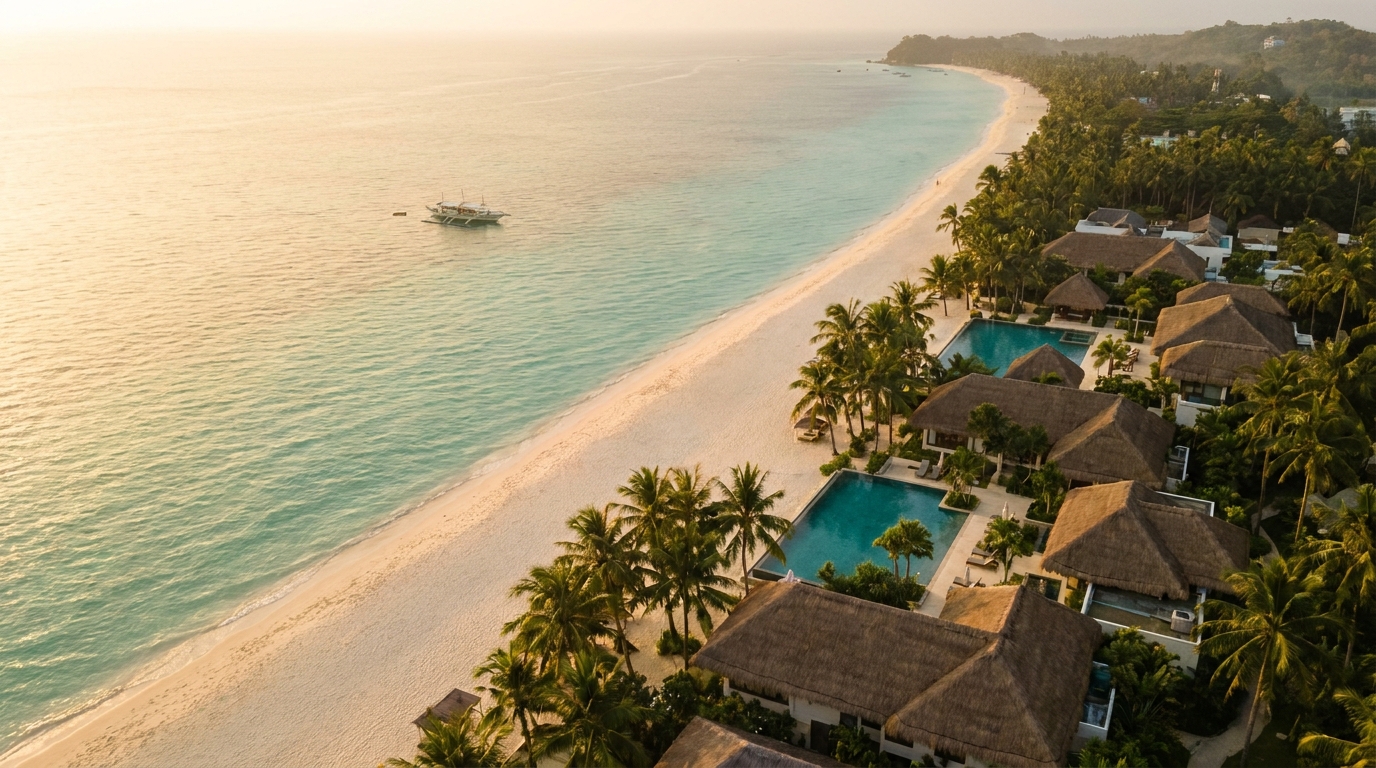
The GM of a beachfront hotel on Boracay's White Beach had a problem she could not see. Her property had 191 reviews averaging 4.6 stars. Her rates were competitive. Her OTA photos were professional. And yet when a couple in Manila opened ChatGPT and typed "best boutique hotels in Boracay for couples," her hotel did not appear. Not on position 5. Not on position 10. Not at all.
On June 6, 2026 we ran a RevPARGenius Hotel AI Visibility check across 28 engine queries on the Boracay comp set. The subject property — a real Station 2 beachfront hotel, anonymised at their request — scored a visibility score of 26/100 with an 11% mention rate across ChatGPT, Perplexity, Gemini and Grok. Shangri-La appeared in 64% of the same checks. The Lind appeared in 54%. The property had been entirely absent from six of seven tracked prompts on ChatGPT and Perplexity. Here is the scan, what the data showed, and what to do about it.
Hotel AI visibility in Boracay is dominated by Shangri-La at 64% and The Lind at 54% — while the average independent beachfront property scores below 15%. A RevPARGenius scan of a real Station 2 property found a 26/100 visibility score and 11% mention rate, with the hotel absent from ChatGPT and Perplexity entirely on six of seven tracked prompts. The fix is not advertising. It is structured OTA profiles, review volume, and earned editorial coverage on the sources AI engines already trust.
The Boracay AI Visibility Scan — 6 June 2026
Station 2 Beachfront Hotel
Boracay Island, Malay, Aklan
Competitor Visibility
28 engine checks · latest run
Frequently mentioned — not yet tracked
Tracked competitor set
RevPARGenius Hotel AI Visibility Dashboard · Run: 6 Jun 2026, 11:03 UTC · ChatGPT · Perplexity · Gemini · Grok · ★ = subject property (anonymised)
Is an 11% mention rate in Boracay actually a problem?
The honest answer is yes — with context. The Station 2 Beachfront Hotel is not a weak property. It has 4.6 stars, 191 reviews, a genuine beachfront position, and competitive rates. But hotel AI visibility in 2026 is not a product quality competition. It is an information footprint competition. A 2024 Skift Research survey found that 56% of U.S. travellers already use AI tools to plan trips — and that share is growing faster in Southeast Asian markets where mobile-first ChatGPT adoption is accelerating. When a couple in Manila asks Perplexity "where should we stay in Boracay for our anniversary," the hotels Perplexity recommends capture the booking intent at its highest point. Hotels invisible at that moment are invisible to the guest entirely.
The 11% mention rate is a problem because of who is above it. Shangri-La at 64%, The Lind at 54%, Crimson at 50% — these are not just hotels with bigger marketing budgets. They are hotels with deeper, wider, more structured information footprints across the sources that AI engines cite. The Station 2 hotel's product is competitive. Its AI presence is not.
The scan ran 7 tracked prompts across 4 engines — 28 valid checks. The hotel appeared in 3: position 8 on Gemini for "hotels near landmarks" (the bullseye query), a neutral mention on Grok for the same prompt, and position 5 positive on Grok for "top rated hotels in Boracay." On all other prompts — "best boutique hotels," "where to stay for couples," "luxury hotels," "best hotel for families," "best hotel in Boracay" — it was absent on all four engines.
What does the citation source breakdown reveal?
The scan analysed 210 citations across all engine checks. Of those: 52.4% came from "other" sources — editorial content, travel blogs, and destination guides. Review platforms accounted for 19%. OTAs for 15.7%. The hotel's own website: just 6.7%. Reddit and community sources: 3.8%. Trade press: 2.4%.
The 52.4% "other" category is where the gap lives. Shangri-La appears in hundreds of editorial sources — Condé Nast Traveler features, Tatler Asia reviews, CNN Travel destination pieces, travel blogs across multiple languages. These are exactly the sources AI engines weight most heavily when selecting which hotels to cite. The Station 2 hotel has almost no presence in any of them.
The OTA citation share of 15.7% is worth noting in a different direction. It sits well below the Cloudbeds 2025 industry baseline of 55.3% — meaning the hotel is less OTA-dependent than typical, which is commercially healthy. But it also means AI engines are not finding it through the channels they most commonly cite. The own-site figure of 6.7% confirms the website is present but not authoritative enough to be the primary source AI engines draw from for this property.
Why does Shangri-La appear in 64% of checks when this hotel appears in 11%?
Shangri-La's dominance is structural, not arbitrary. The Princeton/IIT Delhi GEO study (Aggarwal et al., KDD 2024) found that content with named, dated statistics generates 31% higher AI citation rates, and named expert quotes generate 41% higher rates. Those lifts compound across every source that covers a property. Shangri-La Boracay is referenced in thousands of pages across Condé Nast, CNN Travel, Tatler, TripAdvisor with 3,000+ reviews, a detailed Wikipedia page, and Booking.com and Expedia profiles with hundreds of structured data points. That depth of structured, corroborated, editorially validated information is what AI engines are trained to cite.
For the Station 2 Beachfront Hotel, the information landscape is thinner on every dimension. 191 reviews is a solid base — but the volume gap matters. Fewer reviews means a weaker social proof signal. Limited editorial coverage means AI engines have little authoritative third-party content to cite. And a website that accounts for just 6.7% of citations is present but not functioning as a primary authority source.
The gap is not product quality. The hotel has a 4.6-star average — higher than some competitors with significantly higher AI mention rates. The gap is information quality, and information quality is fixable.
Review volume and recency. AI engines treat review count as a social proof proxy. Shangri-La has 3,000+ TripAdvisor reviews. The Station 2 hotel has 191. Volume drives citation frequency, not just rating average. Structured editorial presence. The 52.4% "other" citation category is dominated by travel editorial. Shangri-La appears in hundreds of these. The independent hotel appears in almost none. Structured data on the hotel website. AI engines crawl hotel websites looking for property description, amenities, location schema, and review schema. A website with rich structured data is cited more reliably — even when review scores are comparable.
What should a Boracay independent hotel actually do about this?
The same scan that showed the gaps showed which two prompts the hotel already appeared on — "Boracay hotels near landmarks" (position 8 on Gemini) and "top rated hotels in Boracay" (position 5 positive on Grok). Those two appearances are the blueprint: they are the prompts most responsive to OTA ranking signals and review volume, not editorial coverage. That is the right starting order for the fix.
1. Structured OTA profile optimisation. OTAs account for 15.7% of citations in the Boracay scan — below the 55.3% industry baseline. Complete the Booking.com and Expedia profiles with specific amenity tags, room type descriptions using the property's actual distinguishing features, and a fully structured property description. This is the fastest citation signal to improve and directly lifts performance on the two prompts where the hotel already appears.
2. Review velocity campaign. At 191 reviews, the hotel has solid social proof but insufficient volume to compete with The Lind (1,200+ reviews) and Crimson (2,000+ reviews) in AI citation frequency. A post-stay WhatsApp message sent 24 hours after checkout with a direct TripAdvisor and Google link consistently generates 15–25% review conversion from guests who rated their stay 8 or above on in-stay NPS. The target is 500 reviews within 12 months — the threshold at which AI citation frequency moves into a materially different tier.
3. Editorial presence on sources AI trusts. The 52.4% "other" citation category is where the hotel has almost no presence. Philippines-specific travel media — When in Manila, Tatler Philippines Travel section, Spot.ph — are regularly cited in Perplexity and Gemini answers for Philippine travel queries. A single feature on any of these produces a citation source that AI engines draw from repeatedly, not just once. This is the slowest of the three actions but the one with the longest compounding return.
The clearest thing this scan teaches is that hotel AI visibility is not a mystery. It is the visible output of a small number of measurable inputs — review volume, OTA profile completeness, editorial coverage on sources AI trusts. Apply them in order and the score moves. The hotel that starts this quarter compounds for the next 18 months while competitors are still figuring out what AEO stands for.
What does this case study reveal about the Boracay AI visibility gap overall?
The Boracay scan revealed a market where chain-affiliated and internationally profiled hotels capture the vast majority of AI citations, while independent beachfront properties with genuinely competitive product are structurally underrepresented. Two of the eight tracked competitors — Hue Hotels (4%) and The Tides Hotel Boracay (0%) — face an even starker gap. The Tides Hotel, a property with a real Station 2 beachfront presence, did not appear in a single one of 28 AI engine checks. In 2026, a 0% mention rate is not just a visibility problem. It is a booking problem.
The AI visibility category in Boracay is roughly 12–18 months old as a structured discipline. Most independent properties have not started. The chains — Shangri-La, The Lind, Crimson — are not actively managing AI visibility either. Their dominance is a legacy of their information footprint depth, not the result of a deliberate AEO strategy. That means the window for independent hotels to close the gap, before AI visibility becomes a formally managed and funded category for large hospitality brands, is still open.
The Bottom Line
The Station 2 Beachfront Hotel's 11% AI mention rate is not a reflection of its product. It is a reflection of its information footprint — and information footprints are fixable. The three hotels in the Boracay scan with 0–4% AI visibility are not worse properties than The Lind or Crimson. They are less visible properties, and in 2026 that distinction determines who gets considered before an OTA search begins.
The Boracay AI citation gap will widen over the next 12–18 months as AI search adoption accelerates across Southeast Asia. Hotels that begin building their information footprint now — structured OTA profiles, review volume, editorial coverage on Philippines travel media — compound that advantage over time. Hotels that wait are waiting for something that will not close on its own.
Frequently Asked Questions
What is a good hotel AI visibility score for a Boracay property?
Based on RevPARGenius scan data from June 2026, the Boracay market stratifies into three tiers: chain-affiliated luxury at 50–64% (Shangri-La, The Lind, Crimson), mid-tier independents at 18% (Aqua Boracay, Henann Garden, Fairways & Bluewater), and the majority of independents at 4–11%. A realistic 90-day target for a property currently at 11% is 25–32%, achievable through structured OTA profiles, review velocity, and one or two editorial placements in Philippines travel media.
Which AI engines are most important for Philippines hotel visibility?
ChatGPT and Perplexity have the broadest traveller adoption for trip planning queries in Southeast Asia. Gemini is growing rapidly on Android, the dominant mobile platform in the Philippines. Grok has a smaller but technically engaged audience. The RevPARGenius scan covers all four simultaneously. A hotel appearing on Gemini but absent from ChatGPT and Perplexity is capturing a fraction of the available AI-referred booking intent — which is precisely the pattern this Station 2 hotel showed.
Why does Shangri-La dominate AI search in Boracay?
Shangri-La's 64% mention rate is a function of information footprint depth — thousands of references across Condé Nast, CNN Travel, Tatler, TripAdvisor, Booking.com, and Wikipedia, all sources AI engines weight heavily. Independent hotels can close this gap through review volume, earned editorial coverage in Philippines travel media, and structured OTA profiles. The gap is not product quality — the Station 2 hotel has a higher review score than some properties outperforming it in AI citation rate. It is information quality.
How is the RevPARGenius Hotel AI Visibility score calculated?
The score runs tracked prompts across ChatGPT, Perplexity, Gemini and Grok and counts how many responses mention the hotel by name. The mention rate is appearances divided by total valid checks (28 in the Boracay scan). The visibility score combines raw mention rate with a sentiment weighting — positive mentions score higher than neutral, neutral score higher than negative. The score is designed to be trended across multiple runs rather than interpreted as a single absolute figure.
Can a small Boracay hotel compete with Shangri-La on AI visibility?
Not on overall mention rate — Shangri-La's footprint is built over decades. But competing on specific prompts is realistic and achievable. "Boutique hotels in Boracay," "best Boracay hotel for couples," and "beachfront hotels Boracay Station 2" are all prompts where an independent property with strong reviews, structured OTA profiles, and targeted editorial coverage can appear consistently. AI engines do not only cite the biggest hotels — they cite the most well-documented properties for each specific query.
The first step in fixing a hotel's AI visibility is knowing exactly where it stands — which prompts it appears in, which engines are citing it, and what its competitors are capturing that it is not. The Hotel AI Visibility Checker runs that scan automatically, tracks it over time, and shows the specific gaps that matter most.
Run the Same Scan on Your Hotel
See What AI Says About Your Property
The Hotel AI Visibility Checker queries ChatGPT, Perplexity, Gemini and Grok on your tracked prompts — showing your visibility score, competitor leaderboard, and recommended actions. The same dashboard we used on this Boracay scan.
Run Your Free Hotel AI Visibility ScanSee Plans From $79/Month
Live data at app.revpargenius.com/hotel-ai-visibility
Related Reading
Sources: RevPARGenius Hotel AI Visibility Checker scan, 6 June 2026 (28 valid checks across ChatGPT, Perplexity, Gemini and Grok; 210 citations analysed); Cloudbeds 2025 "The Signals Behind Hotel AI Recommendations" (OTA citation baseline 55.3%); Princeton/IIT Delhi GEO Study (Aggarwal et al., KDD 2024) on +31% citation lift from dated statistics and +41% from named expert quotes; Skift Research 2024 AI Travel Planning Adoption Survey (56% of U.S. travellers use AI for trip planning). Subject property anonymised at owner's request. Competitor names and mention rates are observational data from AI engine responses. Last reviewed June 2026.